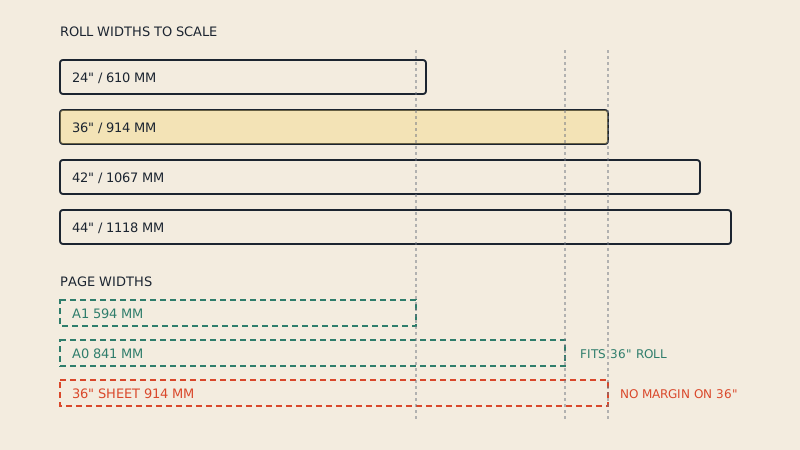
An A0 sewing pattern prints fine on a 36-inch roll. A0 is 841 mm (33.1") wide and a 36" roll is 914 mm, so the sheet fits across the roll with about 73 mm (2.9") to spare, and the 1189 mm (46.8") length simply runs along the roll. Ask the shop to print at 100 % with no fit to page, because the most common error is a plotter scaling A0 up to fill the full 36" width.
In the US and Canada, plan printers and copy shops load rolls in inch widths rather than A-sizes. That raises a few practical questions about orientation, margins and very long files, answered below.
Roll widths and what fits on them
| Roll width | In mm | Fits across the roll | Notes |
|---|---|---|---|
| 24" | 610 mm | A1 (594 × 841 mm), Tabloid sheets | Too narrow for A0 in either direction |
| 36" | 914 mm | A0 (841 × 1189 mm) in portrait | The most common wide roll in North America |
| 42" | 1067 mm | A0, with more margin | Not every shop has one |
| 44" | 1118 mm | A0 | Often a photo or poster printer |
A0 does not fit a 24" roll; an A0 pattern sent to a shop with only 24" rolls will be either scaled down or tiled onto two strips. If that is all the shop has, ask for the file split into A1 sheets instead. Roll widths, plotters and paper weights are covered more generally in large-format pattern printing.
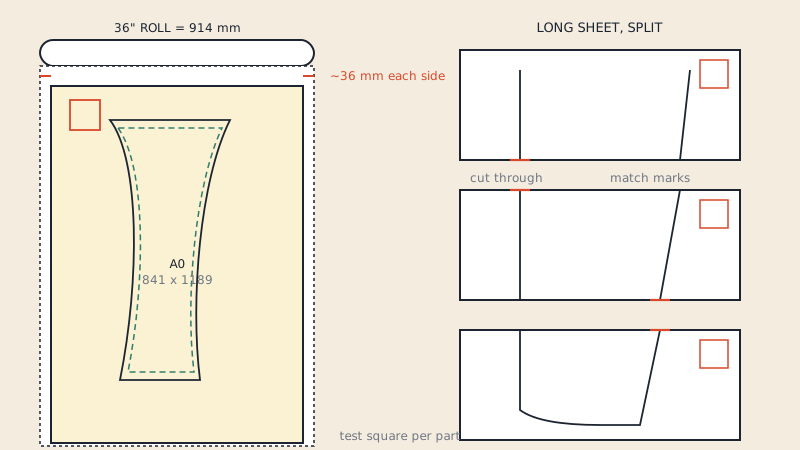
Orientation: portrait along the roll
The short side of A0 (841 mm) goes across the roll and the long side (1189 mm) runs along it. Most plotter drivers rotate the page automatically if it fits better one way. If the shop's software asks, choose the orientation that puts the 841 mm side across.
Landscape A0 (1189 mm across) would need a roll wider than 47". That is rare in copy shops, so if your file is laid out as landscape, the plotter will rotate it. That is fine: rotation does not change scale.
The scaling trap on a 36" roll
On a 36" roll, there is 73 mm of extra width. Some plotter drivers and print kiosks have a setting such as "fit to roll width" or "scale to media" that enlarges the page to use it. That makes the pattern about 8.7 % too large (914 / 841). On a 100 cm hip, that is almost 9 cm.
Avoid it by:
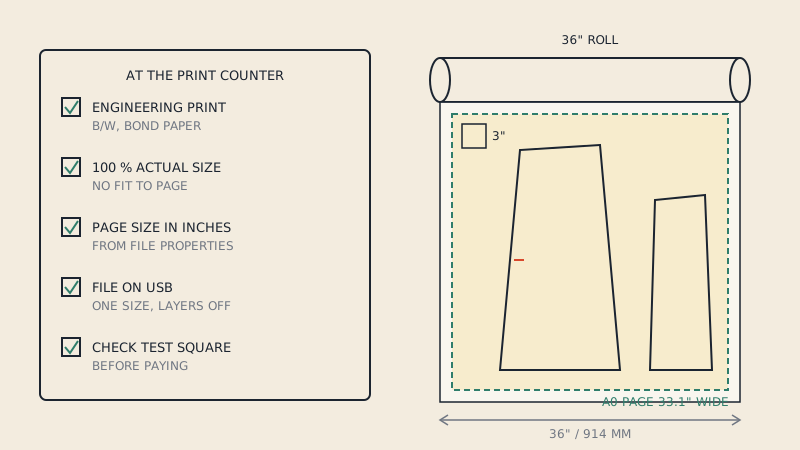
- Asking for 100 %, actual size, no scaling, in writing on the order
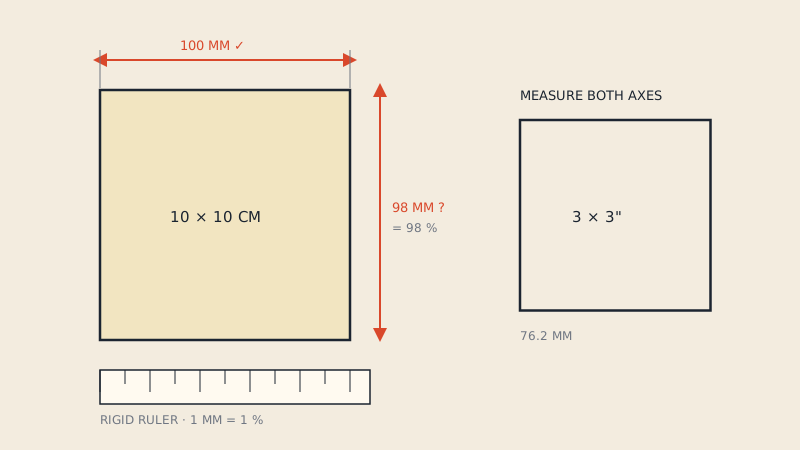
- Checking the test square before leaving the shop: 10 cm should measure 10 cm, 3" should measure 3"
- Bringing a file that already says its size, for example "A0 841 × 1189 mm" in the file name
A shop that prints engineering drawings every day knows the difference between "print at scale" and "fit to roll", but a busy counter may default to fit. A short note on the order prevents it.
Margins: why 73 mm is enough
Plotters cannot print right to the edge of the roll. Unprintable margins of a few millimetres per side are typical, though the exact value depends on the machine. On a 36" roll with an A0 sheet, the 73 mm of spare width covers that easily.
At the leading and trailing edge of the sheet, the plotter adds its own margin and a cut. Your pattern drawing should not reach the very edge of the A0 page; well-made copy-shop files leave a border.
US sizes vs A0: what if the file is 36" wide?
Some patterns sold in North America come with a copy-shop file drawn at 36" width instead of A0. That needs a little caution:
- A file exactly 36" wide leaves no room for the plotter's margin on a 36" roll. Some plotters will shrink it slightly to fit, others will clip the edges.
- Many designers draw such files a bit narrower than the roll, or leave a white border inside the page, to allow for this. Check the page size in the PDF's document properties.
- If the file is exactly 914 mm wide and the drawing reaches the edges, a 42" roll is safer.
In Europe the same issue appears with files exactly 914 mm wide printed on a 914 mm roll. A0 width avoids it.
Long sheets: splitting and joining
A copy-shop file can be longer than one A0: a long coat, wide-leg trousers or a full skirt may be laid out on a sheet several metres long. That brings two separate limits.
Plotter and shop limits
Many plotters can print long lengths in one go, but shops often prefer, or price by, standard lengths. Some online services have a maximum length per sheet. Ask before sending a 4-metre file.
PDF page size limit
Adobe Acrobat and Reader cannot handle pages larger than 200 × 200 inches (5080 mm). A single page longer than that may not open correctly or may be rejected by the shop's software, so very long layouts are better split into several pages.
How to split well
If you need to split a long sheet, make the cut through empty space or along a straight line, and add match marks on both sides. Each part should carry a test square or a known dimension so you can confirm both were printed at the same scale. When pieces cross the cut, tape them on the table with the match marks aligned, the same way you join large tiles.
Our service builds the One Page copy-shop sheet and also splits the pattern into A0 and smaller sheets, each starting with 10 cm and 3" test squares and an assembly map, so you can pick the version that suits the shop's roll.
What to tell a North American copy shop
Plan and engineering printing is common at reprographics shops and at some office-supply print centres; chains differ by branch, as described in printing at Staples, FedEx Office or Office Depot. A clear request:
Please print this PDF on a 36" roll, black-and-white line drawing on bond paper, at 100 % scale, actual size, no fit to roll width. The page is A0, 841 × 1189 mm (33.1 × 46.8"). There are 3 pages.
After printing, measure the test square on each sheet before you pay.
A0 or tiles: which to choose in North America
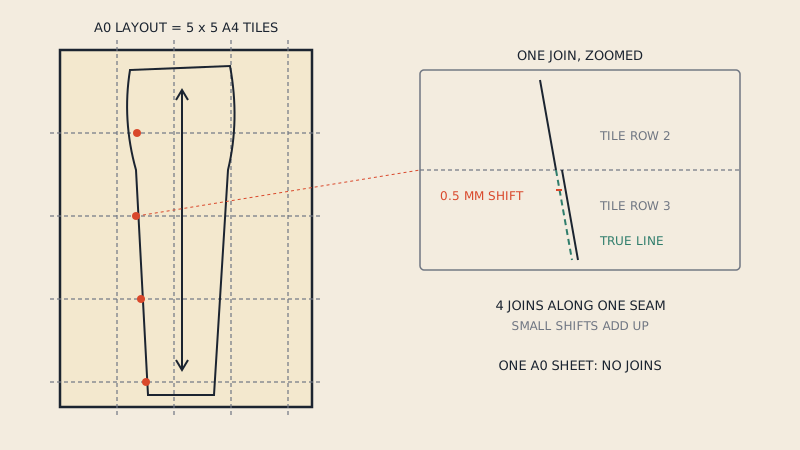
A0 files are increasingly common in patterns from North American designers too, because 36" rolls are widespread. If a pattern comes with both an A0 file and a Letter tile file, the A0 file saves taping time, and for long pieces it removes the risk of small errors at every tile join. The general comparison is in A0 vs A4 PDF patterns.
FAQ
Can I print an A0 pattern on a 36-inch roll?
Yes. A0 is 841 mm (33.1") wide, and a 36" roll is 914 mm, so the sheet fits with about 73 mm to spare. Ask for 100 % scale so the plotter does not enlarge it to the roll width.
What happens if the shop scales A0 to fit a 36-inch roll?
The pattern prints about 8.7 % too large. Check the test square before leaving the shop and ask for a reprint at actual size if it is off.
Will an A0 pattern fit on a 24-inch roll?
No. A0 is 841 mm wide in its shortest direction and a 24" roll is 610 mm. Ask for the pattern split into A1 sheets (594 × 841 mm), which do fit.
Is there a maximum length for a copy-shop pattern sheet?
It depends on the plotter and the shop, so ask first. Adobe Acrobat and Reader limit a PDF page to 200 inches (5080 mm), so very long layouts are better split into several pages with match marks.