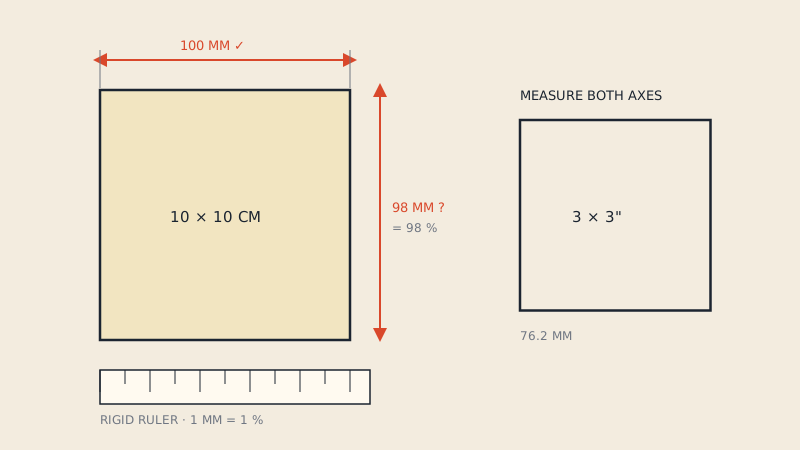
The test square is a box of known size - usually 10 cm, 1" or 3" - printed on the first page of a PDF pattern so you can check that the printer reproduced the file at exactly 100 %. Print that page alone, measure the square in both directions with a rigid ruler, and only print the rest if it is within about 1 mm on a 10 cm square. A square that is 2 % off looks harmless on paper but becomes several centimetres around a hip or chest.
Why the test square exists
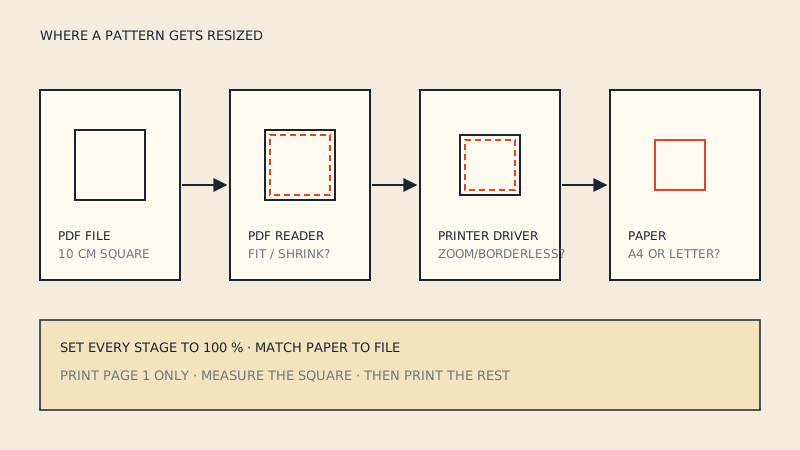
A PDF knows its own size precisely. The trouble is everything between the file and the paper: the reader, the printer driver, the paper size and the printer's mechanics. Any of them can change the scale without warning, and a scaled pattern looks perfectly normal - the lines are crisp, the pages tile, nothing tells you it is 97 %.
The test square is the only part of the pattern with a size you can check without knowing the design. It turns "I hope it printed right" into a measurement.
It also checks something people forget: whether scale is the same horizontally and vertically. A printer that feeds paper slightly fast or slow can print correct width and wrong height. That is why you measure both sides.
Common square sizes
| Square | Metric | Imperial | Notes |
|---|---|---|---|
| 1" | 25.4 mm | 1" | Too small to show errors under about 2 % with a normal ruler |
| 2" | 50.8 mm | 2" | Common on older patterns |
| 3" | 76.2 mm | 3" | Easier to measure in inches; a good compromise |
| 5 cm | 50 mm | about 2" | Common on European patterns |
| 10 cm | 100 mm | about 3 15/16" | Easiest to read: 1 mm = 1 % |
Bigger is better. On a 10 cm square, every millimetre of error is 1 % of scale, which makes the arithmetic trivial. A 1" square that is 1 % small is only 0.25 mm short - narrower than a pencil line.
Many patterns carry a metric and an imperial square side by side, sometimes nested. Measure the one that matches your ruler; you do not need both. Our print files start with a 10 cm and a 3" square on every format for this reason.
How to measure it properly
- Print the test page alone, at 100 % or Actual size, on the paper you will use for the whole pattern.
- Let the ink dry and lay the page flat on a hard surface. Do not measure against your leg or a sofa arm.
- Use a rigid ruler or a quilting ruler, not a tape measure. Tape measures stretch and their first centimetre is often a metal hook with play.
- Measure from the outside edge of one line to the outside edge of the opposite line (or inside to inside - just be consistent). On a thick line, outside-to-outside and inside-to-inside can differ by a millimetre.
- Measure both directions: across the width and down the height.
- Look straight down at the ruler marks, not at an angle; parallax easily adds half a millimetre.
- Write the result on the page. If you later find pages that do not match, you will know whether it was the print.
If the square has a scale bar or numbered ruler inside, that is a convenience; the outer box is still the reference.
What counts as "close enough"
There is no single industry tolerance for home printing, but a working rule from our studio:
| Error on a 10 cm square | Scale | Verdict |
|---|---|---|
| 0-0.5 mm | 99.5-100.5 % | Fine for anything |
| 0.5-1 mm | 99-101 % | Fine for most garments; check fitted styles |
| 1-2 mm | 98-99 % | Find the cause before printing everything |
| over 2 mm | below 98 % | Something is resizing the page; do not use |
Half a millimetre is roughly the width of a printed line, so it is the practical limit of what you can measure at home. Anything bigger than a millimetre is worth chasing.
What a 2 % error does to fit
Scale errors are proportional: the bigger the measurement, the bigger the error. A 2 % shrink on a pattern is:
| Measurement | Intended | At 98 % | Lost |
|---|---|---|---|
| Hip circumference | 100 cm (39 3/8") | 98 cm | 2 cm (3/4") |
| Bust circumference | 92 cm (36 1/4") | 90.2 cm | 1.8 cm |
| Back length | 42 cm | 41.2 cm | 0.8 cm |
| Trouser outseam | 105 cm | 102.9 cm | 2.1 cm |
| Cuff width | 24 cm | 23.5 cm | 0.5 cm |
Two centimetres around the hip is about the difference between adjacent sizes in many size charts, which commonly step by 4-5 cm - so you are roughly half a size off. On a fitted dress with little ease, that is the gap between comfortable and tight. On a loose shirt it may not matter. Our article on ease in pattern making explains why close-fitting styles are the most sensitive.
Note that the error is not only in circumference. Lengths shrink too, and pieces that should match can end up mismatched if they were printed at different scales - for example, a bodice printed at 100 % and a sleeve printed the next day at 98 %.
The square is right, but pages still don't meet
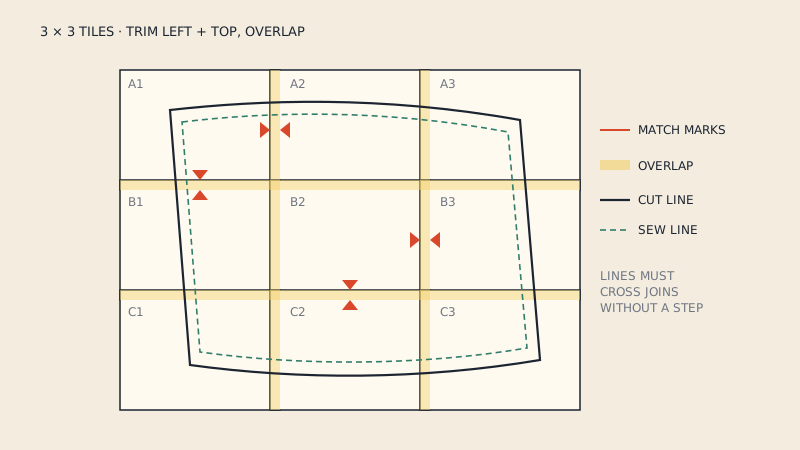
A correct test square proves the scale of that page. If tiles still refuse to line up, the cause is usually assembly - trimming on the wrong side of the frame, or tape order - rather than scale. See assembling a PDF pattern for a method that keeps errors from adding up.
Two exceptions are worth checking:
- Mixed print runs. If you reprinted some pages later, measure a square or a known dimension on those too.
- Mixed paper. Heavier or lighter paper can feed differently in the same printer.
The square is wrong
Do not compensate by guessing a custom percentage. Find the setting that resized the page - the reader, the driver or a paper-size mismatch - and turn it off. The step-by-step fixes are in PDF pattern not printing to scale.
Test squares on large sheets and projectors
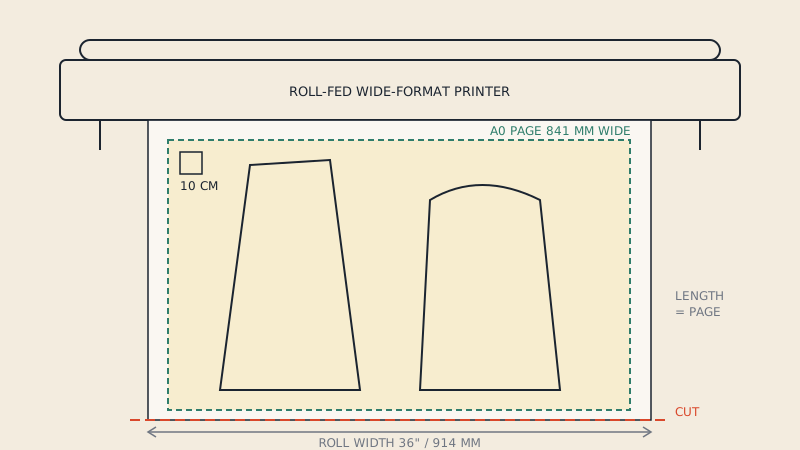
Large-format prints have the same problem in a different form: a copy shop's plotter set to fit the roll width will shrink an A0 sheet. Measure the square before you leave the shop - it takes seconds, and a reprint is easier to ask for on the spot. The copy shop guide covers what to ask for.
Projectors are calibrated rather than printed, but the principle is the same: you project a known square or grid and measure it on the cutting mat. That is a separate procedure, described in calibrating a projector for sewing.
FAQ
What size is the test square on a PDF sewing pattern?
Usually 10 cm, 5 cm, 1", 2" or 3", and the size is printed inside or next to the square. A 10 cm square is the easiest to check because each millimetre of error equals 1 % of scale.
How accurate does the test square need to be?
Within about 0.5-1 mm on a 10 cm square is fine for most garments. An error over 1 mm means something is resizing the page and is worth fixing before you print the whole pattern.
Should I measure the test square in both directions?
Yes. Printers can scale width and height differently because of how the paper feeds, so a square can be correct across and short down. Measure both sides.
Does a 1 % error in the test square matter?
On a 100 cm hip, 1 % is 1 cm, which is usually acceptable on relaxed garments but noticeable on close-fitting ones. Errors of 2 % or more shift the fit by roughly half a size.
My pattern has no test square. How can I check the scale?
Measure a printed dimension you know, such as a labelled ruler or a piece measurement given in the instructions. If nothing is labelled, a metric or imperial grid line spacing on the page can work as a reference.