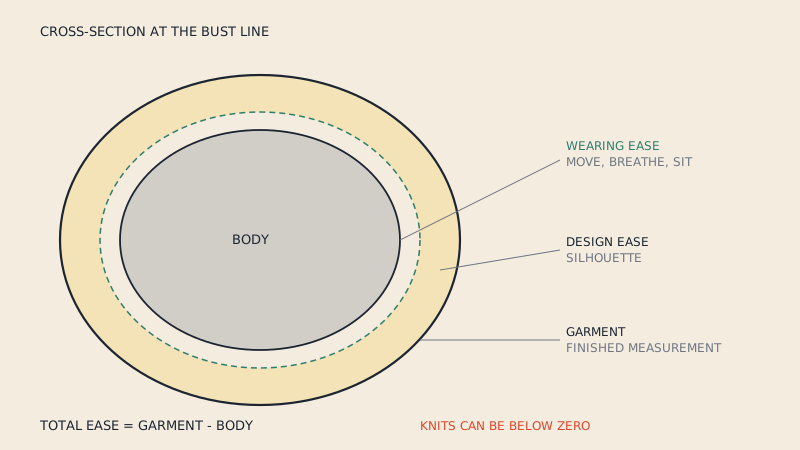
Ease is the difference between a body measurement and the garment measurement at the same place. In pattern making it is split into two parts: wearing ease, the minimum extra needed to breathe, sit and move, and design ease, the extra the designer adds to create the silhouette. A fitted bodice has mostly wearing ease; an oversized coat has a lot of design ease on top. Knits can have negative ease, where the garment is smaller than the body and the fabric stretches to fit.
Knowing how much ease a pattern has is the most reliable way to predict how it will fit, and it is the first thing to check when a converted pattern or a 3D sample looks too tight or too loose.
The two kinds of ease
Wearing ease
Wearing ease (also called fitting ease or functional ease) is the minimum a woven garment needs beyond the body measurement to be wearable. Without it, a dress cut exactly to your bust measurement would be tight when standing still and impossible to sit or reach in.
Wearing ease depends on the body area:
- Bust and chest: room for breathing and arm movement.
- Waist: room for sitting and eating; less than at the bust.
- Hip: room for sitting, when the hip spreads.
- Upper arm and armhole: room to lift the arm.
- Crotch depth on trousers: room to sit and bend.
It also depends on the fabric. A firm woven needs more wearing ease than a soft, slightly elastic one; a stretch woven with elastane may need less.
Design ease
Design ease is everything added on top of wearing ease to create a style: the volume of a smock dress, the drop of an oversized shoulder, the straight boxy line of a jacket. It is a design decision, not a fit requirement, and it varies from almost zero in a close-fitting sheath to tens of centimetres in a cocoon coat.
The pattern does not label the two parts separately. What you can measure is total ease:
Total ease = finished garment measurement − body measurement.
Typical ease ranges
The figures below are commonly used starting points for woven garments in women's wear, given here as illustrative examples. Pattern companies, drafting systems and individual designers use their own values, so treat them as orientation, not a standard.
| Fit | Total ease at bust | At waist | At hip |
|---|---|---|---|
| Close-fitting (bodice, sheath) | about 5–8 cm (2"–3") | about 2–3 cm (3/4"–1 1/4") | about 4–6 cm (1 1/2"–2 1/4") |
| Fitted / semi-fitted (blouse, shirt dress) | about 8–12 cm (3"–4 3/4") | depends on style | about 6–10 cm (2 1/4"–4") |
| Loose-fitting (relaxed shirt, shift) | about 12–20 cm (4 3/4"–8") | often undefined | about 10–15 cm (4"–6") |
| Oversized (boxy tops, coats) | 20 cm (8") and more | often undefined | varies widely |
| Outerwear over other garments | add room for the layers underneath |
Two notes on reading the table:
- These are full circumferences. On a half pattern, half of the ease is in the front and back pieces of one side.
- Close-fitting garments in woven fabric rarely go below the lowest values; going below them is where the garment becomes uncomfortable or restricts movement.
Negative ease in knits
Knit fabrics stretch, so a knit garment can be smaller than the body and still be comfortable. That is negative ease.
- Close-fitting tops, bodysuits, leggings: commonly designed with negative ease at bust, waist and hip, in proportion to the fabric's stretch.
- Swimwear and activewear: often more negative ease, because the garment must hold its shape when wet or moving.
- T-shirts and sweatshirts: zero to positive ease, depending on the fit.
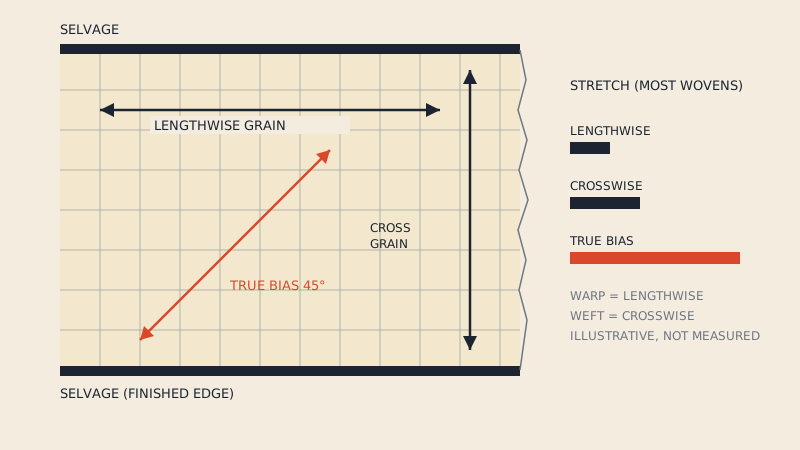
That is why knit patterns state a required stretch, for example "fabric must stretch 50 % across the width". A fabric with less stretch than specified will feel tight, because the pattern's negative ease assumes the stretch is there. The direction of greatest stretch and how to find it are described in grainline vs selvage vs bias.
The other meaning: easing one edge into another
Pattern makers also use "ease" for a related but different idea: a seam where one edge is deliberately longer than the edge it joins, and the extra is worked in without visible gathers.
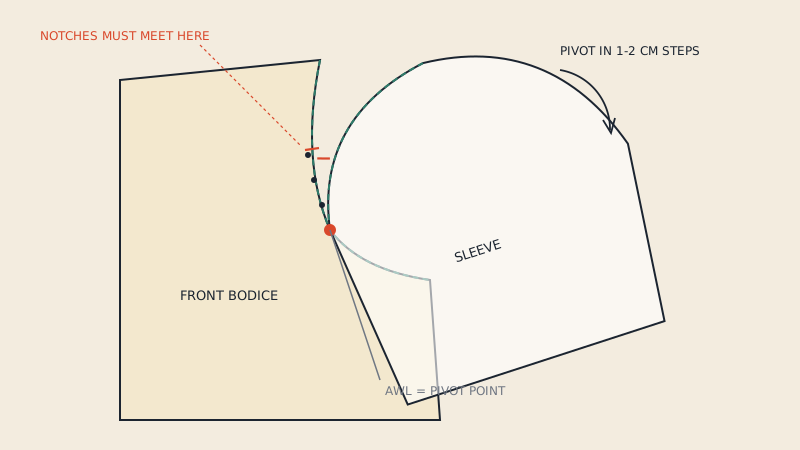
- Sleeve cap ease: the sleeve cap is longer than the armhole. The extra length gives the sleeve room over the top of the arm. It can be close to zero on shirts with dropped shoulders and a few centimetres on tailored jackets, depending on fabric and style.
- Back shoulder ease: the back shoulder seam is often slightly longer than the front, to give room over the shoulder blade.
- Elbow ease: on fitted two-piece sleeves, the back sleeve seam is eased at the elbow.
Notches mark where this ease is distributed. When you check a pattern, the difference in seam length should match the intended ease, no more; a 4 cm difference on a shirt sleeve is probably an error, not ease. How to measure it is in how to walk the seams of a pattern.
How to measure ease on a pattern
You do not need the instruction sheet to know a pattern's ease. Measure it.
- Find the reference line. Bust, waist and hip lines are often marked. If not, measure down from the shoulder or waist to your own bust and hip depth.
- Measure along the sewing line, not the cutting line. Exclude seam allowances at every seam.
- Exclude darts and pleats. Do not count the take-up of a dart that crosses the line, and do not count overlaps such as a button stand beyond centre front.
- Add up all pieces at that line: front, back, side panels. Double the result for half patterns.
- Subtract your body measurement. The result is the total ease at that line for your size.
- Compare with the table and with a garment you already like the fit of, measured flat in the same way.
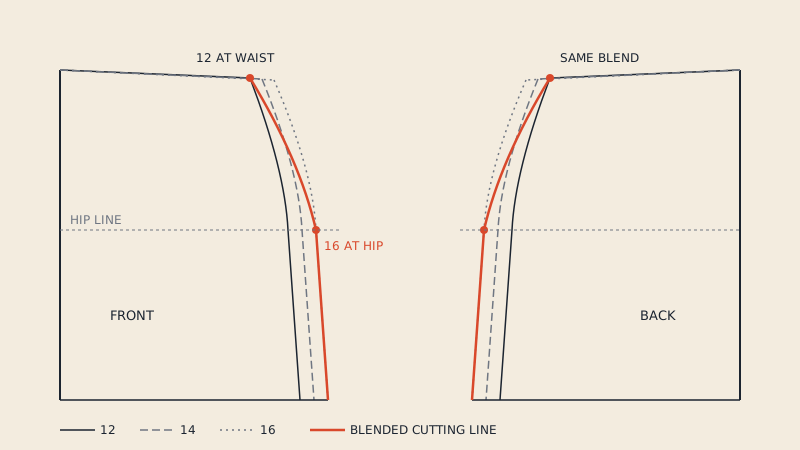
This is also how you choose between sizes on a multi-size pattern when you are between two: pick the size whose ease you prefer. See how to use multi-size sewing patterns.
Why ease matters when converting patterns and fitting in 3D
Scale errors eat ease
Ease is a small number compared with the garment. On a close-fitting bodice, a bust ease of 6 cm is spread over a circumference of about 100 cm. A pattern printed or converted just 2 % too small loses 2 cm of that, a third of the wearing ease, and the garment goes from fitted to tight. That is why printed patterns carry a test square and why a converted DXF should be measured against a known dimension after import. The test square guide explains what a small scaling error does to fit.
A correct vector conversion does not change ease: the pieces are the same shape at 1:1. Our PDF to DXF converter shows the size of every detected piece in the free preview, which lets you check the scale against the paper pattern before you use the file.
3D simulation shows ease directly
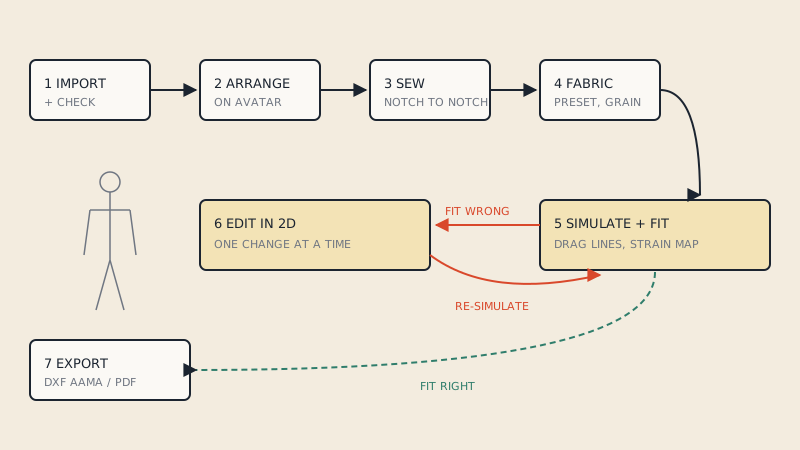
In 3D garment software, ease is what you see between the avatar and the cloth. A few practical points:
- The avatar must match the size. Fit a size 12 pattern on an avatar with size 12 body measurements, otherwise the ease you see is meaningless.
- Fabric properties matter. A stiff virtual fabric stands away from the body; a soft one collapses onto it. Use fabric settings close to the real fabric.
- Read the stress and fit maps. Areas with tension show where wearing ease is missing; areas of loose cloth show design ease.
- Knits need stretch values. A negative-ease knit pattern simulated with a non-stretch fabric will look far too small.
- Seam ease needs sewing. Sleeve cap ease only behaves correctly if the cap and armhole are sewn notch to notch.
A full flat-to-3D workflow is in from flat pattern to 3D sample in CLO3D.
FAQ
What is ease in pattern making?
Ease is the difference between the body measurement and the finished garment measurement at the same point. It is made up of wearing ease, the minimum needed for movement, and design ease, added to create the style.
What is the difference between wearing ease and design ease?
Wearing ease is the extra room any woven garment needs for breathing, sitting and moving. Design ease is extra volume added on top of that by the designer to achieve a particular silhouette, from fitted to oversized.
How much ease should a fitted bodice have?
A commonly used starting point for a close-fitting woven bodice is about 5–8 cm (2"–3") total at the bust. Values differ between drafting systems and fabrics, so compare with a garment that fits you well.
What is negative ease?
Negative ease means the garment is smaller than the body, which works only in stretch fabrics such as jersey or swimwear fabric. The fabric stretches to fit, which is why knit patterns specify a minimum stretch percentage.
How do I find the ease of a pattern?
Measure all pieces along the sewing line at the bust, waist or hip line, excluding seam allowances, darts and overlaps, double the total for half patterns and subtract your body measurement.