The selvage (or selvedge) is the finished edge of the fabric, where the weft thread turns back on itself. The grainline is a direction: the lengthwise grain runs parallel to the selvage, along the warp threads. The bias is any direction diagonal to the threads, and true bias is exactly 45°. On a pattern, the grainline arrow tells you how a piece must sit relative to these directions; the selvage is simply the most reliable reference for finding them.
The words get used loosely, which is where the confusion starts. Here is what each one means, and how the fabric behaves in each direction.
How woven fabric is built
A woven fabric has two sets of threads at right angles.
- Warp threads are stretched lengthwise on the loom before weaving starts. They are held under tension the whole time and are usually the stronger, more tightly twisted yarns.
- Weft threads (also called filling) are passed across the warp, over and under, from one side to the other and back again.
Where the weft turns at each side, it locks the outermost warp threads into a firm band. That band is the selvage: literally a "self edge" that does not fray. It is often woven more densely, and on many fabrics it carries printed text, colour dots or the small holes left by the tenter frame used in finishing.
Everything else follows from this structure.
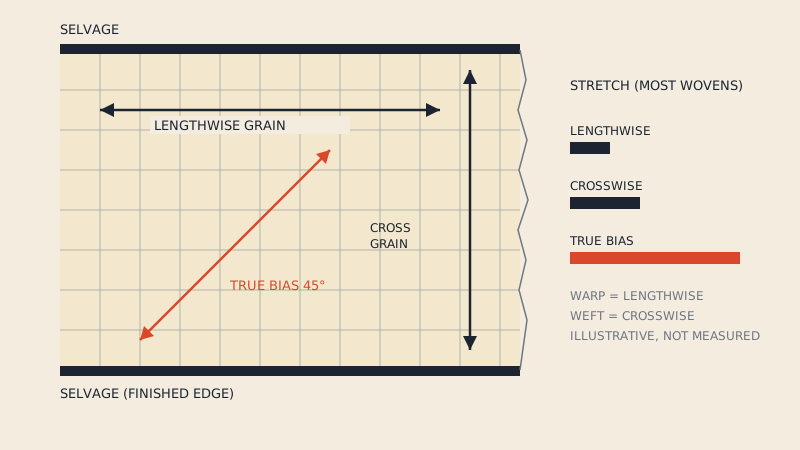
The four terms
Selvage (selvedge)
The two long, finished edges of a woven fabric. "Selvage" is the common American spelling, "selvedge" the British one; they mean the same thing.
- It is a physical edge, not a direction.
- It is usually firmer and may shrink differently from the body of the fabric, so it is normally cut off and not used inside a garment, except deliberately, for example on selvedge denim outseams.
- Because it runs exactly along the warp, it is the reference you measure from when placing pattern pieces.
Lengthwise grain (straight grain)
The direction of the warp threads, parallel to the selvage. When a pattern says "grainline" or "straight of grain" without qualification, it means this direction.
Crosswise grain (cross grain)
The direction of the weft threads, from selvage to selvage, at 90° to the lengthwise grain.
Bias
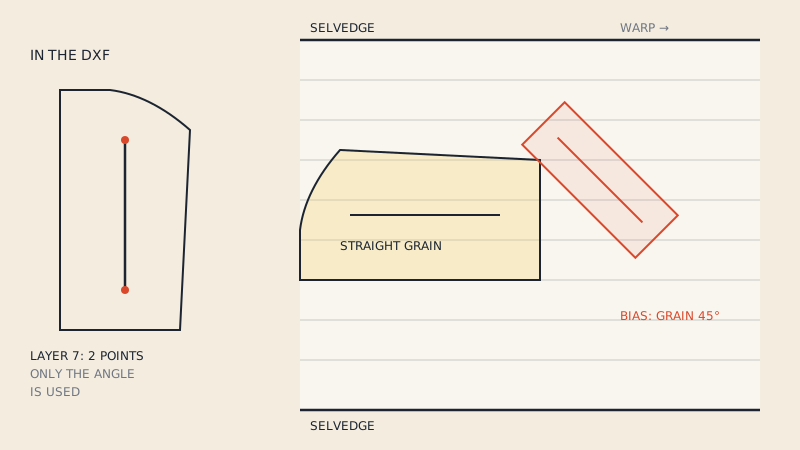
Any direction that is not parallel to either set of threads. True bias is at 45° to both, and it is the direction with the most stretch and drape. When patterns or instructions say "cut on the bias", they mean true bias.
How each direction stretches
The differences are mechanical. Warp threads are under tension on the loom and usually tighter, so they have the least give. Weft threads are slightly looser. On the bias, no thread runs in the direction of pull, so the square grid of threads deforms into a diamond, which is why it stretches so much.
| Direction | Relative to selvage | Stretch in most wovens | Behaviour in a garment | Typical uses |
|---|---|---|---|---|
| Lengthwise grain | Parallel | Least | Hangs straight, stable in length | Most garment pieces, trouser legs, bodices, sleeves |
| Crosswise grain | Perpendicular | A little more than lengthwise | Slightly softer, can "grow" a little | Yokes, waistbands, cuffs, border prints |
| True bias | 45° | Most, often noticeably | Drapes, clings, moulds over curves, edges stretch | Bias binding, slip dresses, cowls, piping, some collars |
| Off grain (not 45°) | Any other angle | Uneven | Twists and hangs unevenly | Avoided unless intended |
These are general tendencies. Fabrics with elastane in the weft, for example, stretch mainly across the width. Some loosely woven fabrics stretch noticeably even on the straight grain. Test a scrap: pull it gently in each direction and you will feel the difference.
Why patterns use the grainline, not the edge
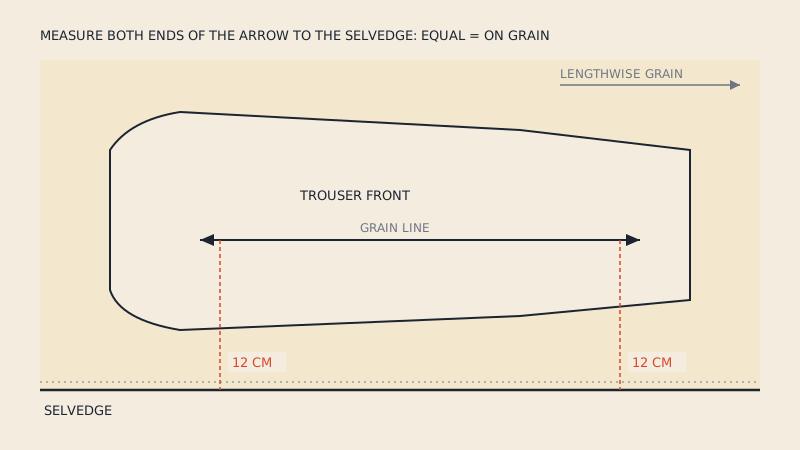
A pattern piece is rarely cut right against the selvage, so a pattern could not simply say "put this edge on the selvage". Instead it gives you a direction: the grainline arrow. That arrow can be anywhere on the fabric as long as it is parallel to the selvage.
The grainline also expresses a design choice. The pattern maker decides how each piece should behave:
- A trouser leg on the lengthwise grain hangs straight and resists stretching in length.
- A skirt cut on the bias clings and flares from the same flat shape.
- A collar cut on the bias rolls more smoothly around the neck.
- A striped yoke on the cross grain shows the stripe in the other direction.
Change the grain, and the same piece of paper produces a different garment. That is why the grainline is drawn on every piece and why it travels with the pattern into CAD files: in DXF AAMA it is a line on layer 7, and 3D garment software uses it to orient the warp and weft of the virtual fabric. More on that in grain lines in DXF patterns.
Common misconceptions
"The grainline is the selvage." No. The selvage is an edge; the grainline is a direction parallel to it.
"The cut end of the fabric is the cross grain." Only if it was cut or torn along a weft thread. Shop cuts are often a few degrees off, which is why you square the fabric before laying out a pattern. The procedure is in how to place the grain line on fabric.
"Any diagonal is bias." Technically yes, but patterns that say bias mean true bias at 45°. A piece cut at 30° behaves differently on its two edges and tends to twist.
"The fold of the bolt is on grain." Usually close, but not always. Fabric folded off grain at the mill leaves a crease that is not parallel to the selvages.
"Print follows the grain." Prints are applied after weaving and can be skewed. The threads, not the print, define the grain.
Knit fabrics: the same idea, different structure
Knits are made of interlocking loops rather than crossing threads, so the terms are adapted.
- Wales are the vertical columns of loops, running along the length of the fabric. They play the role of the lengthwise grain, and the grainline on a knit pattern is placed parallel to them.
- Courses are the horizontal rows of loops, the equivalent of the crosswise grain. In most knits this is the direction of greatest stretch.
- Selvage: circular knits are produced as a tube and slit open, so the edges may be cut or glued rather than finished. Do not rely on them as a straight reference; follow a column of wales instead.
- Bias: knits do have a diagonal, but cutting on it is uncommon; the stretch already comes from the loop structure.
Knit patterns often state the direction of greatest stretch and a required stretch percentage. That requirement is about the fabric, but it directly affects how much ease the pattern needs; see ease in pattern making.
How to find each direction on a piece of fabric
- Selvage: look for the finished, non-fraying edge, often with text or pin holes.
- Lengthwise grain: any line parallel to the selvage. Pull a thread near the selvage if you need a precise reference.
- Crosswise grain: snip the selvage and pull a weft thread across, or tear across if the fabric tears cleanly.
- True bias: fold the fabric so that the crosswise grain lies along the selvage. The diagonal fold is the true bias.
If you have no selvage at all, for example on a remnant, pull threads in both directions to find the grain, then test stretch: the direction with the least give is almost always the lengthwise grain.
FAQ
What is the difference between grainline and selvage?
The selvage is the finished edge of a woven fabric. The grainline is a direction: the lengthwise grain runs parallel to the selvage. Patterns use the grainline arrow so a piece can sit anywhere on the fabric, as long as the arrow is parallel to the selvage.
Is selvage or selvedge correct?
Both are correct and mean the same thing. "Selvage" is more common in American English and "selvedge" in British English and in the denim trade.
Which direction of fabric stretches the most?
In most woven fabrics, the true bias at 45° stretches the most, the crosswise grain a little, and the lengthwise grain the least. Fabrics with elastane can differ, so test a scrap.
What is true bias?
True bias is the direction at exactly 45° to both the lengthwise and crosswise grain. You find it by folding the fabric so the crosswise edge lies along the selvage; the diagonal fold is the true bias.
Do knit fabrics have a grainline?
Yes. On knits the grainline runs parallel to the wales, the vertical columns of loops. The crosswise courses are usually the direction of greatest stretch.