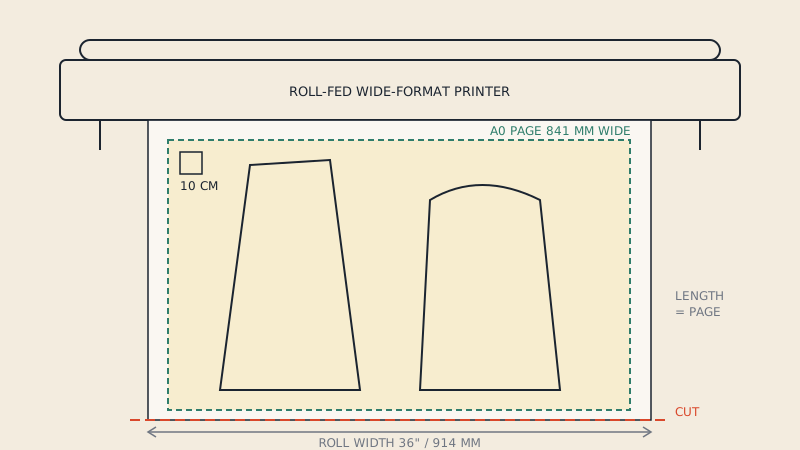
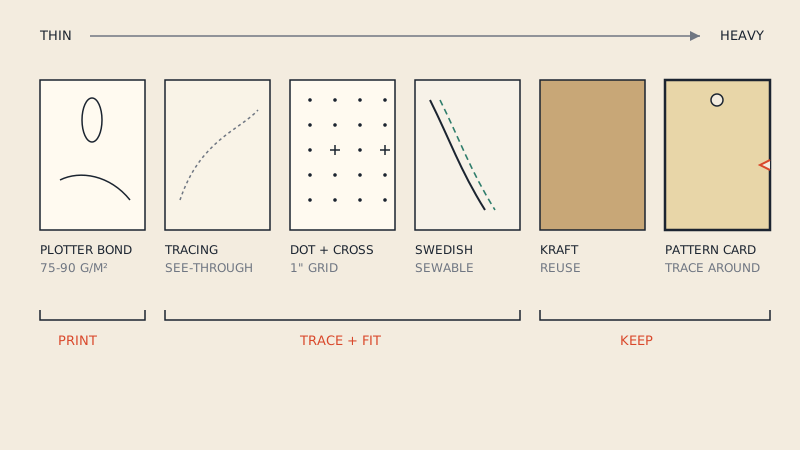
Large-format sewing pattern printing uses roll-fed printers, usually 24" (610 mm), 36" (914 mm), 42" (1067 mm) or 44" (1118 mm) wide, that print a pattern sheet of almost any length in one piece. For patterns, a 36" roll is the most useful single width: it fits A0 (841 mm wide) and the 36" sheets designers make for North American shops. Plain bond paper of about 75–90 g/m² (20–24 lb bond) is the standard choice for printing patterns you trace or cut from.
This is the background article: the machines, the widths and the paper. If you just need to get a file printed, copy shop printing for sewing patterns is the practical guide.
Roll widths and what fits on them
Wide-format paper comes in two families of roll widths: inch-based rolls, common in North America and in most printer specifications, and ISO widths that match the A series exactly.
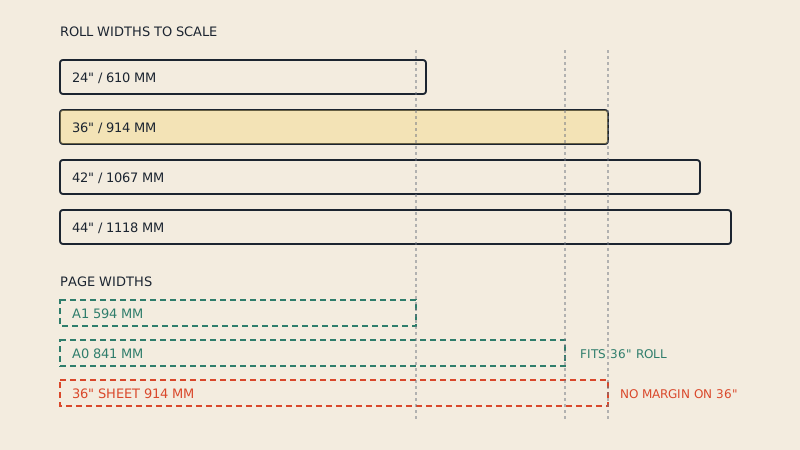
| Roll | Width | Typical pattern use |
|---|---|---|
| ISO A1 width | 594 mm (23.4") | A1 sheets, narrow pattern layouts |
| 24" | 610 mm | A1, children's patterns, small pieces |
| ISO A0 width | 841 mm (33.1") | A0 exactly; no room for margin |
| 36" | 914 mm | A0 with margin; 36" pattern sheets on printers that print close to the edge |
| 42" | 1067 mm | 36" sheets with margin; wide layouts |
| 44" | 1118 mm | Wide layouts; common top width for studio inkjets |
| 60" and wider | 1524 mm and up | Production marker printing, rarely needed for home patterns |
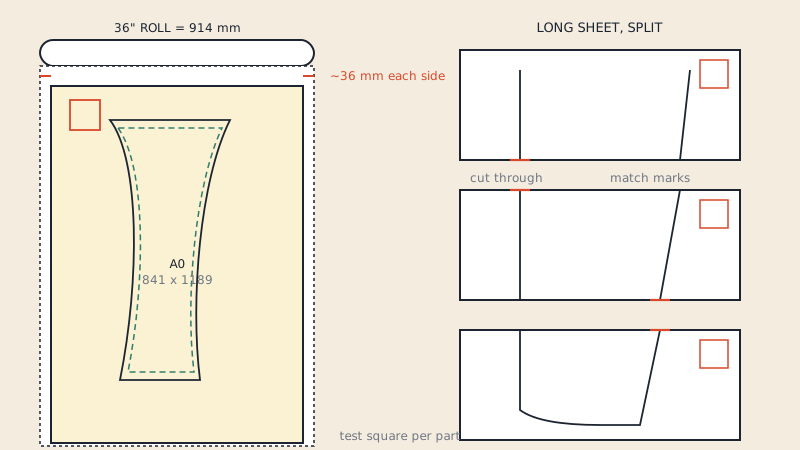
Width is the hard limit; length is not. A roll printer feeds as much paper as the page needs, up to a maximum the machine and its software allow. That is why pattern designers often make "36 × any length" sheets rather than fixed A0 pages. Very long pages have their own issues, which printing on a 36-inch roll goes through, along with splitting a long sheet.
Two details trip people up:
- Printable width is less than roll width. Most printers keep a few millimetres of margin on each side. A page exactly as wide as the roll will either be clipped or scaled down, depending on the settings.
- Orientation matters. A0 is 841 × 1189 mm. Fed upright, it needs an 841 mm roll plus margin. Rotated, it needs 1189 mm, which only very wide printers have.
Plotter vs printer: what is actually printing your pattern
"Plotter" is used loosely for any large-format machine, but there are several kinds and they suit different jobs.
Wide-format inkjet printers
The most common machine at copy shops and in design studios. They print on rolls with inkjet heads, handle both line drawings and colour, and print fine lines sharply. Speed and running cost depend on the model and on ink coverage: a line pattern uses little ink, a pattern with grey or coloured fills uses much more.
Toner and LED engineering systems
Black-and-white systems built for architectural and engineering drawings. Reprographics shops and some office chains use them. They are fast on line work, typically cheap per sheet, and commonly offer only monochrome. For patterns they are often the best value, as long as your sizes are readable in black and white.
Pen plotters
The original plotters drew with pens moved over the paper. Some pattern rooms still use pen or marker plotters for markers and pattern prints, driven by HPGL/PLT files from pattern CAD. Inkjet has replaced them almost everywhere else. If you meet a PLT file, PLT/HPGL pattern files explains how it differs from DXF.
Cutting plotters
Cutting plotters cut pattern card or paper with a blade or a drag knife rather than printing on it. They are production tools for factories and pattern rooms and take CAD output, not PDF. A wider look at studio machines is in pattern plotters.
| Machine | Colour | Typical source file | Good for |
|---|---|---|---|
| Wide-format inkjet | Yes | PDF, also CAD plot files | Copy-shop pattern prints, studios |
| Toner / LED engineering system | Usually black only | PDF, TIFF | Cheap, fast line prints |
| Pen / marker plotter | Pen colours | HPGL / PLT | Pattern rooms, markers |
| Cutting plotter | None | CAD output (PLT, DXF, vendor formats) | Cutting pattern card |
Paper
Weights and what they mean
Paper weight is given in grams per square metre (g/m², gsm) in most of the world and in pounds bond in the US. The conversions below are approximate, as is usual for paper.
| Weight | Approx. US bond | Feel | Pattern use |
|---|---|---|---|
| 60–70 g/m² | 16–18 lb | Thin, slightly translucent | Light for tracing through; tears more easily |
| 75–80 g/m² | 20 lb | Standard copy and plan paper | The default for pattern prints |
| 90 g/m² | 24 lb | A little stiffer | Prints you will reuse and pin to fabric often |
| 120 g/m² and up | 32 lb and up | Card-like, heavy | Rarely worth it; trace onto card instead |
Lighter bond is cheaper and easier to fold and store; slightly heavier bond survives repeated pinning. Neither matters to accuracy as long as the print is at 100 %.
Paper types
- Uncoated bond. The standard. Takes pencil and marker, cheap, available at every shop.
- Coated (matte) inkjet paper. Sharper colour, more expensive. Unnecessary for line patterns.
- Translucent bond or vellum. You can see fabric or a second layer through it, useful for comparing sizes or tracing. More expensive and not every shop stocks it.
- Photo and poster papers. Glossy, heavy, expensive. Avoid for patterns.
For what to trace onto after printing (dot paper, Swedish tracing paper, kraft, card), see plotter paper and pattern paper.
Rolls and cores
Plotter rolls are sold by width and length, commonly 45–50 m (150 ft) for bond, and on a cardboard core, commonly 2" (50 mm) or 3" (76 mm) in diameter. If you are buying paper for your own plotter, check the printer's supported core size and maximum roll diameter; a roll that does not fit the spindle is a common mistake.
Running your own large-format printer
Small studios and pattern designers sometimes buy a wide-format inkjet. Questions worth asking before you do:
- Which width? 24" printers are smaller and cheaper but do not take A0. 36" is the practical minimum for full patterns; 44" adds room for wide layouts.
- How often? Inkjet heads dislike long idle periods. A printer used once a month may spend ink on cleaning.
- Space. A 36" printer with its stand needs floor space and room in front for the paper to come out and drop into a basket.
- Software. Most print fine from PDF. If you work from pattern CAD, check it can send to the printer driver directly or export a PDF at 1:1.
- Paper and ink supply. Find out who stocks the roll width and inks locally.
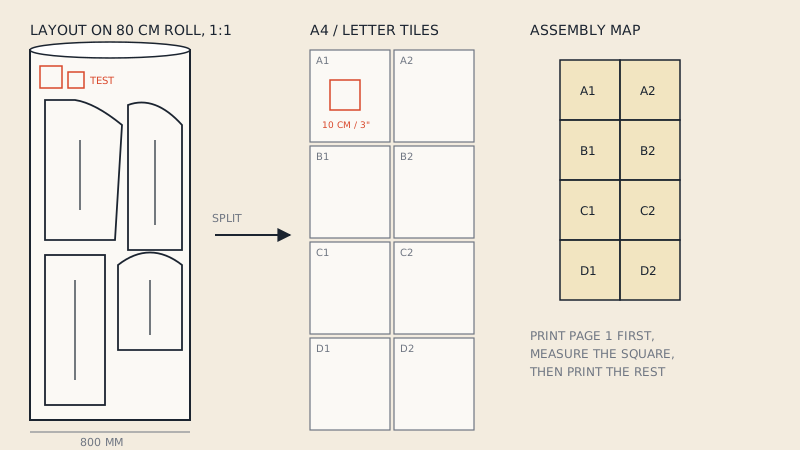
If you work in pattern CAD and only need occasional prints, outputting a 1:1 PDF and sending it to a shop is often simpler. Our DXF to PDF print files guide covers the layout side; the print files service takes a DXF AAMA and lays the pieces out at 1:1 on an 80 cm (31.5") wide roll sheet, which fits 36" printers, and splits it into A0 to A4 and US Letter sheets as well.
Checking any large-format print
The same three checks apply whatever the machine:
- Measure the test square in both directions with a ruler.
- Check the edges for clipping, especially along the roll's width.
- Lay a long ruler along a straight grain line or a centre-front line: it should be straight, which tells you the paper fed without skew.
FAQ
What roll width do I need to print sewing patterns?
A 36" (914 mm) roll covers most patterns: it fits A0 with margin and 36"-wide pattern sheets on most printers. A 24" roll is too narrow for A0, and 42" or 44" rolls give extra room for wide layouts.
What is the difference between a plotter and a printer for patterns?
Today most "plotters" at copy shops are wide-format inkjet printers. Traditional pen plotters and cutting plotters are found in pattern rooms and take CAD files such as HPGL/PLT rather than PDF.
What paper weight should I use for printing sewing patterns?
Plain bond around 75–90 g/m² (20–24 lb bond) is the usual choice. Lighter paper is easier to trace through and store; slightly heavier paper lasts longer if you pin it to fabric repeatedly.
Can a large-format printer print a pattern longer than A0?
Yes, if it is roll-fed. The width must fit across the roll, but the length can usually run well beyond 1189 mm, up to the limit of the printer and its software.
Is black-and-white large-format printing accurate enough for patterns?
Yes. Black-and-white engineering prints reproduce pattern lines and text accurately at 100 % scale. Colour adds nothing unless sizes are told apart only by colour.