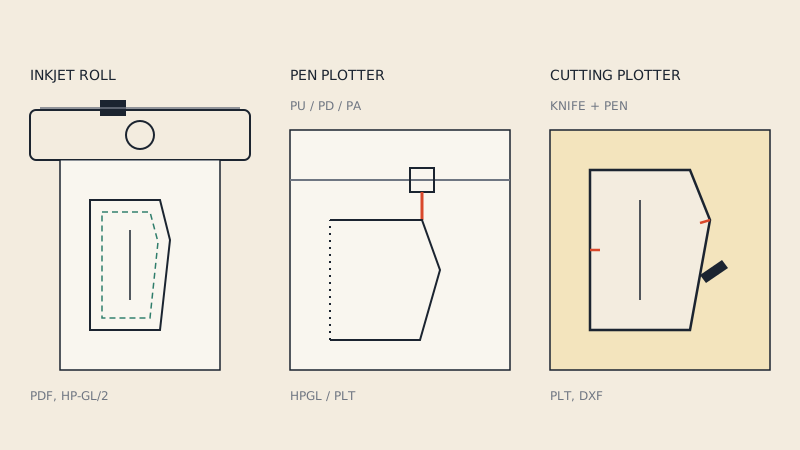
A pattern plotter is a large-format machine that draws or cuts full-size pattern pieces and markers on a roll of paper or card. In a studio it usually means one of three things: an inkjet roll plotter that prints patterns and markers on plain paper, an older pen plotter that draws them with pens, or a cutting plotter that cuts the outlines out of pattern card. They take different files and solve different problems, so it pays to know which one you are talking about before you buy one or send a file to someone who has one.
Why studios use plotters at all
Printing at home on A4 or US Letter works for one pattern; it does not work for a studio that needs full-size patterns every day. A plotter gives you:
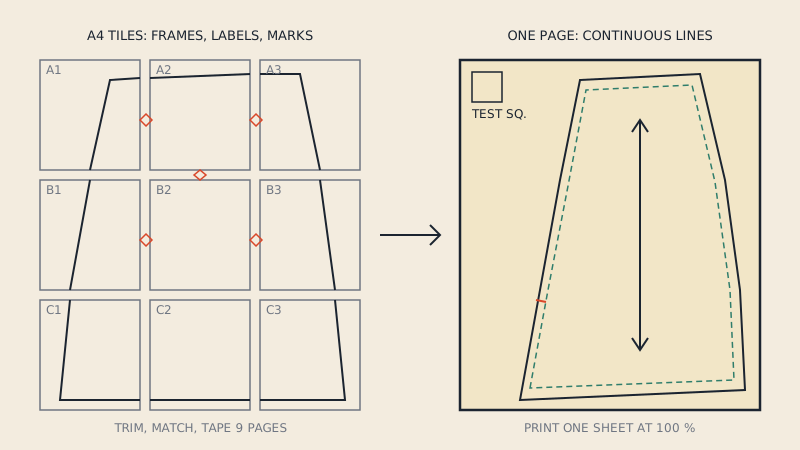
- Full-size pieces in one go, with no tiling and no tape.
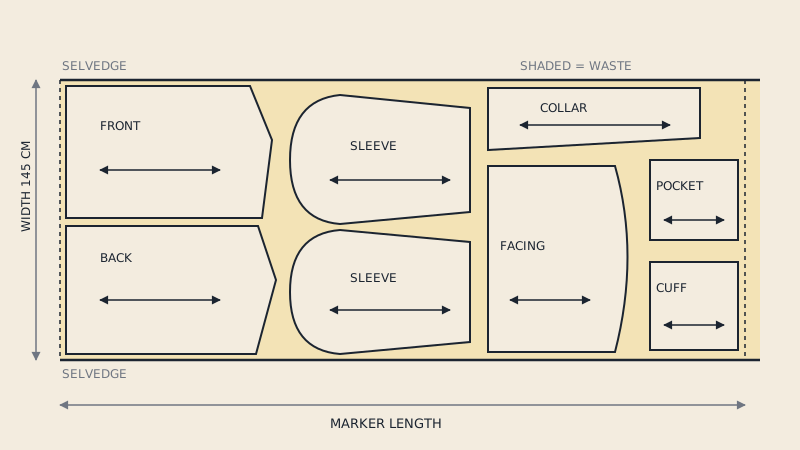
- Markers: a full-width cutting plan for a fabric spread, which can be several metres long. See marker making basics.
- Repeatability: the same file always comes out at the same scale, once the machine is checked.
- Hard patterns (with a cutting plotter): card templates that last for production.
The three kinds of pattern plotter
Inkjet roll plotters
Today the most common choice. These are wide-format inkjet printers fed from a roll. There are two broad groups:
- General wide-format printers, the same machines architects and copy shops use for drawings. They print PDFs through a driver, and many also accept HP-GL/2 files directly.
- Apparel marker plotters, built for garment CAD. They are usually wider, print single-colour lines on plain paper at speed, and are driven by the pattern or marker software directly.
For patterns, line accuracy matters far more than colour. A monochrome line print on uncoated bond paper is the norm.
Pen plotters
The older technology: a pen moves over the paper (or the paper moves under the pen) following vector commands. Pen plotters spoke HPGL, which is why apparel CAD still exports PLT files today. Some studios keep them running; for new purchases, inkjet plotters have largely replaced them.
Cutting plotters
These carry a knife (drag knife or tangential knife) and cut along the outlines, often in pattern card or heavy paper. Some combine a pen and a knife, drawing internal lines and text, then cutting the outline and notches. Smaller craft cutters exist too, but their cutting width limits them to small pieces and templates. Laser cutters are a separate category, used for card templates, acrylic templates and fabric itself.
Comparison
| Type | Output | Typical files | Good for | Watch out for |
|---|---|---|---|---|
| Inkjet roll plotter (general) | Printed lines on paper | PDF through driver, often HP-GL/2 | Patterns, small markers, copy-shop work | Driver scaling, roll width |
| Apparel marker plotter | Printed lines on wide paper | Sent from CAD, PLT/HPGL or vendor format | Full-width production markers | Usually needs the CAD system |
| Pen plotter | Drawn lines | HPGL / PLT | Legacy setups, archival markers | Pens, maintenance, speed |
| Cutting plotter | Cut card or paper, plus pen lines | HPGL / PLT, DXF, vendor format | Hard patterns and templates | Knife depth, material hold-down |
| Laser cutter | Cut and engraved material | DXF, SVG, vendor format | Templates, small parts, fabric | Burn marks, ventilation, kerf |
Roll widths and what fits
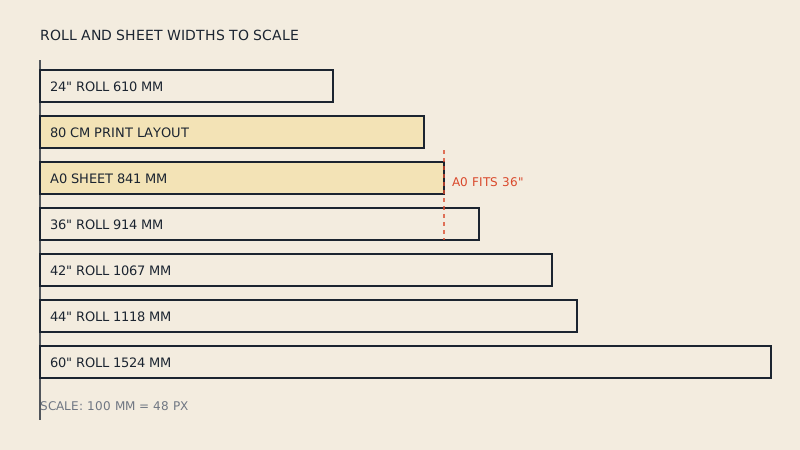
Roll plotters are classed by the widest roll they take. The common widths:
| Roll width | Metric | Fits |
|---|---|---|
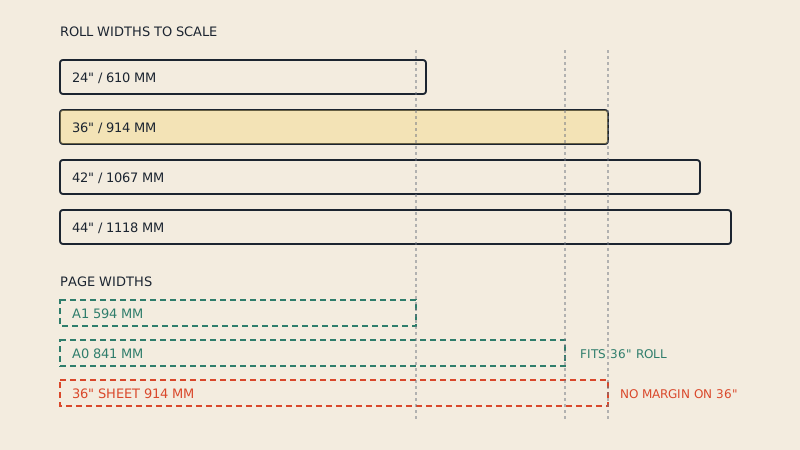
| 24" | 610 mm | A1 width (594 mm), small pieces, sleeve and collar sheets |
| 36" | 914 mm | A0 width (841 mm), most single pattern pieces |
| 42" | 1067 mm | A0 with margins, wider markers for narrow fabrics |
| 44" | 1118 mm | Same as 42" with more room |
| 60" | 1524 mm | Full-width markers for many woven fabrics |
For patterns alone (not markers), a 36" (914 mm) plotter covers nearly everything, which is why A0 copy-shop files work so well in North America too; printing on a 36-inch roll goes into the details. For production markers, you need a plotter as wide as the usable fabric, or you split the marker. The large-format pattern printing article covers paper and rolls from the print-shop side.
File formats plotters accept
The plotter does not care about pattern pieces; it cares about lines. That is the main thing to understand about plotter files.
- PLT / HPGL is a plotter language: pen up, pen down, move to x, y. It carries lines and sometimes text, but no piece structure, no layers in the AAMA sense, no grain-line meaning. Our article on PLT/HPGL pattern files explains why this matters when you want to get the pattern back into CAD.
- PDF goes through the printer driver. It is the easiest format to send to a copy shop, as long as nobody scales it.
- DXF is the format cutting plotters and laser cutters often import directly, and the one pattern CAD uses to exchange pieces.
- Vendor formats connect a CAD system to its own plotters and cutters.
In practice, the pattern lives in CAD or as a DXF AAMA file, and the plotter file is generated from it each time. Keep the DXF as your master and treat PLT as an output, not an archive.
Getting the scale right
A plotter that prints 0.5 % too long on a 2 m marker is 1 cm (3/8") out. Check it.
- Turn off any scaling in the driver: no "fit to page", no "scale to roll width". Print at 100 %.
- Plot a test file with a 10 cm square and a long line of known length, ideally 1 m along the roll and the full width across it.
- Measure both directions. Errors along the roll come from paper feed; errors across come from the carriage. They are corrected separately, in the plotter's calibration menu or the CAD's plotter settings.
- Repeat after changing paper, since a different paper weight can feed differently.
- Keep the test result with the date, so you can tell if the machine drifts.
The test square article explains what tolerance is reasonable and what a small percentage error does to fit.
Paper and card
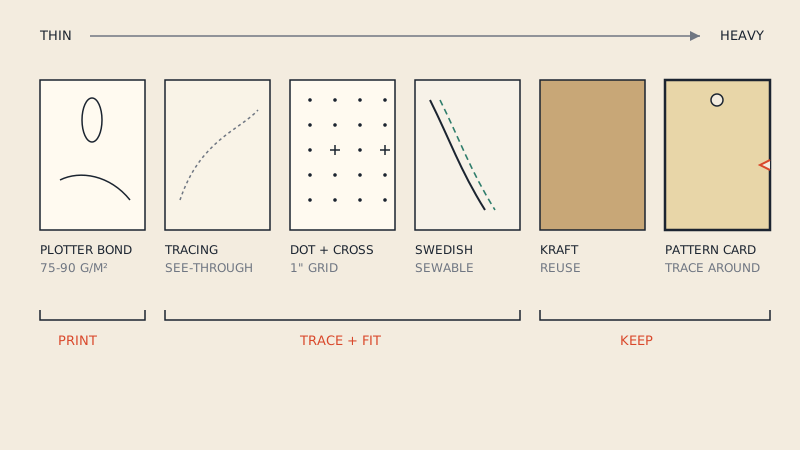
- Plain bond paper on rolls is the default for patterns and markers. Weights commonly sit in the 80 to 90 g/m² range; heavier paper lasts longer but feeds and folds differently.
- Dot or grid paper is used for hand drafting, not usually plotted.
- Pattern card for hard patterns is cut on cutting plotters or by hand.
More on choosing paper is in plotter paper and pattern paper.
If you do not own a plotter
Most studios start without one, and a copy shop with a wide-format printer covers patterns well. What you need is a correct 1:1 file:
- From a PDF pattern with A4 or Letter tiles, a one-page file assembled from the tiles goes straight to the copy shop.
- From a DXF pattern out of your CAD, you need the pieces laid out on a roll width and exported as a 1:1 PDF. Our service does this for DXF AAMA files: the pieces are laid out at 1:1 on an 80 cm (31.5") roll, which fits 36" plotters, and also split into A0 to A4 and US Letter sheets with test squares and an assembly map.
If you plot markers rarely, the same route works for markers exported from your marker software as PDF.
Buying checklist
- What will you plot most: patterns, markers or hard patterns?
- What width do you need? For markers, at least your widest usable fabric.
- Which formats can your software send: PDF, PLT/HPGL, a vendor driver?
- Can you calibrate both axes, and how?
- Paper supply: roll diameter, core size, weight range.
- Floor space and a table to receive long prints.
FAQ
What is a pattern plotter?
A pattern plotter is a large-format machine that prints, draws or cuts full-size pattern pieces and markers from a roll of paper or card. Most studios today use inkjet roll plotters; cutting plotters are used for hard card patterns.
What file format does a pattern plotter use?
Many plotters accept HPGL/PLT, and wide-format inkjets usually print PDF through a driver. Cutting plotters and laser cutters often import DXF directly.
What roll width do I need for sewing patterns?
A 36" (914 mm) roll fits A0 width (841 mm) and nearly all individual pattern pieces. Production markers need a roll at least as wide as the usable fabric.
How do I check that a plotter prints to scale?
Plot a file with a 10 cm square and a long reference line, at 100 % with no fit-to-page, then measure along the roll and across it. Correct each axis separately if needed.
Can I print a DXF pattern without a plotter?
Yes. Lay the pieces out at 1:1 and export a PDF for a copy shop, or split it into A4 or Letter tiles to print at home. Pattern CAD and some online services can produce these files from a DXF.