For printing sewing patterns, plain plotter bond paper of about 75-90 g/m² (20-24 lb) on a roll is the standard: cheap, flat, and thin enough to trace through. For tracing your size off a printed master, use dot and cross paper or tracing paper; for patterns you will use again and again, kraft paper or card; and for fitting, Swedish tracing paper, which can be pinned and even sewn. The right choice depends on whether the paper is a print master, a working copy or a garment test.
Two jobs: printing and tracing
It helps to separate the two:
- Print paper goes through a printer or plotter. It must feed reliably, take ink or toner cleanly and stay flat. You usually treat it as a master copy.
- Pattern paper is what you trace onto, cut and pin to fabric. It needs to survive handling, show your markings and, for some uses, drape.
Many sewists print on cheap bond paper and trace the size they need onto something sturdier. That keeps the multi-size master intact and gives you a clean single-size piece.
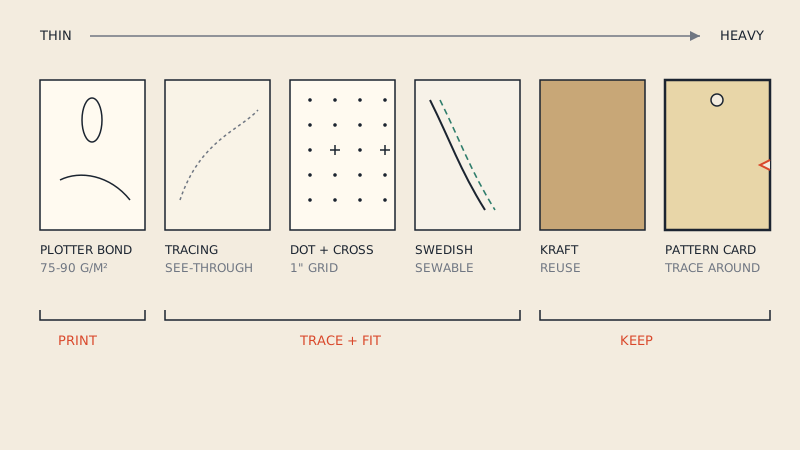
Plotter paper for printing
Copy shops and studios print patterns on wide-format inkjet or LED plotters fed from rolls. The paper is usually called bond, plotter bond or engineering paper.
| Property | Typical choice for patterns | Why |
|---|---|---|
| Weight | 75-90 g/m² (20-24 lb bond) | Thin enough to trace through, strong enough to handle |
| Finish | Uncoated matte | Takes pencil, tape and glue; no glare |
| Colour | White | Maximum contrast for line plots |
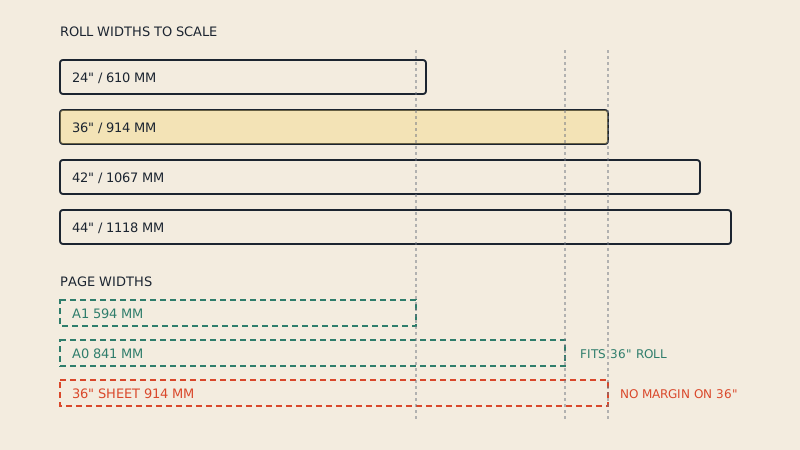
| Roll width | 610, 914, 1067 mm (24", 36", 42") are common | A0 is 841 mm wide, so it fits a 36" roll |
| Print mode | Black line, no fill | Fast and economical |
Heavier coated papers (often 120 g/m² and up) are made for posters and photos. They are stiffer, harder to see through and more expensive, with no benefit for a line drawing.
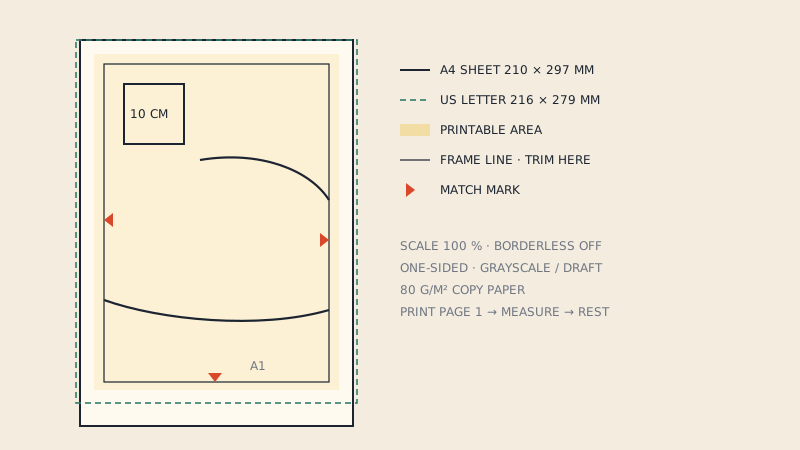
At home, the equivalent is ordinary 75-80 g/m² copy paper; our A4 and US Letter printing guide covers that side. For roll widths and printer types at copy shops, see large-format pattern printing.
Can I buy plotter paper for home use?
Yes - plotter rolls are sold for office plotters and are a cheap source of tracing and drafting paper, even without a plotter. A 36" (914 mm) roll gives you wide, continuous paper for tracing long pieces such as trousers. Rolls are heavy and need a holder or a cardboard tube to unroll flat.
Paper for tracing your pattern
Dot and cross paper
Pattern paper printed with a regular grid of dots and crosses - commonly at 1" spacing - so you can square lines, place grain lines and check measurements without a ruler grid of your own. A variant with letters and numbers on the grid is often called alphanumeric dot paper and is widely used in the trade. It is lightweight and semi-translucent, so you can see printed lines beneath it.
Best for: tracing sizes, drafting from measurements, making working copies.
Tracing paper (transparent)
Thin, smooth and very transparent. Easy to trace through, but it tears and crinkles with handling and does not like pins. Good for small pieces and for adjustments where you need to see the original line underneath.
Swedish tracing paper
Not paper in the usual sense: a soft, non-woven material, semi-transparent enough to trace through. It can be pinned, folded and machine-sewn, so you can tack a traced bodice together and try it on before cutting fabric. It is usually sold on rolls and costs more than paper.
Best for: fitting checks on simple garments, patterns you will adjust.
Other things sewists trace on
- Medical examination paper. Cheap, long rolls; very thin and tears easily.
- Non-fusible interfacing or lightweight non-woven. Drapes and lasts; can also be sewn for a rough fit check.
- Freezer paper. Plastic-coated on one side; can be ironed temporarily onto fabric for small, precise pieces.
- Wrapping or newsprint paper. Usable for one-off tracing if it has no print on it.
Paper for patterns you keep
| Material | Weight (typical) | Use |
|---|---|---|
| Kraft / brown paper | 70-120 g/m² | Working patterns you will reuse; tougher than bond |
| Manila or pattern card ("oak tag") | Often 150 g/m² and heavier | Blocks, slopers, production patterns traced around with chalk |
| Card stock | 160-300 g/m² | Small templates: pockets, collars, buttonhole guides |
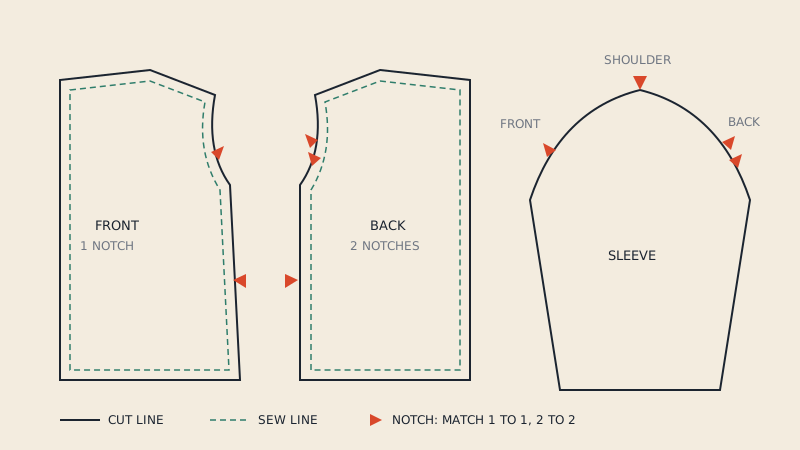
Card patterns are traced around rather than pinned. They keep their shape for years and are standard in production rooms, where the same piece is marked hundreds of times. Notches on card are cut as small slits or V-cuts so a chalk or pencil can mark them; see notches in sewing patterns.
How to choose
| You want to... | Use |
|---|---|
| Print a copy-shop or A0 file | 75-90 g/m² plotter bond |
| Print at home | 75-80 g/m² copy paper |
| Trace one size off a multi-size master | Dot and cross or tracing paper |
| Test the fit before cutting fabric | Swedish tracing paper |
| Keep a pattern you will sew many times | Kraft paper or pattern card |
| Make small templates | Card stock |
Tracing well
Whatever paper you trace on, transfer more than the outline:
- cut line and, if the pattern shows it, sew line;
- every notch, with its number of ticks;
- grain line, fold line and "cut 2" or "cut on fold";
- darts, pleats, buttonholes, pocket placements;
- piece name, pattern name, size and date.
Our guide on how to trace a sewing pattern goes through the method and which tools help.
Storing paper and patterns
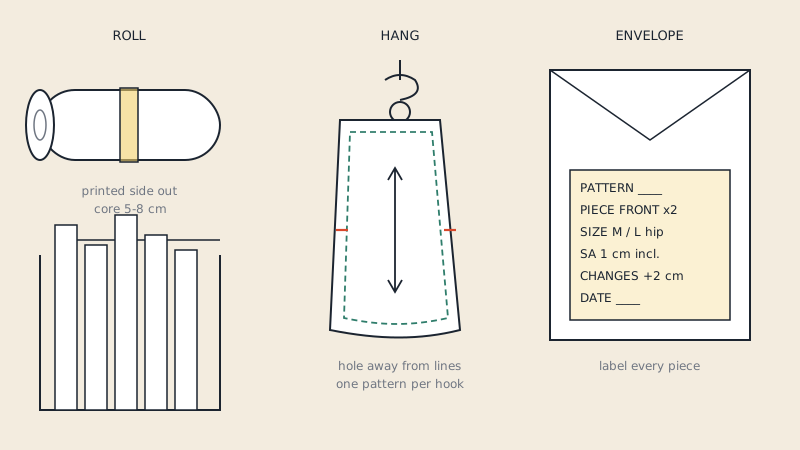
- Rolls: store upright or on a wall rack; lying on a shelf, a roll flattens on one side and unrolls with a kink.
- Bond prints: roll loosely, printed side out, and label the outside. Folding creases the lines, and a fold through a notch can hide it.
- Card patterns: hang them through a punched hole on a hook or rail, grouped by style.
- Traced working copies: fold along existing fold lines and keep them in labelled envelopes.
More ideas, including keeping a digital archive, are in how to store printed and traced patterns.
If your pattern only exists as A4 or Letter tiles and you would rather print it once on a roll, our converter assembles the tiles into a single copy-shop sheet without the original tile frames.
FAQ
What paper do copy shops use for printing sewing patterns?
Usually uncoated plotter bond paper of about 75-90 g/m² (20-24 lb) on rolls such as 24", 36" or 42" wide. It is the cheapest wide-format paper and is thin enough to trace through.
What is the best paper to trace sewing patterns onto?
Dot and cross paper is a common choice because it is light, semi-transparent and printed with a grid for squaring lines. Tracing paper is more transparent but tears more easily.
What is Swedish tracing paper used for?
It is a soft, non-woven material you can trace onto and then pin or sew together, so you can try on a pattern before cutting fabric. It is also durable enough for patterns you reuse.
What paper weight is best for printing PDF patterns?
Around 75-90 g/m² (20-24 lb). Heavier paper is harder to trace through and costs more, and lighter paper tears and curls more easily.
What do pattern makers use for patterns they keep?
Kraft paper for working patterns and manila pattern card for blocks and production pieces. Card keeps its shape and is traced around with chalk instead of being pinned.