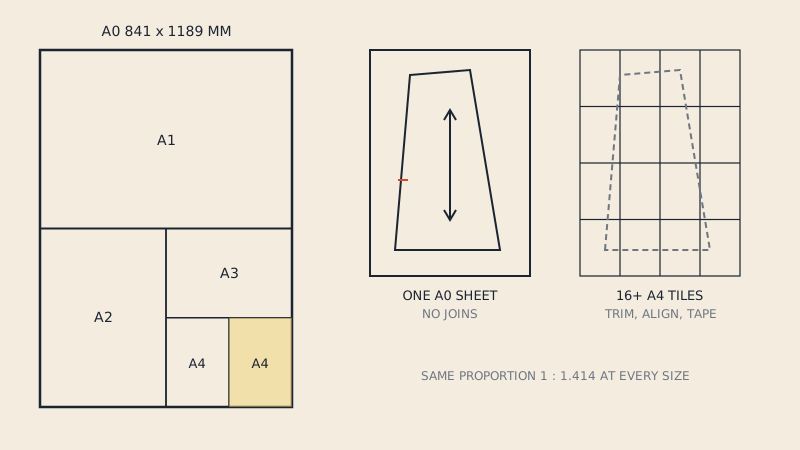
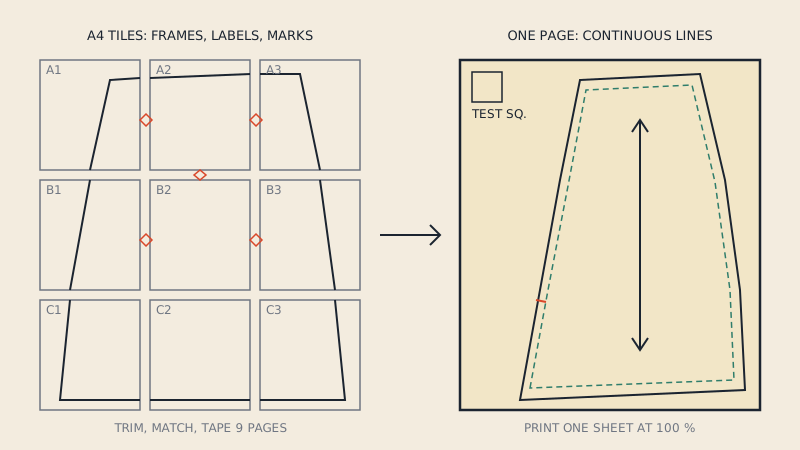
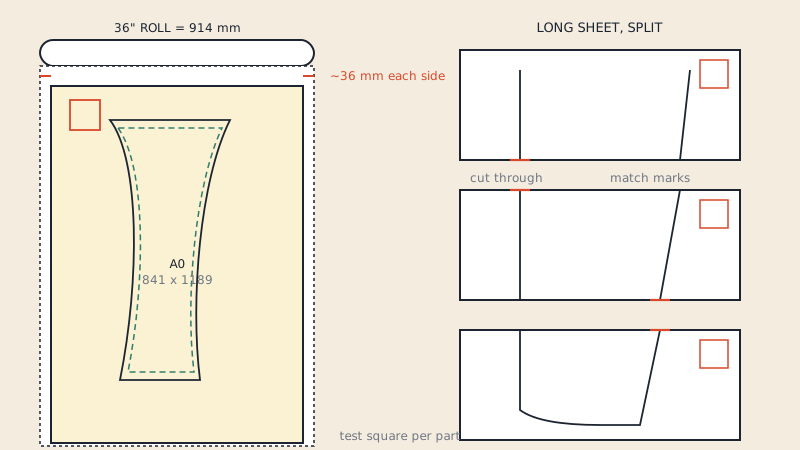
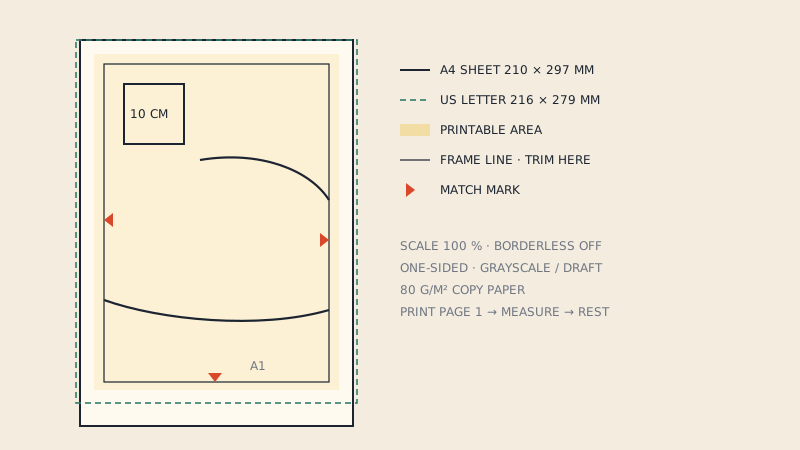
If the pattern has large pieces (trousers, dresses, coats) print the A0 file at a copy shop: one sheet instead of 20 to 30 taped pages, and no small errors building up at the joins. Print the A4 file at home for small projects, for a quick start tonight, or when you have no shop within reach. In North America the same choice is between US Letter tiles and a 36" (914 mm) roll print.
The two files contain the same pattern. What differs is the paper, who prints it, and what happens between printing and cutting.
The short comparison
| A4 / US Letter tiles | A0 / 36" roll sheet | |
|---|---|---|
| Printed by | You, on a desktop printer | Copy shop, print service |
| Pages for one full A0 layout | Commonly 20–30 | 1 |
| Assembly | Trim, align and tape every page | None |
| Time before cutting | Printing plus assembly | Travel or delivery |
| Accuracy risk | Scale setting, plus drift at every join | Scale setting only |
| Cost | Your paper and ink | Per-sheet price at the shop |
| Storage | Bulky taped sheets, or folded | One rolled or folded sheet |
| Best for | Small pieces, kids' clothes, accessories, starting immediately | Garments with long or wide pieces, reprinting favourites |
The A0 format itself, its dimensions and where it comes from, is explained in how to print an A0 sewing pattern. This page is about choosing.
Page counts: why one A0 is more than 16 A4 pages
By area, one A0 sheet equals exactly 16 A4 sheets. In practice a pattern drawn on A0 splits into more pages than that, because every tile loses some area:
- Printer margins. Most desktop printers cannot print to the paper edge, so each page carries an unprinted border.
- Overlaps or trim areas. Tiles are designed either to overlap or to be trimmed and butted, and both use a strip of each page.
- Rounding up. A layout that needs 4.3 columns of tiles needs 5.
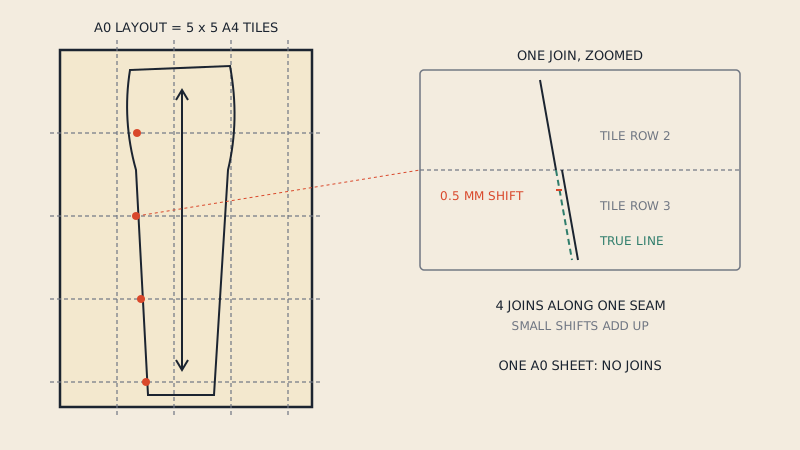
With a printable area of roughly 19 × 27 cm per A4 page, one A0 layout (84.1 × 118.9 cm) comes out as a 5 × 5 grid: 25 pages. US Letter has a similar printable area, so the count is similar. Patterns with a narrow sheet or a few small pieces need fewer, and many tiled files skip pages that would be blank.
North American equivalents
| Large format | Tiles at home | Notes |
|---|---|---|
| A0, 841 × 1189 mm (33.1 × 46.8") | Commonly 25 A4 or Letter pages | Prints on a 36" roll with room to spare |
| 36 × 48" (914 × 1219 mm) sheet | Commonly 25 Letter pages | A common US large-format size |
| 36" roll, any length | Depends on length | Long layouts, one sheet per pattern |
| A1, 594 × 841 mm | Commonly 15–16 pages | Half of A0; fits narrower 24" rolls |
If you are in North America with an A0 file, it prints on a 36" roll without scaling; the details of width and length are in printing on a 36-inch roll. If you have the A4 file but Letter paper (or the reverse), read US Letter vs A4 before printing.
Time
A4 printing feels faster because it starts immediately. The time cost comes after: trimming or folding margins, laying out pages in the right order, matching marks, taping, and fixing the page that went on upside down. For a pattern with 25 or more pages that is a real session of work before you can trace or cut, and it is repeated every time you print the pattern again.
A0 moves the time to before: finding a shop, sending the file, collecting the print or waiting for the post. Once the sheet is in your hands you can trace straight away. If you sew from the same pattern repeatedly, or print several patterns at once, the large-format route usually wins on total time.
Accuracy
Both files print at exact scale if you print at 100 %. The difference is what happens next.
On a tiled pattern, every join is a small manual alignment. If each one is off by half a millimetre, a piece crossing four or five joins can be a couple of millimetres off along its length, and the error can go in any direction, including a slight angle. On most garments that is harmless. It matters on long seams that must match exactly (a trouser inseam, a long princess seam), on closely fitted garments, and when two pieces that will be sewn together were assembled on different days with different care.
An A0 sheet has no joins. The remaining risks are the print scale (check the test square) and paper stretch with humidity, which is small for plain bond paper.
If you do print at home, careful trimming and matching keeps tiling errors small.
Cost factors
Home printing uses paper and ink or toner you already pay for. A copy shop charges per sheet, with the price depending on the shop, sheet size and whether you print in colour. Neither is free; which is cheaper depends on your printer's running costs and local prices, so compare the shop's price per black-and-white sheet with what 25 pages cost you at home.
Hidden costs on each side:
- A4: misprints at the wrong scale, the second print of a page you trimmed wrongly, tape.
- A0: travel, delivery, colour printing you did not need, a reprint if the shop scaled the file.
When A4 is the better choice
- The pattern is small: a bag, a top for a child, a pair of mittens, a single facing.
- You want to cut tonight and the shops are closed.
- The pattern only exists as A4 or Letter tiles and you do not plan to sew it again.
- You want to print just one or two pieces. Most tiled files have a page map, so you can print only the pages a piece sits on.
Home printing tips are in printing sewing patterns on A4 or US Letter.
When A0 is the better choice
- Any garment with pieces longer than about two A4 pages: trousers, maxi skirts, dresses, coats.
- Patterns you will reuse or share between sizes in the household.
- Fitted garments where small assembly errors matter.
- You have several patterns to print at once and can make one trip.
What if the pattern only comes in one format?
Older patterns and some free patterns are supplied only as A4 or Letter tiles. Some large-format-only patterns have no tiled version. Either way you can convert between them: tiles can be assembled into a single large sheet (see one-page PDF patterns), and a large sheet can be split into tiles of any size. Our print files service does both from a vector PDF for €5 per pattern, with the original tile frames removed and a test square and assembly map at the start of each tiled set.
FAQ
Is A0 or A4 better for sewing patterns?
A0 is better for garments with large pieces because there is nothing to assemble and no error at the joins. A4 is better for small patterns or when you need to start immediately and have no copy shop nearby.
How many A4 pages make an A0 pattern?
By area 16, but because of printer margins and overlaps a full A0 layout commonly splits into about 25 A4 or US Letter pages. Files often skip pages that would be blank.
Is A0 the same as 36 x 48 inches?
No. A0 is 841 × 1189 mm (33.1 × 46.8"), slightly narrower and shorter than a 36 × 48" sheet. An A0 file fits on a 36" roll without scaling.
Are A0 patterns more accurate than A4?
Both print at exact scale when printed at 100 %. A0 avoids the small alignment errors that can build up when taping many A4 pages, which matters most on long seams and fitted garments.
Can I print an A4 pattern at a copy shop?
You can print the A4 pages there, but you still have to assemble them. To get a single large sheet, the tiles first have to be combined into one large-format file.