To print an A0 sewing pattern, take the pattern's A0 or "copy shop" PDF to a shop with a wide-format printer, or upload it to an online plan-printing service, and ask for it printed at 100 % on plain paper, black and white unless the sizes are colour-coded. A0 is 841 × 1189 mm (33.1 × 46.8"), one square metre of paper, and most garment patterns fit on one to three sheets. The cost depends mainly on the number and size of sheets, colour versus black and white, and the type of shop.
What A0 actually is
A0 is the largest common sheet of the ISO 216 "A" series used in most of the world outside North America. Each smaller size is the larger one cut in half, so all A sizes share the same proportion (1 : 1.414) and the same layout scales cleanly between them.
| Size | mm | inches (approx.) | A4 sheets by area |
|---|---|---|---|
| A0 | 841 × 1189 | 33.1 × 46.8 | 16 |
| A1 | 594 × 841 | 23.4 × 33.1 | 8 |
| A2 | 420 × 594 | 16.5 × 23.4 | 4 |
| A3 | 297 × 420 | 11.7 × 16.5 | 2 |
| A4 | 210 × 297 | 8.3 × 11.7 | 1 |
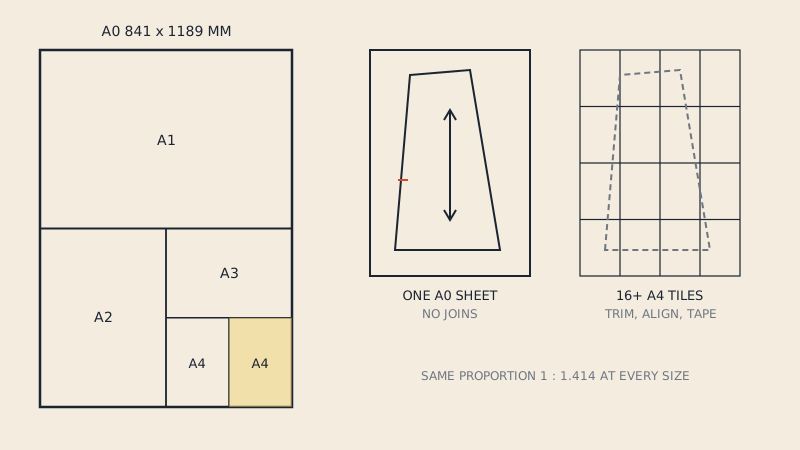
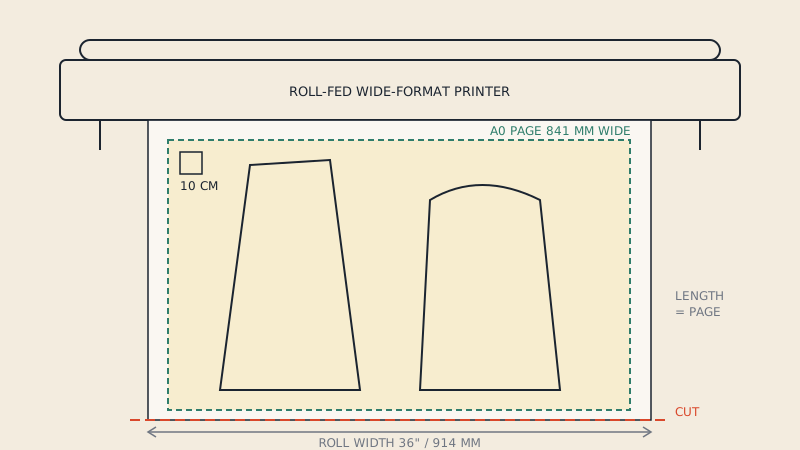
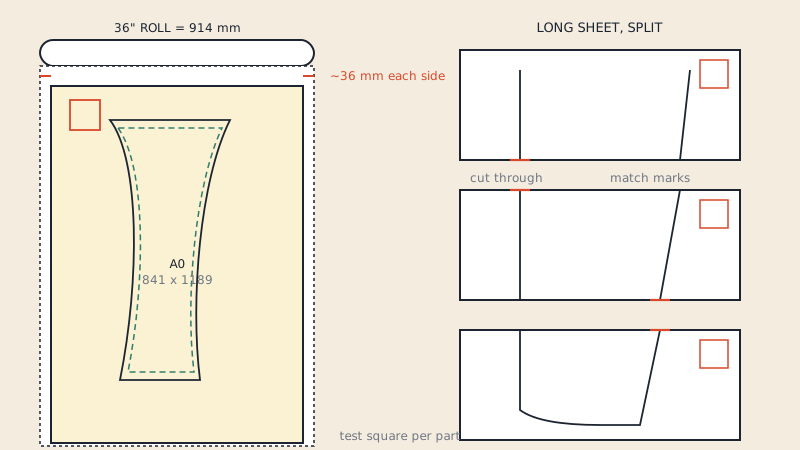
For sewing, the useful fact is that A0 is wide enough for the largest pieces of most garments, such as a trouser leg, a skirt panel or a coat front, without splitting them. "A0 pattern" has become shorthand for the large-format copy-shop file, even when a designer's file is a slightly different size or is meant for a 36" roll. North American readers should look at printing on a 36-inch roll, because a 36" (914 mm) roll is wider than A0 and that changes how files fit.
Step 1: check the file before you send it
A few minutes with the file saves a wasted print.
- Find the right file. Pattern bundles often include "A0", "copy shop", "large format" or "plotter" files. That is the one you want, not the A4 or Letter tiles.
- Check the page size. In Adobe Acrobat Reader, File > Properties shows the page size. It should read 841 × 1189 mm (or 33.1 × 46.8 in), or whatever size the designer states. Some A0 files are longer than A0 and need a roll printer rather than a cut-sheet A0 printer.
- Count the pages. Each page is one sheet. A two-page A0 file is two prints.
- Look for the test square. It is usually on the first sheet. You will measure it when you collect the print.
- Decide on layers. If the pattern has a layer per size and you want only yours, hide the other layers and save a copy, then open the copy to make sure it saved the way you see it. Many shops print the file exactly as it opens.
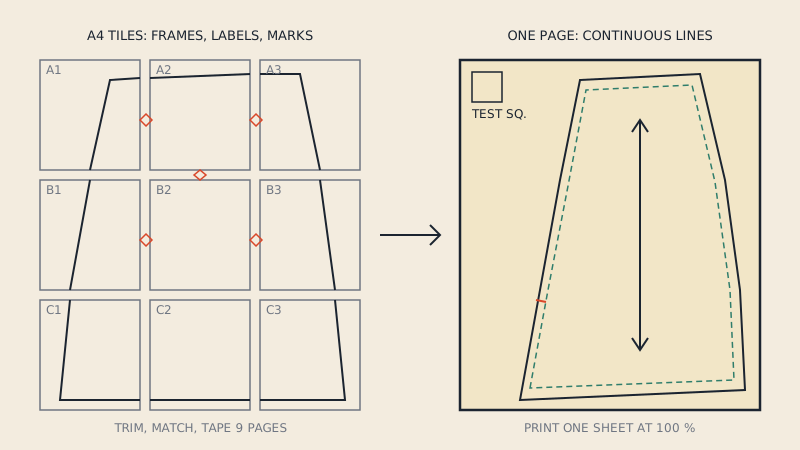
If your pattern came only as A4 or Letter tiles, there is no A0 file to send. The tiles can be assembled into one large sheet; see one-page PDF patterns.
Step 2: choose where to print
Places that print A0 fall into a few types:
- Local copy and print shops with a wide-format printer. Often the quickest for one or two sheets, sometimes while you wait.
- Reprographics and plan-printing shops that serve architects and engineers. They print large black-and-white drawings all day and are usually accurate and used to "print at 100 %" requests.
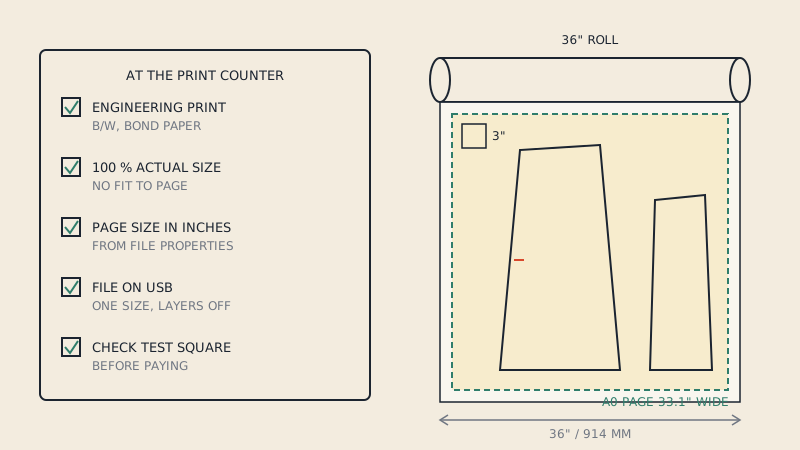
- Chain office stores with print counters. In North America this usually means engineering or blueprint printing on 36" rolls; printing at Staples, FedEx Office or Office Depot covers what to say there.
- Online print services that post rolled sheets. Useful when nothing is local; allow for delivery time.
- University and library print rooms, which sometimes offer plotter printing to the public.
A wider list, with what to check before you go, is in where to print sewing patterns.
Step 3: ask for the right thing
The shop's default settings are made for posters and drawings, not for patterns. Ask for:
- 100 % scale, no fit to page. Say it plainly; it is the single most important instruction.
- Black and white (monochrome) line printing, unless sizes are distinguished only by colour.
- Plain bond paper, typically around 80–90 g/m² (20–24 lb bond). Thicker or coated poster paper costs more and is no better to trace from.
- No lamination, mounting or trimming to a different size.
The exact wording and an email you can send in advance are in copy shop printing for sewing patterns.
Why black-and-white line plots are enough
A sewing pattern is lines and text. A black-and-white wide-format print, the kind used for building plans, reproduces those lines sharply and is commonly the cheapest option. Colour helps only when the designer uses colour as the sole way to tell sizes apart. If sizes also differ by dash pattern, or you hid the other sizes, black and white works.
Patterns with large solid fills (coloured backgrounds, shaded pieces) use much more toner or ink. Some shops price by coverage, so a file with grey pieces can cost more than the same file with outlines only.
What it costs: the factors
Prices vary too much between countries, cities and shops to quote a meaningful figure, so ask your shop for its price per sheet. What moves the price:
| Factor | Effect |
|---|---|
| Number of sheets | The main driver; a two-sheet pattern costs roughly twice a one-sheet pattern |
| Sheet length on a roll | Roll printers often charge by length or by area |
| Black and white vs colour | Colour is commonly several times more expensive |
| Ink or toner coverage | Heavy fills can be charged extra |
| Paper type | Bond paper is cheapest; photo or poster paper adds cost |
| Turnaround | Same-day or while-you-wait can cost more |
| Delivery | Online services add postage and a tube |
| Minimum charges | Some shops have a minimum order or file-handling fee |
Two ways to keep the cost down: print one size only, so the layout is less crowded and colour is unnecessary, and keep the pattern sheets for reuse by tracing your size rather than cutting the print.
Step 4: check the print before you leave
At the counter, or when the tube arrives:
- Measure the test square with a ruler in both directions. 10 cm should be 10 cm, within about 1 mm.
- Check that the edges of the sheet are not cropped: notches, labels and seam lines near the edge should be complete.
- Count the sheets against the page count of the file.
If the square is off, ask for a reprint at 100 %. The test square guide explains what a small error means for fit.
Storing A0 sheets
Rolled sheets curl. Roll them the other way for a few minutes before use, or store them rolled around a tube with the print facing out. Many sewists trace their size onto pattern paper and keep the A0 print as the master.
FAQ
What size is A0 for sewing patterns?
A0 is 841 × 1189 mm, about 33.1 × 46.8 inches, or one square metre. It is the size of 16 A4 sheets and is wide enough for the largest pieces of most garments.
Can I print an A0 pattern in colour?
Yes, but it is usually only worth it when sizes are told apart by colour alone. Black-and-white line printing is generally cheaper and reproduces pattern lines just as accurately.
What should I tell the shop when printing an A0 pattern?
Ask for the file printed at 100 % scale with no fit-to-page, in black and white on plain bond paper, one copy of each page. Mention that it is a sewing pattern and must print at exact size.
How much does it cost to print an A0 sewing pattern?
It depends on the shop, the country, the number of sheets and whether you print in colour. Ask for the price per A0 sheet in black and white; the number of pages in the file tells you how many sheets you need.
My A0 file is longer than 1189 mm. Is that a problem?
Not for a roll printer, which can print any length up to its limit. A shop that prints only cut A0 sheets cannot print it at full size, so ask for roll printing or choose a shop that has it.