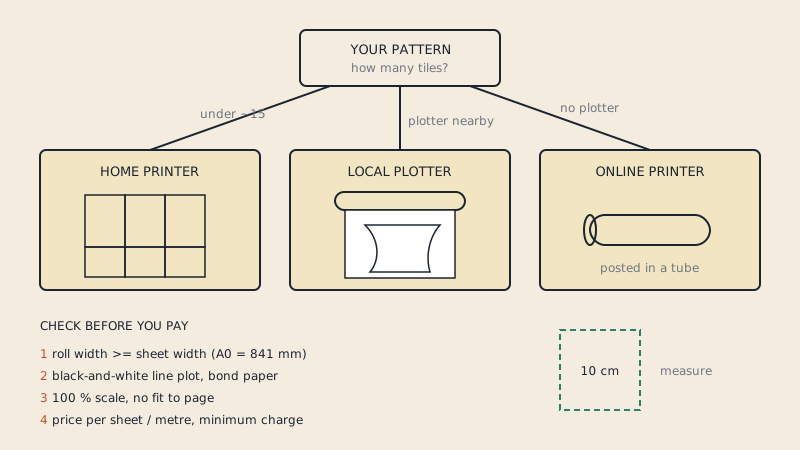
The best place to print a large sewing pattern is usually a place that prints architectural or engineering drawings: a reprographics studio, a copy shop with a wide-format plotter, or an online plan-printing service that posts the sheets to you. Big-box office stores and some public libraries can do it too, but not every branch has a plotter. Whatever you choose, ask for a black-and-white line plot at 100 % scale on plain bond paper, and bring a file whose sheet size matches the shop's roll.
This guide is about choosing the place. For the conversation at the counter itself, see what to ask a copy shop.
The five kinds of places that can print a pattern
Pattern sheets are large, mostly white and covered in thin lines. That is exactly what architects and engineers print every day, which is why the right shop is often not the one that advertises "printing" most loudly.
| Place | What they usually have | Good for | Watch out for |
|---|---|---|---|
| Reprographics / plan printing studio | Wide-format plotters, 24" and 36" (61 and 91 cm) rolls, sometimes wider | A0 and 36" sheets, many pages at once | May be closed on weekends; aimed at trade customers |
| Copy shop or print-and-ship store | One wide-format machine, sometimes only poster printers | Walk-in jobs, quick turnaround | Staff may default to "fit to page" or colour poster paper |
| Office-supply chain with print centre | Engineering prints on some branches | Convenience, opening hours | Equipment varies by branch, so call first |
| Online plan or pattern printing service | Large plotters, postal delivery | No shop nearby, repeat orders | Shipping time, minimum order, roll packaging |
| Public library or makerspace | Sometimes a plotter, often only A3/Tabloid | Small jobs, cheap test prints | Booking rules, limited sizes |
The chain stores in the US deserve their own note, because what they offer differs a lot between branches.
How to find one near you
Search terms matter. "Printing near me" returns flyer and photo shops. Better searches are:
- "plan printing" or "blueprint printing" plus your town
- "large format printing" or "wide format printing"
- "engineering prints" or "CAD plotting"
- "reprographics" (common in the UK, Australia and Europe)
- "A0 printing" outside North America, "36 inch printing" inside it
When you find a candidate, look at their price list or upload page. If it mentions plans, drawings, CAD or engineering, they almost certainly print plain line plots on a roll. If it only mentions posters, banners and canvas, they print photos on coated paper, which works but usually costs more and curls.
What to check before you send the file
A phone call or a short email saves a wasted trip. Check these five points.
1. Roll width
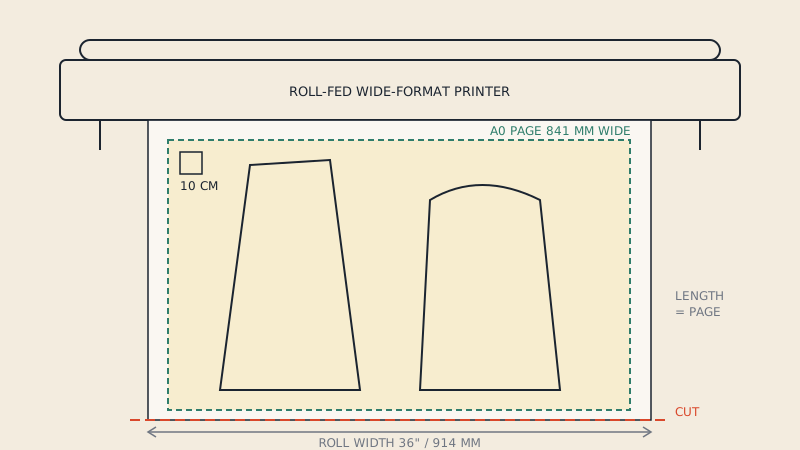
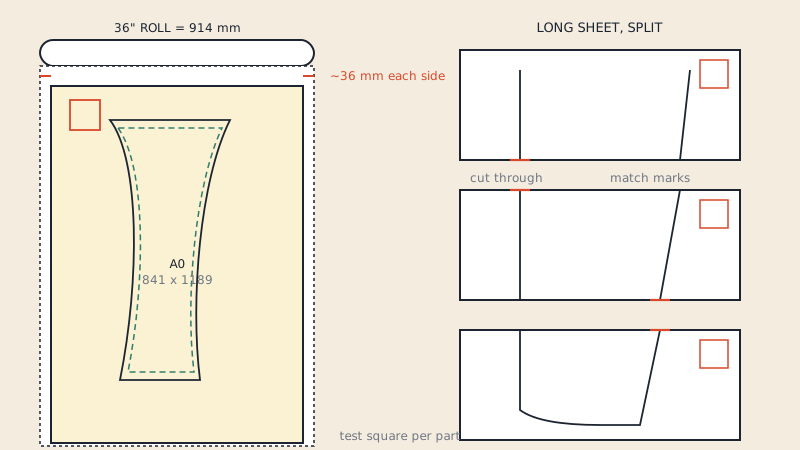
The roll width decides which file you can send. Most plan printers in Europe load 914 mm (36") or wider rolls and print A0 (841 × 1189 mm) without problems. In the US and Canada the common widths are 24", 36" and 42" (61, 91 and 107 cm). If your pattern sheet is A0, a 36" roll fits it with about 7 cm to spare. The details are in our guide to 36-inch roll printing.
2. Black-and-white line plot
Ask for monochrome or black-and-white printing on uncoated bond paper. Pattern lines are vector graphics, so a line plot is sharp and cheap. Colour is only worth paying for when the pattern uses colour to tell sizes apart and you have not switched off the other sizes in the PDF layers panel.
3. 100 % scale
Say it twice and write it on the order: print at 100 %, actual size, no fit to page, no scaling. A shop that prints posters may resize your file to fill the paper without asking. The test square on the sheet is how you check the result before you leave.
4. File format and size
Most shops accept PDF. Some online services want one page per file, others accept a multi-page PDF. Ask if they have a file size limit for email, and whether they prefer a USB stick or an upload link.
5. Price basis
Large-format jobs are priced per sheet, per running metre or foot of roll, or per square metre. Ask which one applies, and whether there is a minimum charge. Do not compare shops on poster prices; ask specifically for a black-and-white line drawing of your sheet size.
Make the file match the shop
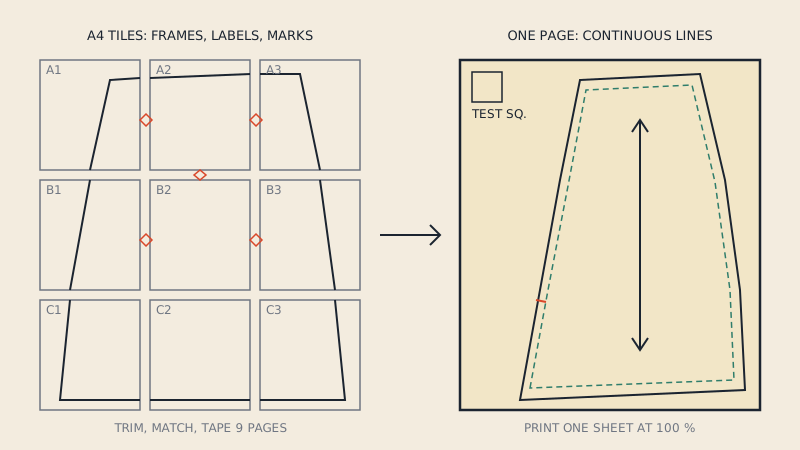
Many people arrive at the shop with the wrong file. The pattern came only as 30 or 40 A4 or US Letter tiles, and the shop cannot print those on a roll in a useful way. Printed one tile per sheet, you still have to tape them; printed several per roll width, the overlaps and margins no longer line up.
The fix is a single large sheet. Some pattern designers include a copy-shop file in A0 or 36" format; check the download folder for a file with "A0", "copy shop", "large format" or "plotter" in the name. If there is none, you can turn the tiles into one sheet. Our service builds a One Page copy-shop file from the tiles, along with A0 and smaller splits, each starting with test squares.
Also check the file for:
- Sheet size: open the document properties in your PDF reader and look at the page size. Compare it with the shop's roll width.
- Number of sheets: several A0 sheets are normal for a coat or a dress with many pieces.
- Only your size: if the pattern has layers, hide the sizes you do not need before printing, or export a copy with only your size visible.
Online printing services: when they win
If the nearest plotter is an hour away, an online service can be cheaper in total, even with postage. They suit:
- People in rural areas or small towns
- Repeat sewists who print several patterns at once
- Anyone printing very long sheets, such as a full-length coat or a gown with a train
They are less suitable when you need the pattern tomorrow. Most send the sheets rolled in a tube; ask for that rather than folded, since fold lines on pattern paper are hard to flatten and can distort a long sheet slightly when you weigh it down.
Libraries, schools and makerspaces
Some public libraries, universities and makerspaces have plotters for students and members. Prices can be low, but access often depends on membership or booking. Many only have A3 or Tabloid (11 × 17") printers, which still save you time compared with A4: about a quarter as many sheets to tape. If they have a plotter, ask whether it is set up for paper rolls or only for cut sheets.
Cheapest overall: compare the whole job
The cheapest print is not always the cheapest pattern. Add up:
- The print itself (per sheet or per metre)
- Travel or postage
- Your time taping tiles, if you print at home instead
- The cost of a mistake: a reprint after a scaling error, or a garment cut from a pattern that was 3 % too small
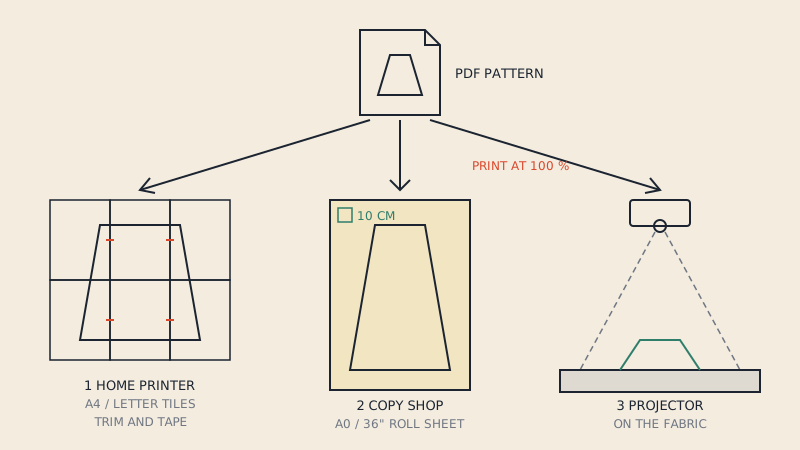
For a small top with a dozen A4 pages, home printing is often the sensible choice. For a coat, a jumpsuit or anything with long pieces, a single sheet from a plotter saves hours and removes assembly errors. Our overview of the three printing routes compares home, copy shop and projector in more detail.
A short message you can send
When you contact a shop for the first time, a short message gets a clear answer:
Hello, I would like to print a sewing pattern. The PDF has 2 sheets, each 841 × 1189 mm (A0). Black-and-white line drawing on plain bond paper, printed at 100 % scale with no resizing. Can you print this, on which roll width, and what is the price per sheet?
Replace the sheet count and size with your own. If the answer comes back with poster paper or photo prices, ask again for an engineering or line-drawing print.
FAQ
Where can I print an A0 sewing pattern near me?
Look for reprographics studios, plan or blueprint printers and copy shops with a wide-format plotter. Search for "plan printing" or "large format printing" with your town name, and confirm they have a roll at least 36" (914 mm) wide.
Can a regular print shop print sewing patterns?
Yes, if it has a wide-format plotter. Ask for a black-and-white line print on bond paper at 100 % scale; poster or photo printing works too but usually costs more.
Is it cheaper to print sewing patterns online?
It can be, especially if you print several patterns at once or have no plotter nearby. Compare the full cost including postage and the minimum order, and allow for delivery time.
What file do I bring to the copy shop?
Bring a PDF with one large sheet per page, sized to fit the shop's roll, such as A0 or a 36" wide sheet. A4 or Letter tiles are not suitable for a plotter; convert them into a single copy-shop sheet first.