A dart is a wedge of fabric folded out and stitched so that a flat piece takes on a three-dimensional shape: over the bust, around the shoulder blade, from the waist to the hip. In pattern making a dart has three defining parts, two legs, a point and the take-up between the legs, and it can be moved anywhere around the body point it serves without changing the fit. Marking it precisely, shaping the seam allowance at its base and sewing it to a smooth point are what make it disappear into the garment.
Anatomy of a dart
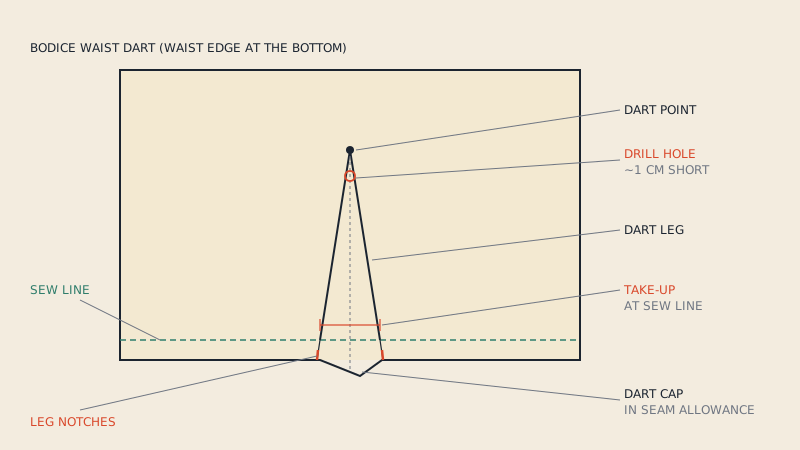
| Part | What it is | How it is marked on a pattern |
|---|---|---|
| Legs | The two stitching lines that converge to the point | Two lines from the edge to the point, sometimes dashed |
| Point (tip, vanishing point) | Where stitching ends and the fold runs out | A dot, circle or the meeting of the legs |
| Take-up (intake) | Width of fabric folded out, measured between the legs at the sew line | Not drawn as such; the distance between the legs |
| Centre line (fold line) | The line along which the dart is folded | Often a fine line from the base to the point |
| Dart cap (dart end, dart shape) | The small peak of seam allowance at the base of the dart | The cut line bulges out at the dart |
| Leg notches | Mark where the legs meet the cut edge | Notches on the cut line |
| Drill hole | Industrial mark for the point | A small hole or circle short of the point |
The dart point is not the same as the body point it serves. A bust dart aims at the bust apex but usually stops short of it, so the fullness is released smoothly rather than as a cone. A distance of roughly 1.5–3 cm (5/8"–1 1/8") from the apex is common for bust darts, more for larger cup sizes and softer fabrics; the pattern maker sets it, and you can adjust it in a fitting.
Common dart types
- Single-pointed dart: one wide end at a seam, one point. Waist darts on skirts and trousers, bust darts from the side seam, shoulder darts.
- Double-pointed dart (fisheye, contour dart): wide in the middle, pointed at both ends. Used in one-piece dresses and fitted blouses without a waist seam, shaping both bust and hip from the waist.
- Curved dart: legs follow a curve, for example a French dart running diagonally from the lower side seam towards the bust.
- Neck and shoulder darts: small darts that shape over the shoulder blade or around the neck.
- Elbow dart: small dart or set of darts on a fitted two-piece sleeve.
The type is a design decision; the underlying shaping is the same. Which leads to the most useful idea in dart work.
Moving darts: the pivot principle
A dart that radiates from a body point can be rotated to any other position around that point. A bust dart at the side seam can become a shoulder dart, an armhole dart, a neckline dart or a waist dart, and the garment will still fit the same body, because the total amount of shaping around the apex stays the same.
There are two classic methods.
Slash and spread
- Trace the piece. Mark the bust apex (or the relevant body point).
- Draw the new dart position: a line from the edge where you want the dart to the apex.
- Cut along the new line up to, but not through, the apex.
- Close the old dart: fold its legs together and tape. The cut opens into a new wedge.
- Tape the piece onto fresh paper and redraw the new dart legs, shortening the point back from the apex.
- True the edge: fold the new dart closed and redraw the cut line smoothly.
Pivot
- Mark the apex and the new dart position on the edge.
- Trace the part of the piece from the old dart leg round to the new dart position.
- Hold a pin or awl on the apex and pivot the paper until the old dart's legs meet.
- Trace the rest of the piece from the new position round to the other old leg.
- The gap left at the new position is the new dart.
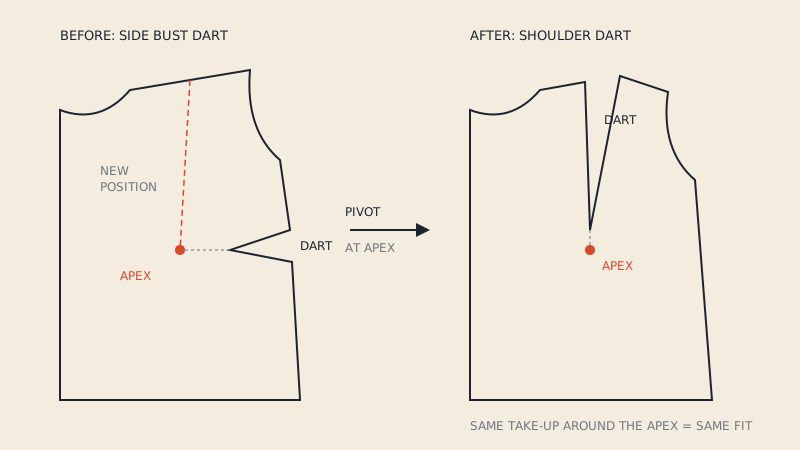
The same principle turns darts into other forms of shaping: split between two smaller darts, transferred into a princess seam, released as gathers, pleats or tucks, or absorbed into a yoke seam.
Seam allowance at a dart
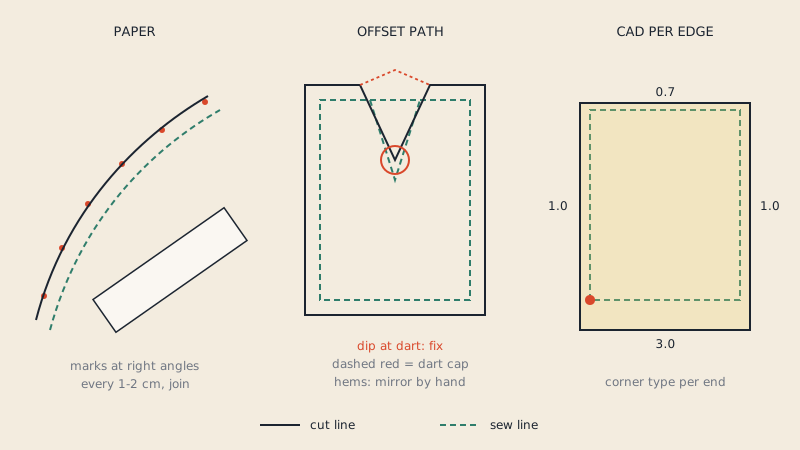
At the base of a dart, the cut edge cannot simply run straight across. When the dart is folded and pressed to one side, the fabric of the dart must reach the edge of the seam allowance, or the seam will have a notch-shaped gap.
The fix is the dart cap:
- Add seam allowance to the piece as usual, but leave the area over the dart open.
- Fold the dart closed along its legs, and fold it in the direction it will be pressed (vertical darts usually towards centre front or centre back, horizontal darts usually downward).
- With the dart folded, draw or cut the seam allowance edge straight across.
- Unfold. The edge now has a small peak over the dart: that is the dart cap.
How to add seam allowance around corners and darts in different tools is in how to add seam allowance to a pattern, and the general widths are in the seam allowance guide.
Marking a dart on fabric
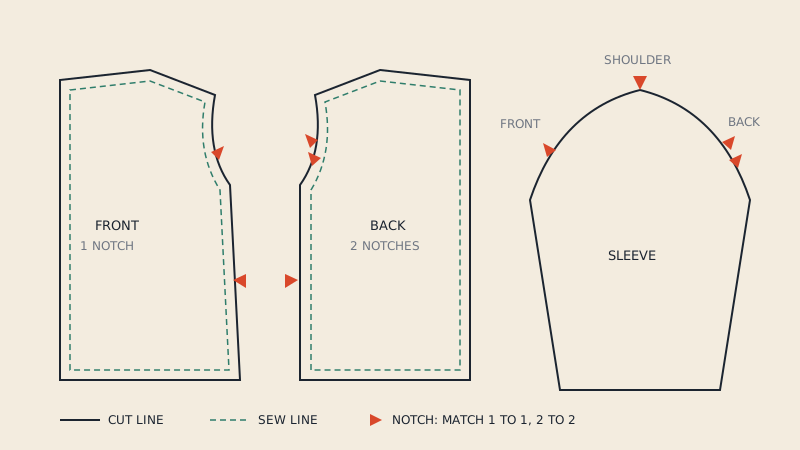
- Cut the leg notches at the cut edge, as a short snip or an outward notch. These two marks set the take-up; without them the dart will be the wrong width. Notch methods are covered in notches in sewing patterns.
- Mark the point. Use a tailor's tack, a chalk dot or a pin through both layers. Industrial patterns use a drill hole a little short of the point, commonly about 1 cm (3/8"), so the hole is hidden inside the stitched dart.
- Mark the legs if needed. For long or curved darts, mark the legs with chalk or tracing paper and a wheel; for short straight darts, the notches and point are enough.
- Mark both layers when cutting a pair, so left and right darts match.
Sewing a dart
- Fold the dart right sides together, matching the leg notches and placing a pin through the point.
- Stitch from the wide end towards the point, along the leg.
- Taper the last 1–2 cm so the final stitches run right along the fold, almost parallel to it. A dart that ends abruptly makes a dimple.
- Do not backstitch at the point. Leave thread tails and tie them, or sew a few stitches off the fold and trim.
- Press over a tailor's ham, first flat as sewn, then to one side. On thick fabric, slash a wide dart along the fold and press it open.
Double-pointed darts are sewn from the middle out to each point, or from one point to the other in one pass, tapering at both ends. Clip the fold at the widest point so the dart lies flat.
Darts in CAD and DXF files
In pattern CAD a dart is usually a special object: you define the legs, the point, the fold direction, and the program builds the dart cap and the seam allowance automatically. You can rotate it with a dart manipulation tool, which is the digital pivot method.
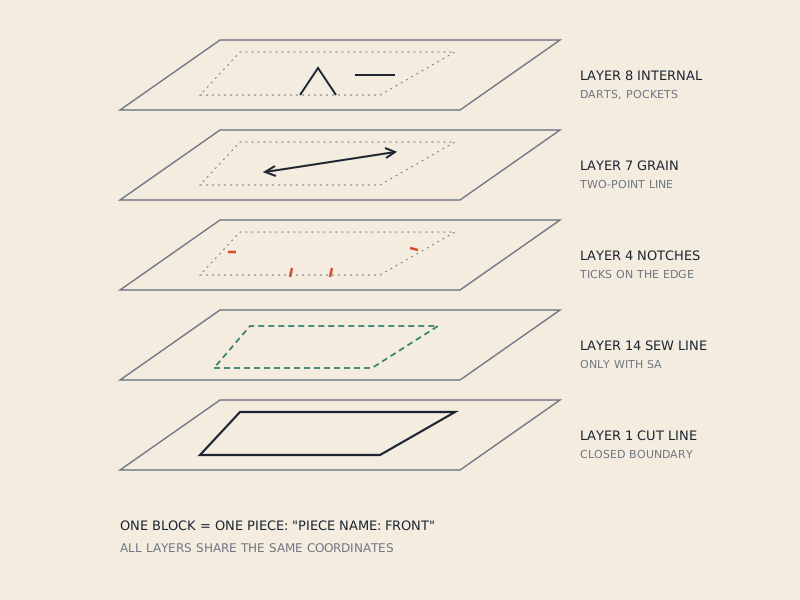
When patterns are exchanged as DXF AAMA, that object is broken down into standard elements:
| Dart element | Where it goes in DXF AAMA |
|---|---|
| Cut line with dart cap | Layer 1, as part of the piece boundary |
| Sew line around the dart base (if the pattern has seam allowance) | Layer 14 |
| Dart legs and centre line | Layer 8, internal lines |
| Leg notches | Layer 4 |
| Drill hole at the point | Layer 13 |
Different CAD programs read these differently: some reconstruct a dart object, others keep the legs as plain internal lines. Check after import that the legs and point are where you expect, and remember that in 3D software a dart drawn only as an internal line will not sew itself closed; you have to define it as a dart or as seams. The full layer list is in the AAMA DXF layers, one by one.
When we convert a PDF pattern, darts printed on the piece are written as internal lines on layer 8, along with buttonholes and pocket placements. Our converter shows each detected piece in the free preview, so you can check that darts were found before buying.
FAQ
What are the parts of a dart?
A dart has two legs (the stitching lines), a point where they meet, and the take-up, the width folded out between the legs. Patterns also show leg notches at the cut edge, a dot or drill hole at the point and a dart cap in the seam allowance.
Why does the dart point stop short of the bust apex?
So that the fullness is released gradually over the curve of the body rather than ending in a visible point. A distance of roughly 1.5–3 cm (5/8"–1 1/8") from the apex is common for bust darts, adjusted in fitting.
Can you move a dart without changing the fit?
Yes, as long as the dart still radiates from the same body point and keeps the same total take-up. Use slash and spread or the pivot method to rotate it, or convert it into a seam, gathers or tucks.
What is a dart cap?
A dart cap is the small peak in the cut edge at the base of a dart. It is created by folding the dart closed in its pressing direction before cutting the seam allowance, so the edge is straight when the dart is sewn and pressed.
How are darts stored in a DXF AAMA file?
The cut line with its dart cap is on layer 1, dart legs are internal lines on layer 8, leg notches on layer 4 and the drill hole at the point on layer 13. Some CAD programs rebuild a dart object on import; others keep plain lines.