Seam allowance is the strip of fabric between the cut edge and the stitching line. There is no single correct width: home sewing patterns in the US commonly use 1.5 cm (5/8"), many European and indie patterns and most industry patterns use 1 cm (3/8"), and tight curves such as necklines often get only 0.6–0.7 cm (1/4"). Hems, zips and fitting seams get more. What matters most is that the width is consistent with the instructions, and that corners and darts are shaped so the allowance lies flat once sewn.
This is the overview. The procedure for drawing allowance on paper and in software is in how to add seam allowance, and telling whether a pattern already has it is covered in seam allowance included or not.
Cut line, sew line, net and gross
Every pattern piece has two outlines, whether they are both drawn or not:
- Sew line (stitching line, seam line): where the needle goes. This is the true shape of the garment.
- Cut line: the outer edge, where the scissors go. The distance between the two is the seam allowance.
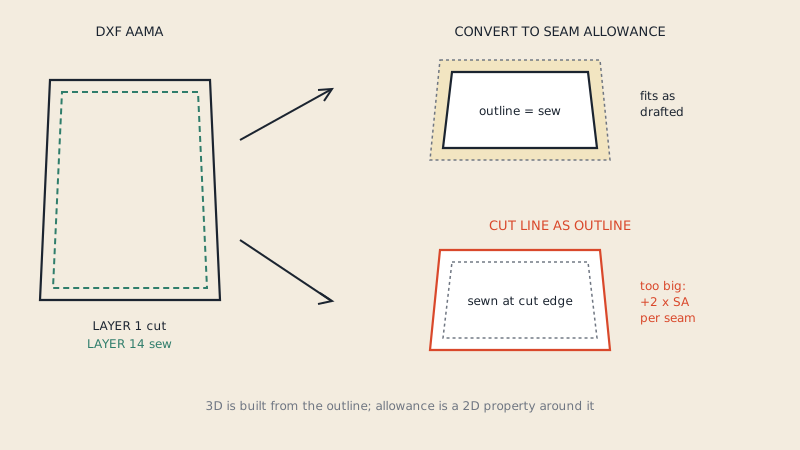
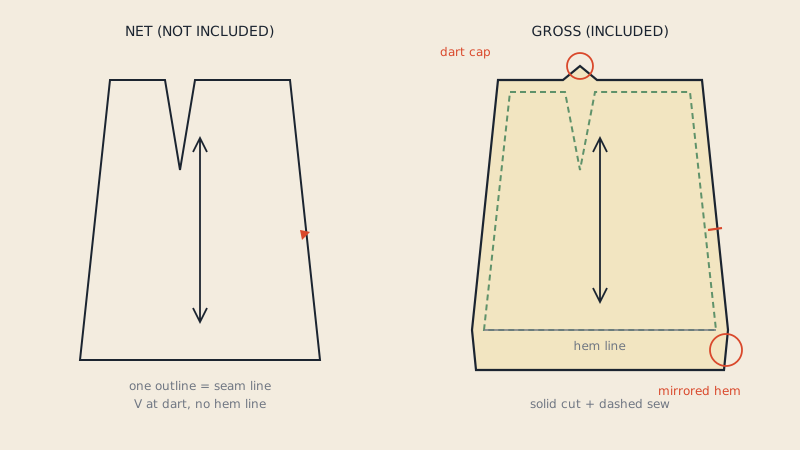
A pattern with only the sew line is a net pattern; you add allowance when cutting. A pattern drawn to the cut line with allowance built in is a gross pattern. Many pattern CAD systems keep both: in DXF AAMA, the cut line is on layer 1 and the sew line on layer 14. Why that matters for conversion is explained in PDF to DXF with or without seam allowance.
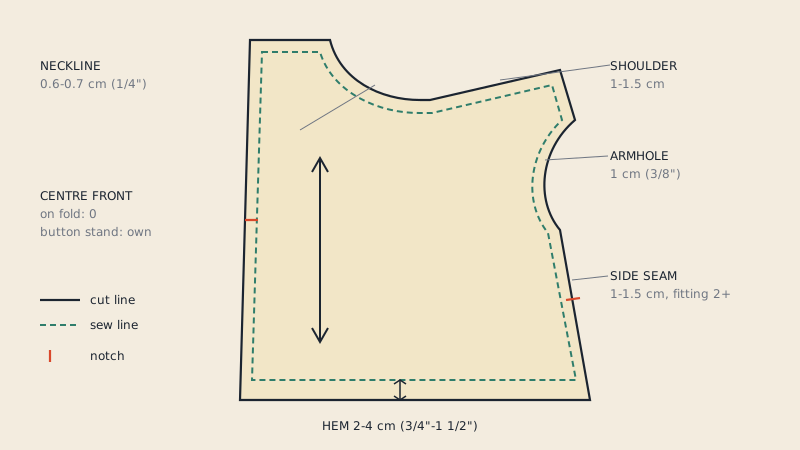
How much: typical widths by seam
The table shows common values. They are conventions, not standards; individual patterns and factories vary.
| Seam or edge | Common width | Imperial | Why |
|---|---|---|---|
| General seams, home patterns (US style) | 1.5 cm | 5/8" | Room for fitting changes and for beginners |
| General seams, industry and many EU/indie patterns | 1 cm | 3/8" | Less bulk, faster to sew, less fabric |
| Overlocked/serged seams | 0.6–1 cm | 1/4"–3/8" | Matches typical overlocker cutting width |
| Necklines, armholes in facings, collars | 0.6–0.7 cm | 1/4" | Tight curves turn smoothly with less clipping |
| Centre back with zip | 1.5–2 cm | 5/8"–3/4" | Zip tape and invisible-zip feet need width |
| Fitting seams (side, centre back in tailoring) | 2–3 cm | 3/4"–1 1/8" | Allows letting out later |
| Hems, tops and dresses | 2–4 cm | 3/4"–1 1/2" | Weight and a clean turn |
| Hems, trousers and jackets | 3–5 cm | 1 1/8"–2" | Length adjustment, drape |
| Knit hems | 2–2.5 cm | 3/4"–1" | Twin needle or coverstitch |
| French seams | 1.5 cm total | 5/8" | Two passes: narrow, then enclosed |
By pattern style and region
Conventions differ by where and for whom a pattern was made:
- Commercial home patterns from US companies traditionally include 1.5 cm (5/8") on most seams.
- Many indie designers use 1 cm (3/8") or 1.25 cm (1/2"), and state it on the instructions.
- Some European sewing magazines and many Japanese pattern books print patterns without allowance; the reader adds it when tracing.
- Industry patterns for production usually include allowance and vary it seam by seam, often 1 cm on main seams and less on curves and facings.
Because of this variety, never assume. Read the instruction page or measure; how to tell is in the sibling article on included or not.
Where: allowance follows the construction
The width on each edge depends on how that edge is finished, not on the piece as a whole.
- Edges finished by a facing or binding: narrow, to keep the curve smooth.
- Edges sewn and pressed open: wide enough to press flat, usually 1–1.5 cm.
- Edges overlocked together: matched to the overlocker width.
- Edges that will be bound or edge-finished with no seam: sometimes zero, as on a bias-bound neckline cut to the finished edge.
- Hems: whatever the hem method needs, from a 0.6 cm rolled hem to a 5 cm trouser hem.
- Pockets, plackets and waistbands: often their own widths for folds and turn-backs.
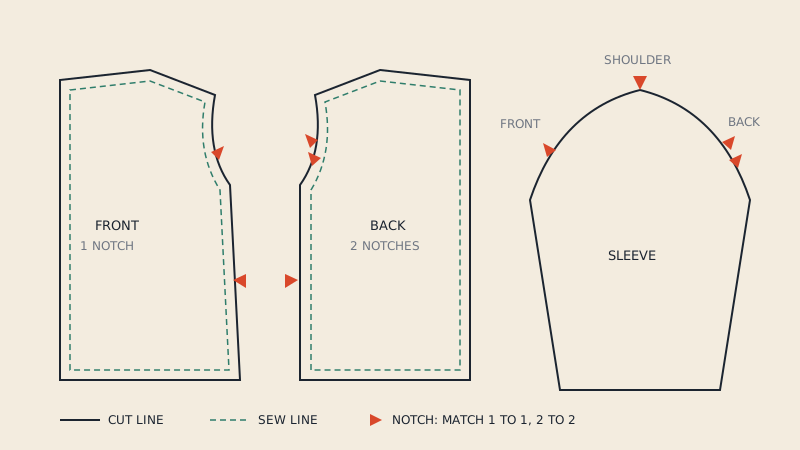
A good pattern uses the same width on both edges of a seam. If a front side seam has 1.5 cm and the back side seam 1 cm, the notches and the stitching line still meet only if you sew at the correct distance on each piece, which is easy to get wrong.
How: curves, corners and darts
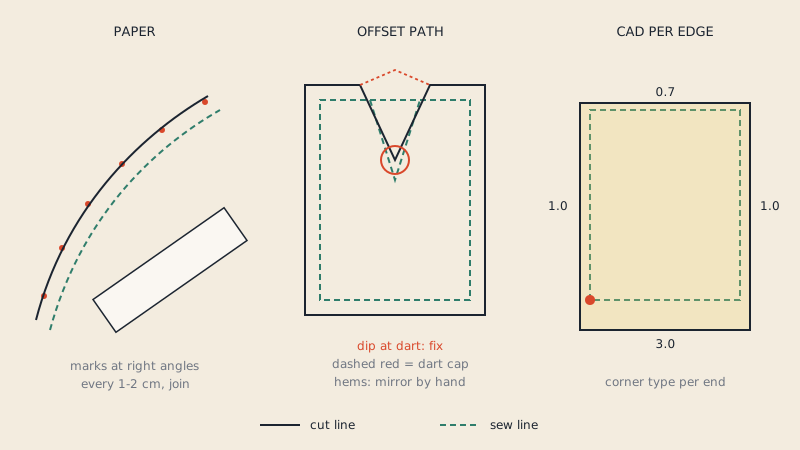
Adding allowance along a straight edge is trivial: a parallel line. The skill is in the places where the shape changes.
Curves
Allowance on a curve is a true offset: every point is the same distance from the sew line, measured at right angles. On a concave curve such as a neckline, the cut edge is shorter than the sew line; on a convex curve such as a sleeve cap, it is longer. This is why wide allowance on tight curves is a problem: a 1.5 cm allowance on a neckline must stretch when the seam is turned, so it has to be clipped heavily. A narrower allowance reduces the difference.
Corners at seam ends
Where a seam meets a hem or another seam at an angle, the allowance end must be shaped so it matches the piece it will be sewn or folded against. The usual rule: extend the cut line so that, when the seam is pressed or the hem is turned, the allowance lies exactly on the neighbouring allowance.
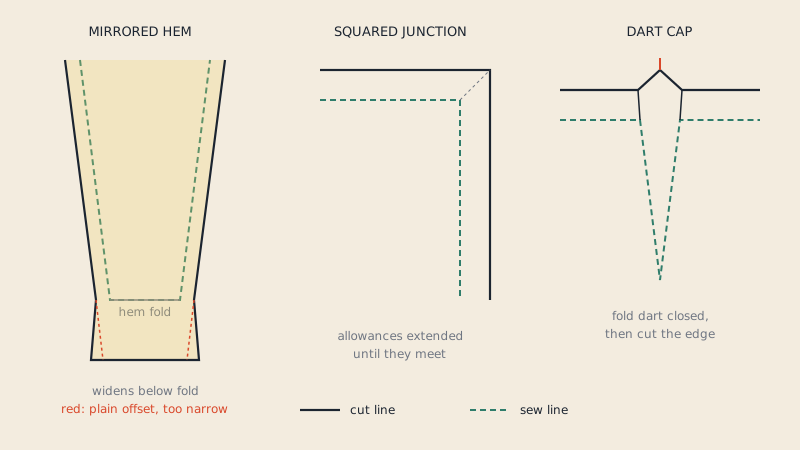
- Hem corner on a tapered leg or flared skirt: the hem allowance is mirrored across the hem line. If the side seam narrows towards the hem, the folded-up hem must widen back out, otherwise it is too narrow to fold flat.
- Square ends: at most seam junctions the two allowances are simply extended until they intersect, giving a squared corner.
- Cut-off corners: in industry, very sharp corners are often trimmed square across the point to save bulk and to make cutting easier.
Darts
A dart closes up when sewn. The allowance at the dart must be the shape of the cut edge with the dart closed, which gives the small peak (the dart cap) you see on many patterns where a dart meets an edge. The traditional method is to fold the dart closed on the paper in its pressing direction, then cut the allowance. Without the cap, the edge has a notch-shaped dip after the dart is sewn.
Notches and seam allowance
Notches sit on the cut edge and mark points on the sew line. When allowance is added, the notches move outwards to the new edge but stay on the same perpendicular. A notch should be shorter than the allowance, so it never cuts into the stitching line; with a 1 cm allowance, notches of about 0.5 cm are common. More on this in notches in sewing patterns.
Seam allowance in digital patterns
In CAD and 3D software, allowance is usually stored as a property of each edge rather than as a separate drawn line, so it can be changed later without redrawing. In 3D simulation the garment is usually sewn on the sew line, so knowing which outline you imported matters; see seam allowance in CLO3D.
When converting a PDF pattern to DXF, the cut line and sew line are taken as they are drawn in the PDF. Our preview shows whether seam allowance was detected for each piece before you pay; the service does not add allowance to net patterns.
FAQ
What is the standard seam allowance?
There is no single standard. US home patterns commonly use 1.5 cm (5/8"), while industry and many European and indie patterns use 1 cm (3/8"). Always check the instructions of the pattern you are using.
Why do necklines have a smaller seam allowance?
A narrow allowance of about 0.6–0.7 cm (1/4") on tight curves turns and presses smoothly with little or no clipping. Wide allowance on a concave curve has to stretch when turned, which causes ripples.
Why is the hem allowance shaped at the corner?
When a seam narrows towards the hem, the folded-up hem has to widen back out to lie flat against the garment. Mirroring the hem allowance across the hem line gives that shape.
What is a dart cap on a pattern?
It is the small peak in the cut edge where a dart meets the seam. It is shaped by folding the dart closed before cutting, so the edge is straight once the dart is sewn.
Should both sides of a seam have the same seam allowance?
Usually yes. Matching widths on both edges let you align the cut edges and sew at one distance; different widths are used only for special seams such as flat-felled seams.