Seamly2D and Valentina are two open-source parametric pattern drafting programs that grew from the same code. Since the 2017 split they have developed separately: Seamly2D ships free binaries with date-based releases and an active community forum, while Valentina, since version 1.0 in 2025, distributes its official installers through a paid subscription while the source code stays under the GPL. For a home sewist or student who wants something free to download and use today, that difference often decides it; for a user who wants commercial support and Valentina's newer export and layout work, the subscription may be worth it.
Both draft the same way and both export the formats pattern makers need. The details below are what separates them.
How one project became two
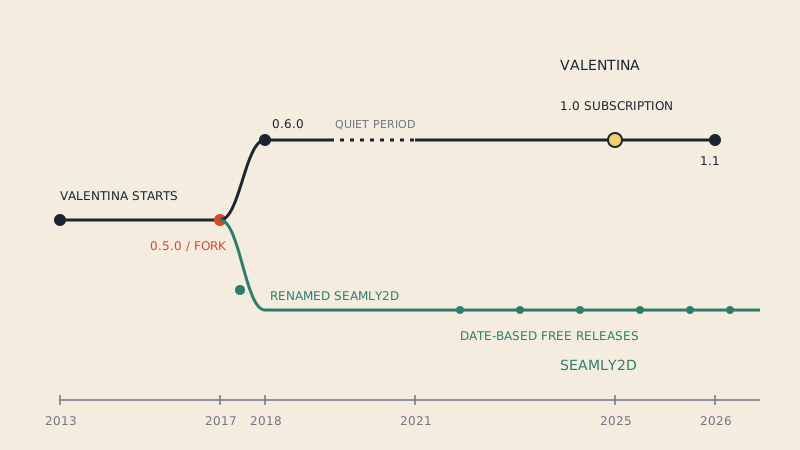
Valentina was started in 2013 by Roman Telezhynskyi, who wrote the code, and Susan Spencer, who worked on community, publicity and finances. After Valentina 0.5.0 in May 2017, the two parted ways. Spencer's branch was rebranded as Seamly2D later that year; Telezhynskyi continued Valentina on his own, releasing 0.6.0 in October 2018.
Valentina then had a quiet period before development picked up again in the early 2020s, reaching 1.0 in 2025 and starting a 1.1 branch in 2026. Seamly2D has kept releasing throughout, with version numbers based on the release date (for example 2026 builds packaged by Homebrew and Linux distributions).
Accounts of the split differ in tone depending on who tells them. What matters for a user now is that the two programs are separate projects with separate file formats, and neither tries to stay compatible with the other's recent files.
What they still have in common
Before the differences, it helps to know how much is shared. Both programs work the same way at the core:
- Parametric drafting. Points are built from other points with distances, angles and formulas that reference body measurements and your own increments.
- Separate measurement files. Individual measurements for made-to-measure, and multi-size tables for standard size runs.
- Three stages. Draft the construction, define pattern pieces with seam allowance, notches, grain lines and labels, then lay the pieces out for export.
- Qt-based desktop apps for Windows, macOS and Linux, under GPL licences.
So a tutorial written for one is often usable for the other, especially for drafting basics. Where tutorials diverge is in the newer features each project added after 2017, the menus that were reorganised, and the file formats, which no longer match.
Side by side
| Criterion | Seamly2D | Valentina |
|---|---|---|
| Licence | GPLv3+ | GPLv3 |
| Official binaries | Free downloads | Paid subscription from 1.0; older binaries archived free |
| Source code | Public (GitHub) | Public (GitLab) |
| Platforms | Windows 10/11 (incl. ARM64 build), macOS, Linux (Flathub, AppImage) | Windows (1.1 requires Windows 10 or newer), macOS, Linux |
| Measurement app | SeamlyMe | Tape |
| Layout tool | Built in | Built in, plus the separate Puzzle app for layouts and tiles |
| Pattern file | .sm2d | .val |
| Measurement files | .smis (individual), .smms (multi-size) | .vit (individual), .vst (multi-size) |
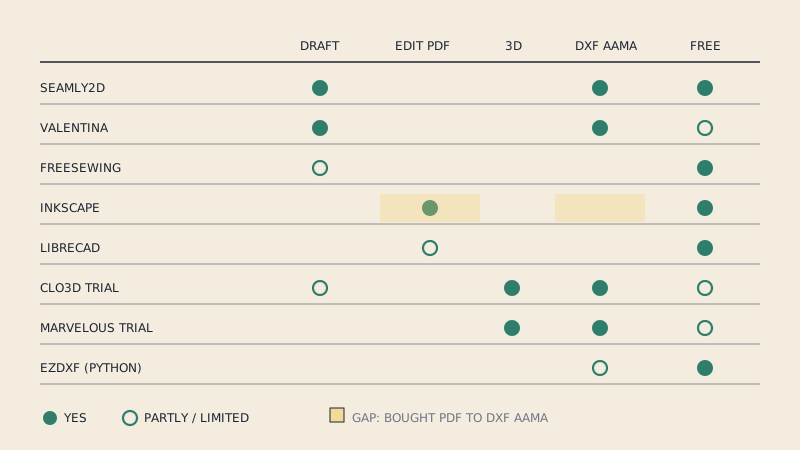
| DXF export | Plain DXF and AAMA variants, R10 to 2013 | DXF AAMA and ASTM |
| Other exports | PDF (incl. tiled), SVG and image formats | PDF (incl. tiled), SVG, PLT, CSV |
| Support | Community forum and wiki | Commercial support via subscription; community |
Feature lists change with every release of both programs, so treat the table as a starting point and check the current release notes.
File compatibility between the two
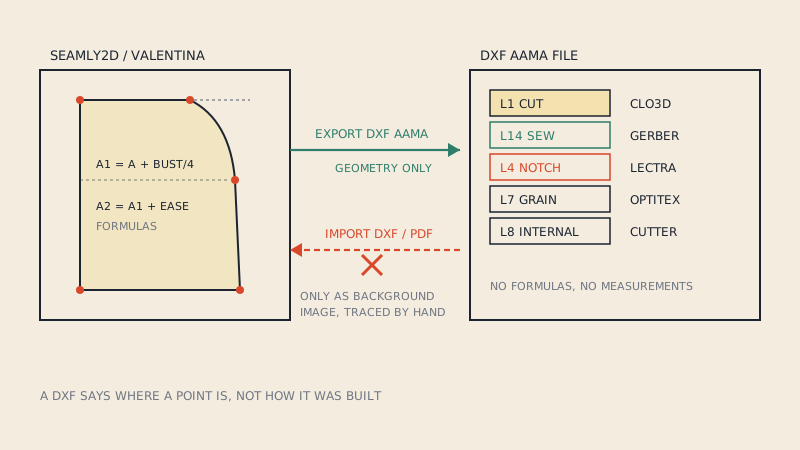
This is the question that catches people out. Seamly2D can open Valentina patterns from before the fork, roughly up to the 0.6 file version, and saves them in its own extensions. Files from later Valentina versions generally do not open in Seamly2D, and the Seamly2D maintainers have said they are not trying to keep compatibility. Going the other way is not supported either.
Practical consequences:
- If you have an old library of .val patterns, Seamly2D may open them; test a few before committing.
- If someone sends you a pattern made in a recent version of either program, you need that program.
- To exchange patterns with people using the other program, or with anyone using commercial CAD, export DXF AAMA. The pattern stops being parametric in the process; Seamly2D and Valentina DXF export explains why and how to get a good file.
Honest pros and cons
Seamly2D
- Pros: free official binaries for all major platforms; regular releases; an active forum where questions from beginners get answered; a wiki with tutorials.
- Cons: the interface still shows its origins as an engineer's tool; DXF AAMA export has had reported issues with label text in 2026 releases; small volunteer team, so fixes depend on contributors' time.
Valentina
- Pros: active development by its original author; Valentina 1.0 focused on stability and polish and added PLT export, improved DXF AAMA/ASTM compatibility and plotter-oriented tile PDFs; a dedicated layout tool (Puzzle); commercial support available.
- Cons: current official installers require a subscription, so "free" applies to the source code and to older archived binaries; one main developer; recent .val files do not open in Seamly2D.
Building from source is always possible for both, and some Linux distributions package them, but most users on Windows and macOS rely on official installers. That is why the binary policy matters more in practice than the licence.
Which one to choose
| You are... | A reasonable choice | Why |
|---|---|---|
| A home sewist wanting free made-to-measure blocks | Seamly2D | Free download, beginner help on the forum |
| A student following a course | Whatever the course uses | Tutorials and files will match |
| A pattern maker needing plotter output and support | Valentina | PLT export, Puzzle, commercial support |
| Someone with an old .val library | Try Seamly2D first, keep a pre-fork Valentina as fallback | Pre-fork files open in both |
| A small brand handing files to factories | Either, exporting DXF AAMA | The factory only sees the DXF |
Neither replaces industry CAD for production grading and markers, and neither does 3D. If you are comparing a wider set of free tools, free pattern making software covers the alternatives, and open-source tools for pattern makers goes beyond drafting programs.
What neither program does
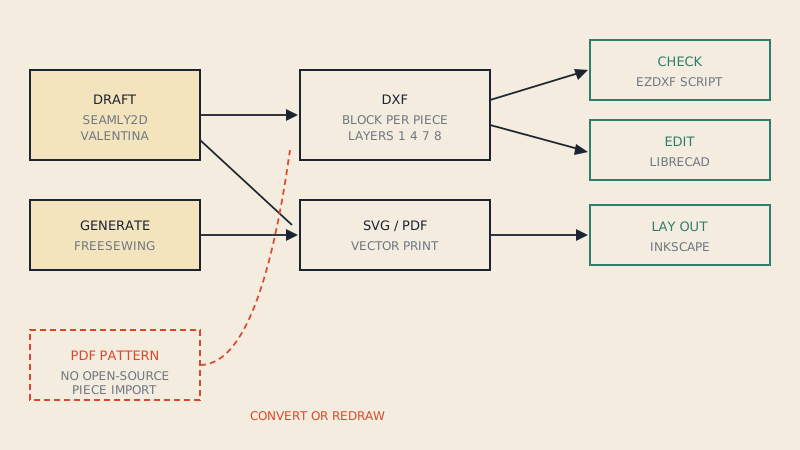
Both draft patterns; neither imports them. If your starting point is a PDF pattern you bought and your goal is a DXF for 3D or a cutter, a parametric drafting program is the wrong tool. A vector PDF can be converted to DXF AAMA directly, keeping cut and sew lines, notches, grain lines and internal lines for the size you choose.
FAQ
Is Seamly2D a fork of Valentina?
Yes. Seamly2D began as a fork of Valentina in 2017, after Valentina 0.5.0, and the two have been developed as separate projects since then.
Is Valentina still free?
The source code is free under the GPLv3. Since version 1.0, official installers are distributed through a paid subscription, while older binaries were archived and remain free.
Can Seamly2D open Valentina files?
It can open Valentina patterns made before the fork, roughly up to the 0.6 file version. Patterns from later Valentina versions generally do not open, and the projects do not aim for compatibility.
Which is better for beginners, Seamly2D or Valentina?
For someone who wants a free download and community help, Seamly2D is the easier start. Valentina suits users who want its newer export and layout features and are fine with a subscription.
Do Seamly2D and Valentina export DXF AAMA?
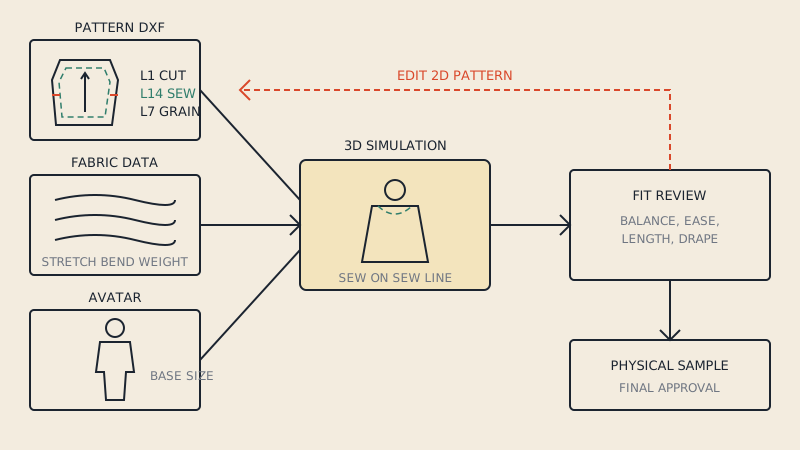
Yes. Both export DXF in the AAMA flavour, and Valentina also offers ASTM. That is the way to move a pattern from either program into CLO3D or industry CAD.