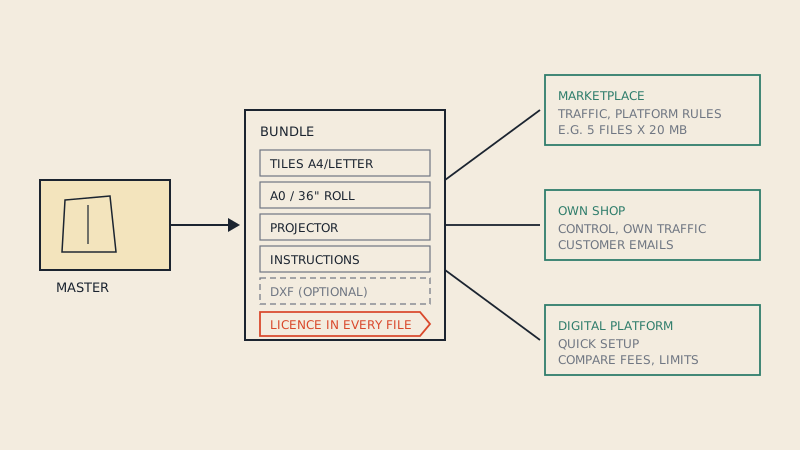
To sell sewing patterns online you need three things settled before your first listing: a file bundle that buyers can print in their country (tiled A4/Letter, A0, projector, instructions), a platform that delivers digital files reliably (a marketplace such as Etsy, your own shop, or both), and a written licence that says what buyers may and may not do with the pattern. Piracy is a cost of doing business, so plan for it rather than hoping to avoid it.
This article is about the business side. Making the files themselves is covered in how to make PDF sewing patterns to sell, and the release checks in the PDF pattern file checklist.
What you are actually selling
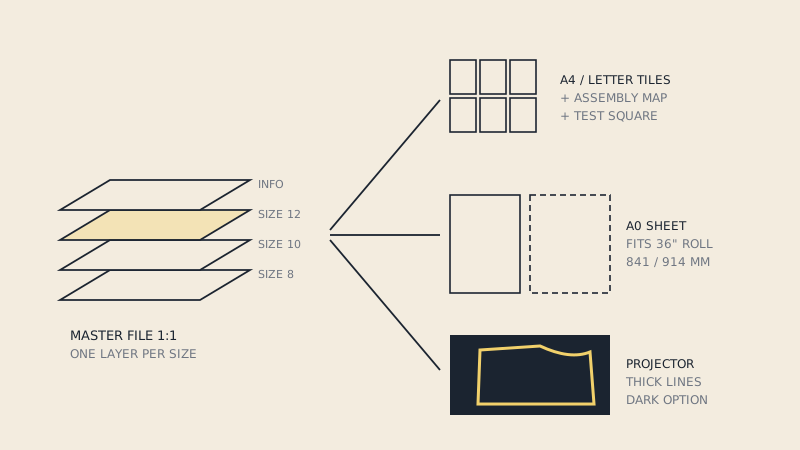
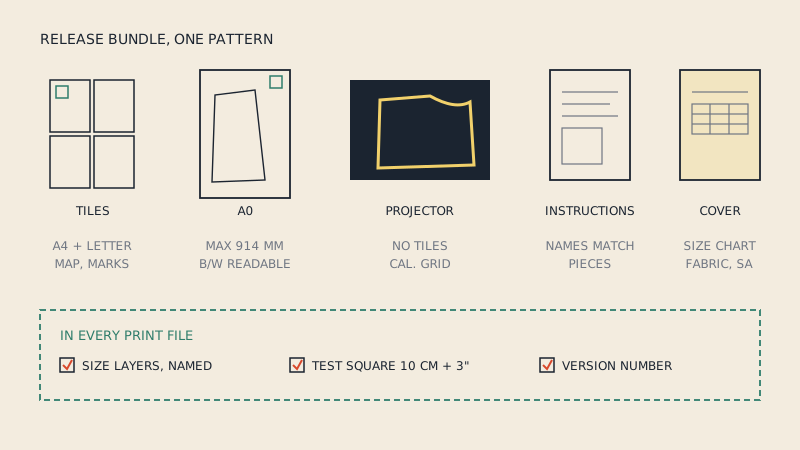
A PDF pattern listing is a bundle of files plus permission to use them. Decide the bundle once and keep it consistent across patterns, because buyers return to designers whose files they know.
| Component | Format | Notes |
|---|---|---|
| Tiled print file | PDF, fits A4 and US Letter | The file most buyers print first |
| Large-format file | PDF, A0 sheets, within 36" width | For copy shops and plotters |
| Projector file | Increasingly expected | |
| Instructions | Separate from the pattern pieces | |
| Licence / terms | Text in the listing and in the files | What the purchase allows |
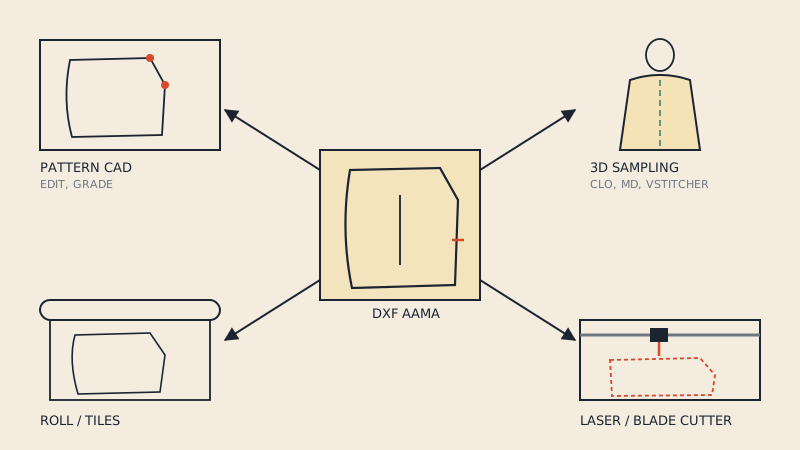
| Optional: DXF | DXF AAMA | For buyers with CAD or 3D software |
Offering DXF
Some buyers work in CLO3D, Marvelous Designer or pattern CAD and will pay more for a DXF. If you offer one, make it from the same master as your PDFs, and say in the licence that the DXF falls under the same terms. What buyers do with DXF patterns, and the licence questions specific to them, are covered in DXF sewing patterns. If your patterns exist only as vector PDFs, a PDF-to-DXF AAMA conversion produces a DXF of one size from your own file; it is a file you are converting for yourself, as the rights holder.
Choosing where to sell
Marketplaces such as Etsy
A large marketplace brings search traffic you don't have to create, which matters most when nobody knows your name yet. In exchange you follow its rules, pay its fees, and compete on the same results page as everyone else.
Etsy supports digital listings with automatic delivery after purchase. According to its help pages, a digital listing can have up to five files, each no larger than 20 MB. Pattern bundles often exceed that, so sellers typically compress files into ZIP archives or split the bundle across the five slots (for example, tiled file, A0 file, projector file, instructions, and an extra sizes file). Check Etsy's current fee schedule and digital-item rules yourself before pricing, since both change.
Your own shop
Your own website with a shop system gives you control over presentation, customer emails, file size limits, licence terms and pricing, and you keep the customer relationship. Hosted shop builders and e-commerce plugins generally support downloadable products, sometimes through an add-on. The trade-off is traffic: you have to bring buyers yourself, through search, social media, a newsletter or a community.
Digital-product platforms and pattern marketplaces
Between the two sit platforms built for selling digital files, and marketplaces dedicated to sewing patterns. They are quicker to set up than your own shop and more focused than a general marketplace. Compare them on file limits, fees, payout schedule, tax handling and whether they let you contact your buyers.
Comparison by criteria
| Criterion | Large marketplace | Own shop | Digital-product platform |
|---|---|---|---|
| Built-in traffic | High | None | Low to medium |
| Control over branding | Limited | Full | Partial |
| File size limits | Platform rules (Etsy: 5 files, 20 MB each) | Set by your host | Platform rules |
| Customer contact | Restricted by platform | Full | Varies |
| Setup effort | Low | High | Low |
| Fees | Platform fees | Hosting, payment fees | Platform fees |
Many designers use more than one: a marketplace for discovery and their own shop for returning buyers.
Taxes on digital sales
Digital products are often taxed differently from physical goods. In the EU, for example, VAT on digital products sold to consumers is generally charged at the rate of the buyer's country. Some marketplaces collect and remit these taxes for you; your own shop may not. Get advice for your country before you scale up.
Writing the licence
The licence is what turns "a file" into "a product with rules". Put it in the listing, on the cover page of the pattern, and in a separate text file in the download. Keep it short and specific.
A typical sewing pattern licence answers:
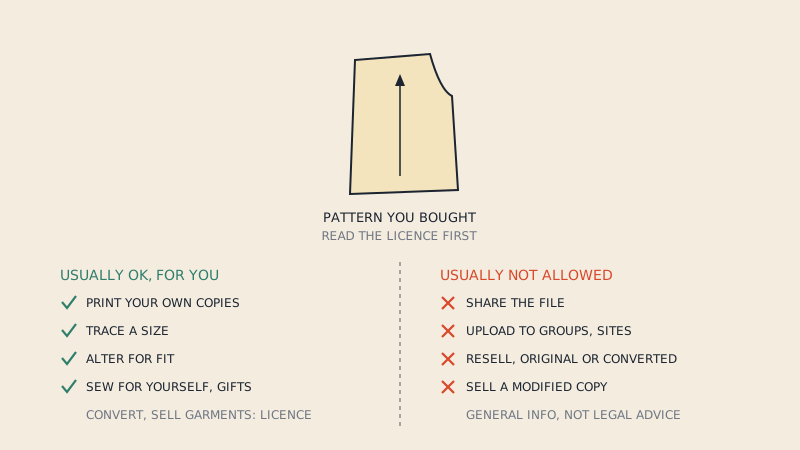
- Who may use the files: usually the purchaser only, for their own sewing.
- Copies: the purchaser may print as many copies as they need for themselves, and may convert the file for their own use (for example, to a format their printer or software reads).
- Sharing: files and printed copies may not be shared, resold, uploaded or distributed, whether original or converted.
- Garments: whether garments made from the pattern can be sold. Many designers allow small-scale or handmade sales, sometimes with credit, and offer a separate commercial licence for larger production.
- Teaching: whether the pattern can be used in a paid class, and on what terms.
- Modification: whether altered versions can be shared (usually not as files).
Don't copy another designer's licence text word for word. Write your own, and if your business depends on it, have a lawyer review it. The general principles behind pattern licences and copyright are explained in sewing pattern copyright, which is general information, not legal advice.
Dealing with piracy
PDF patterns get shared without permission. You can make it less convenient and respond when it happens, but you can't prevent it entirely.
Practical measures:
- Buyer stamping: some platforms can add the buyer's name or email to each downloaded PDF. People are less inclined to share a file with their own name on every page.
- Version and copyright notice on every page of the pattern, not just the cover.
- Search periodically for your pattern names on file-sharing sites and in groups.
- Takedown requests: most hosts and platforms have a process for reporting copyright infringement, such as DMCA notices for US-based services. Keep your original files, dates and listing records as evidence.
- Tone: many buyers who share files don't know it isn't allowed. A clear licence in the file helps more than an angry post.
Avoid heavy copy protection that breaks normal use. Password-protected or print-restricted PDFs frustrate paying buyers (copy shops may be unable to print them) and rarely stop determined sharers.
Pricing and listing basics
There are no reliable universal price points to quote here; look at comparable patterns on the platforms you plan to use. What reliably helps sales:
- clear photos of the finished garment on real bodies, front, back and side;
- the size chart and finished measurements in the listing, not only inside the file;
- the formats included, listed explicitly (A4, Letter, A0, projector, DXF if offered);
- fabric requirements and skill level up front;
- a version number and a promise of updated files if you correct the pattern.
FAQ
What do I need to sell sewing patterns online?
A tested pattern, a file bundle (tiled A4/Letter, A0, projector, instructions), a platform that delivers digital files, and a written licence explaining what buyers may do with the pattern.
Can I sell PDF sewing patterns on Etsy?
Yes, Etsy supports digital listings with automatic delivery. According to Etsy's help pages, each digital listing can include up to five files of up to 20 MB each, so larger bundles are usually zipped or split.
Should I sell on a marketplace or my own website?
A marketplace brings traffic but limits branding and customer contact; your own shop gives control but needs you to bring buyers. Many designers use both.
What should a sewing pattern licence include?
Who may use the files, whether copies and conversions for personal use are allowed, a ban on sharing or reselling the files, whether garments made from the pattern can be sold, and terms for teaching.
How can I protect my PDF patterns from piracy?
Use buyer stamping if your platform offers it, put copyright and version notices on every page, monitor for shared copies and file takedown requests. Heavy copy protection mostly hurts paying customers.