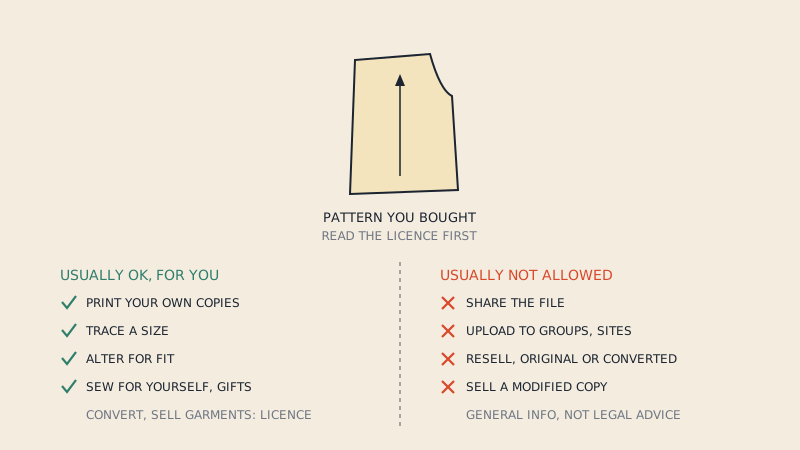
When you buy a sewing pattern you usually get the right to use it for your own sewing: print it, trace it, alter it for fit and make garments for yourself. You usually do not get the right to share or sell copies of the pattern, in any format. What you may do with the garments, and whether converting the file is allowed, depends mainly on the licence the designer attached to the pattern. That licence is the first thing to read.
This article is general information, not legal advice. Copyright and design law differ between countries and change over time. If a decision matters to your business, ask a lawyer in your jurisdiction.
Two layers of rules: copyright and the licence
Two separate things govern what you can do with a pattern.
Copyright (and related rights) is the law. It protects creative works such as text, illustrations and photographs, and gives the author control over copying and distribution. How far it reaches into the pattern shapes themselves is a contested question, discussed below.
The licence is the agreement you accept when you buy. It can give you more permission than the law would by default (for example, explicitly allowing you to sell garments) or set conditions on your use (for example, personal use only). Even where the scope of copyright is uncertain, the terms you agreed to when buying still matter.
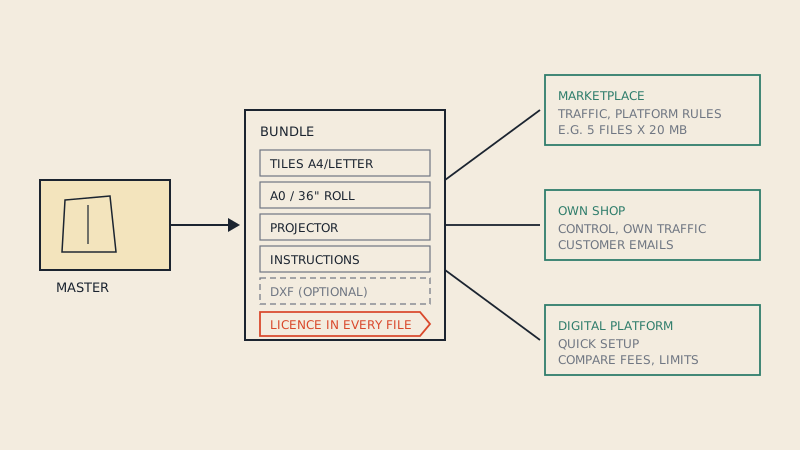
In practice, the licence answers most everyday questions. Designers who sell PDF patterns usually state it on the product page and in the file; how they write one is described in selling sewing patterns online.
What is typically protected
Most legal systems treat these parts of a pattern as protected creative work:
- the written instructions;
- illustrations, technical drawings and diagrams;
- photographs and cover artwork;
- the layout and design of the document as a whole;
- the specific file the designer produced.
That is why copying and sharing the PDF or the printed booklet is a clear problem in most countries, regardless of debates about pattern shapes.
What is less clear
The pattern shapes
Whether the shapes of pattern pieces are protected by copyright is debated and varies by jurisdiction. In some countries, functional items and the methods of making them get limited copyright protection, while the drawings that depict them may be protected as graphic works. Courts and commentators don't all agree, so avoid relying on either "shapes are free" or "everything is protected".
The garment design
Clothing is often treated as a useful article. In the United States, for instance, garments themselves generally receive limited copyright protection, though artistic features that can be separated from the garment's function may be protected; the Supreme Court addressed this in Star Athletica v. Varsity Brands (2017). The EU and the UK have design-right systems that can protect the appearance of products, including clothing, under their own conditions. These questions mostly concern brands copying designs, not home sewists using a bought pattern.
Common actions, at a glance
| Action | Commonly allowed? | What it depends on |
|---|---|---|
| Print the pattern for yourself, as many times as you need | Usually yes | Licence wording |
| Trace your size and keep the original intact | Usually yes | Rarely restricted |
| Alter the pattern to fit you | Yes | Nothing, for personal use |
| Convert the file to another format for your own use (e.g. DXF for your CAD) | Often yes | Licence; some are silent or restrictive |
| Make garments for yourself and as gifts | Yes | Nothing in normal cases |
| Sell garments you made | Often, in small numbers | Licence; some require a commercial licence or credit |
| Teach a paid class using the pattern | Sometimes | Licence; often needs permission |
| Share the file or printed copies with a friend | Usually no | Licence; almost always prohibited |
| Upload or sell the pattern, original or converted | No | Copyright and licence |
| Sell your modified version of the pattern | Usually no | Copyright and licence |
Personal use: printing, tracing and altering
Printing your own copies, tracing a size, shortening a bodice or blending sizes are normal uses of a bought pattern, and designers expect them. Many licences say outright that you may print as many copies as you need for your own use. Tracing is also the usual way to preserve multi-size patterns; there is no general rule against it.
Converting for your own use
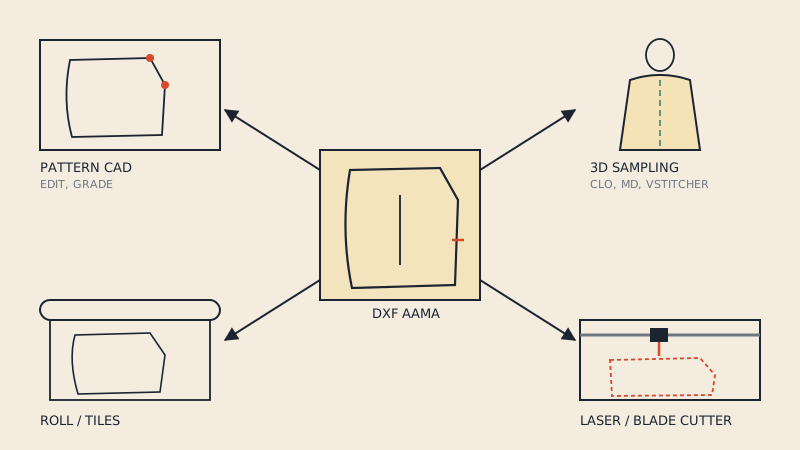
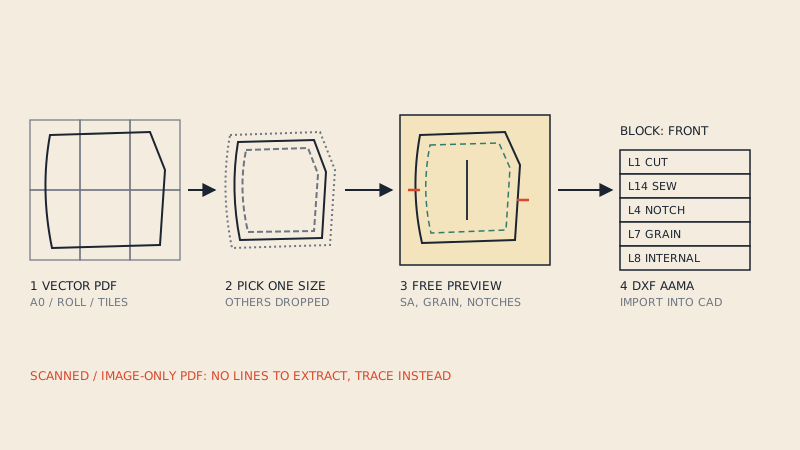
Converting a pattern to another format, for example a PDF to DXF so you can open it in CLO3D or a cutting program, is a form of copying. Many sewists and designers treat a conversion for personal use the same way as printing: you are making a working copy of something you bought, for yourself. Some licences explicitly allow it; some say nothing; a few restrict it. Read the licence, and if in doubt, ask the designer. Many are happy to say yes, and some sell DXF files directly (see DXF sewing patterns).
What does not change with the format is the sharing rule. A converted file is still a copy of the designer's pattern. It may not be shared, uploaded or sold.
Our own terms follow this principle. You may convert only patterns you own or have the right to convert, you confirm this before uploading, and converted files must not be shared or resold. The technical routes for conversion are described in how to convert a PDF sewing pattern to DXF, and our PDF to DXF converter applies those terms to every upload.
Sharing and reselling files
This is the area with the least ambiguity. Sending a friend the PDF, posting it in a group, uploading it to a file-sharing site or selling it, in the original format or converted, is prohibited by almost every pattern licence and is very likely to infringe copyright in the document. "I bought it, so I can do what I want with it" applies to the garments you sew, not to copies of the file.
Physical paper patterns are a little different in many countries: selling or giving away your own original printed copy (and not keeping a copy) is often allowed under first-sale or exhaustion principles. Those principles generally don't apply to digital files, because sharing a file creates a new copy.
Selling garments made from a pattern
Many independent designers allow small-scale sales of garments made from their patterns, often with a request to credit the pattern. Others require a separate commercial or small-business licence, or limit the number of garments. Larger production almost always needs a specific agreement. If you plan to sell, check the licence first and keep a record of it, since terms can change after you buy.
Vintage and out-of-print patterns
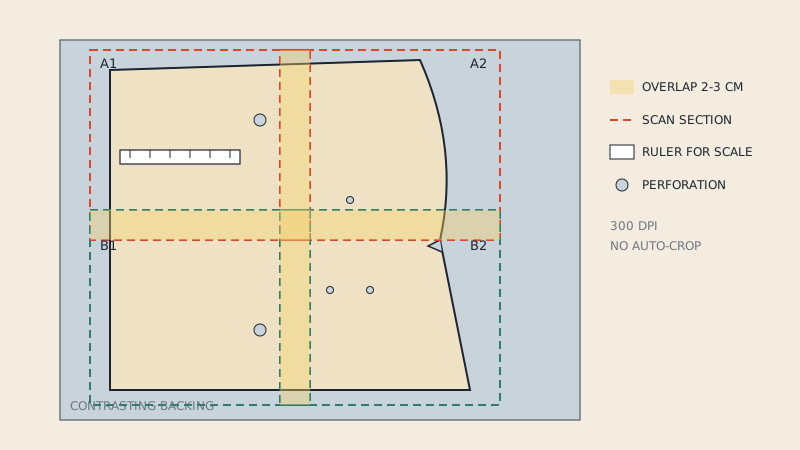
Old does not automatically mean free. Copyright terms differ by country, often running for decades after the author's death or after publication, and company-published patterns have their own rules. Some vintage patterns are in the public domain; many are not. If you plan to share or sell copies of vintage patterns, research the specific pattern's status. Handling and digitizing vintage tissue carefully is covered in digitizing vintage sewing patterns.
Your own patterns
If you draft your own patterns from scratch, you hold the rights in your instructions, drawings and files. If you draft by copying another designer's pattern piece by piece, you are on uncertain ground. Building from a self-drafted block and your own measurements is the clean route.
FAQ
Is it legal to share a PDF sewing pattern I bought?
Usually not. Almost every pattern licence prohibits sharing the file or printed copies, and copying the document is likely to infringe copyright. This is general information, not legal advice.
Can I sell clothes made from a sewing pattern?
Often yes in small numbers, but it depends on the designer's licence. Some allow handmade sales with credit, others require a commercial licence.
Can I convert a PDF pattern I bought to DXF?
Many designers treat conversion for your own use like printing, but licences differ, so read yours or ask the designer. The converted file may not be shared or sold.
Are sewing pattern shapes protected by copyright?
It varies by country and is debated. Instructions, illustrations and the pattern document are generally protected, while protection for the bare shapes is less clear.
Are vintage sewing patterns free to copy?
Not automatically. Copyright terms vary by country and pattern, so check the specific pattern's status before sharing or selling copies.