In industrial pattern making there are a handful of notch types: the slit (also called an I-notch), the V-notch, the T-notch, the castle or box notch, and the U-notch. They all mark the same thing, a matching point on the edge, but they are cut with different tools and suit different materials. Choosing the type is about what the cutter, the fabric and the pattern card can hold.
This article is about the shapes themselves. If you want to know what notches mean on a home sewing pattern and how to match them, start with notches in sewing patterns.
Why there is more than one notch type
A notch has to survive three stages: the pattern (paper, card or a CAD file), the cut fabric, and the sewing operator's hands. Each stage pulls in a different direction.
- On hard pattern card (oaktag, manila), a slit closes up and cannot be traced with a pencil, so card patterns use shapes with width.
- On fabric, a wide notch removes material and weakens a narrow seam allowance, so the fabric notch is usually a thin slit.
- On loose or springy fabric, a slit can close and disappear, so a V is cut instead.
- In the cutting room, the shape depends on the tool: a straight knife makes slits, a notcher on a cutting table makes slits or small V shapes, and an automatic cutter makes whatever its knife and settings allow.
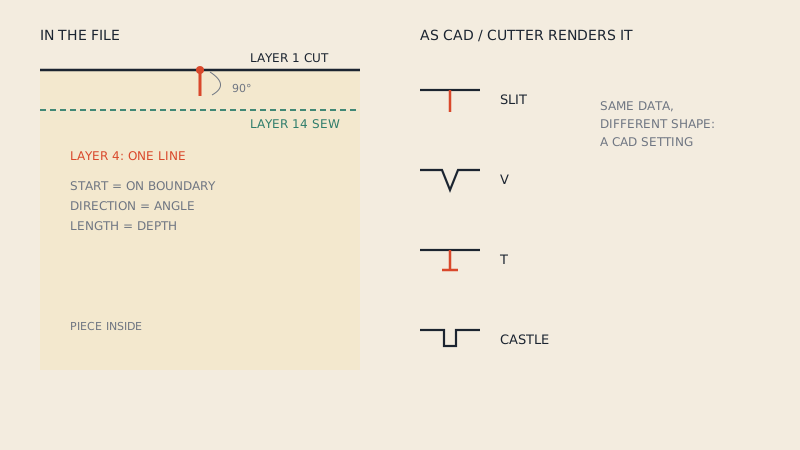
So the same matching point may be a castle notch on the card pattern, a slit in the fabric, and a short line in the CAD file. They are one notch drawn three ways.
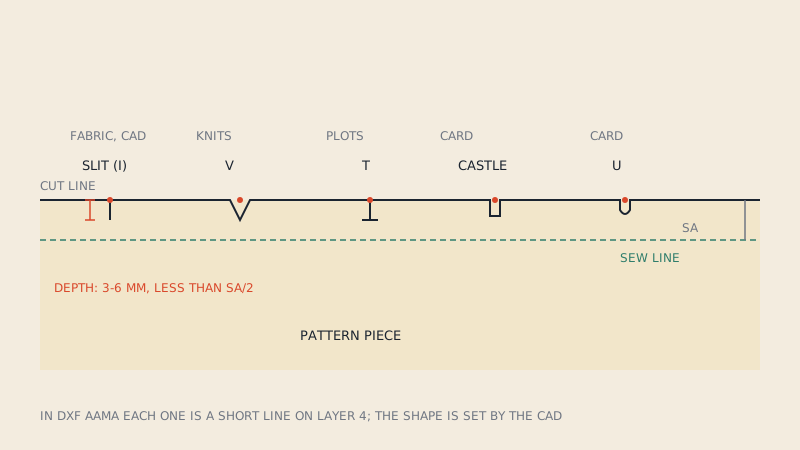
The notch types one by one
Slit notch (I-notch)
A single straight cut into the seam allowance, square to the edge unless set otherwise. It is the default notch in most pattern CAD systems and the most common notch on cut fabric in production.
- Typical depth: commonly 6 mm (1/4"); 3 mm (1/8") on narrow allowances. It must stay well inside the seam allowance.
- Width: none, which is its strength: it is an exact point.
- Weak spot: on thick, spongy or loosely woven fabric it closes up and is hard to find.
V-notch
A small triangular wedge cut into the edge, point inward. The opening is often around 3–5 mm (1/8"–3/16") wide at the edge, with the point at the notch depth.
- Used for: knits, fleece, quilted and spongy materials, where a slit vanishes.
- Also used for: hand-cut patterns where a visible notch helps less experienced sewists.
- Weak spot: it removes material, so it is not a good choice for very narrow allowances or fabrics that fray.
The outward triangles printed on home sewing patterns are the inverse of a V-notch. They are cut outward to avoid weakening the seam allowance, and they serve the same matching purpose.
T-notch
A slit with a short crossbar at its inner end, like a letter T pointing into the piece. It is mostly a drawing and CAD convention: the crossbar makes the notch visible on plotted paper and on screen, especially where it sits on a dense curve.
- Used for: plotted patterns and on-screen work where a plain slit would be lost in the outline.
- In the fabric: usually cut as a simple slit; the crossbar is not cut.
Castle notch (box notch)
A rectangular slot cut into the edge, like a crenellation on a castle wall. On card patterns it is made with a pattern notcher, a plier-like tool that punches a narrow slot of fixed size into the card.
- Used for: hard card patterns. The slot is wide enough for a pencil or chalk point, so the notch can be traced onto the marker paper or the fabric.
- In the fabric: transferred as a slit or a chalk mark, not as a box.
U-notch
A rounded slot, like a castle notch with a curved bottom. It is used where a castle notch would leave sharp corners that tear, for example in some paper patterns and on certain cutting systems.
Comparison table
| Type | Shape in the edge | Where it is typical | Removes material | Good for |
|---|---|---|---|---|
| Slit (I) | Single straight cut | Fabric, CAD default | No | Precise matching, most wovens |
| V | Triangular wedge | Knits, spongy fabrics | Yes, a little | Visibility where slits close |
| T | Slit with crossbar | Plots, CAD display | No (as cut) | Visible notch on dense lines |
| Castle / box | Rectangular slot | Hard card patterns | Yes, in card | Tracing with pencil or chalk |
| U | Rounded slot | Card and paper patterns | Yes, in card | Tracing without torn corners |
Notch angle
A notch is not always square to the edge. Pattern CAD lets you set the notch angle, and production patterns use this deliberately.
- Perpendicular (the default): the notch is at 90° to the cut line. Correct on straight edges and gentle curves.
- Following a seam: on a corner where two seams meet, the notch can be angled to point along the adjoining seam line, so the operator sees where the seam turns.
- Bisecting a corner: on a sharp point such as a collar tip, a notch along the angle bisector marks the turning point at the sew line.
- Aligned to a reference: some notches are set parallel to the grain line, for example at a sleeve hem.
On curved edges, a perpendicular notch points to the matching point on the sew line. A notch that is angled by mistake will be in the wrong place on the sew line, even though it looks right at the cut edge, and it is one of the classic causes of seams that drift.
Notch depth and seam allowance
Whatever the type, the notch is measured from the cut line inward, and it must end before the sew line. A few working rules, presented as common practice rather than a standard:
- Keep the notch depth at no more than half the seam allowance. On a 1 cm (3/8") allowance that is 5 mm; many factories use 3 mm there.
- On 6 mm (1/4") allowances, such as on knit overlocked seams, use a very short slit or a V that ends well short of the sew line.
- Do not notch hems and facings so deeply that the notch shows after turning.
- On fabrics that unravel, prefer a shallow slit or a mark over a V.
How pattern CAD stores notches
In pattern CAD the notch is an object attached to a point on the piece boundary. It has a position, a type, a depth, a width (for V, castle and U) and an angle. When you plot, the CAD draws the shape; when you send to an automatic cutter, it converts the notch into knife moves or a notch tool command.
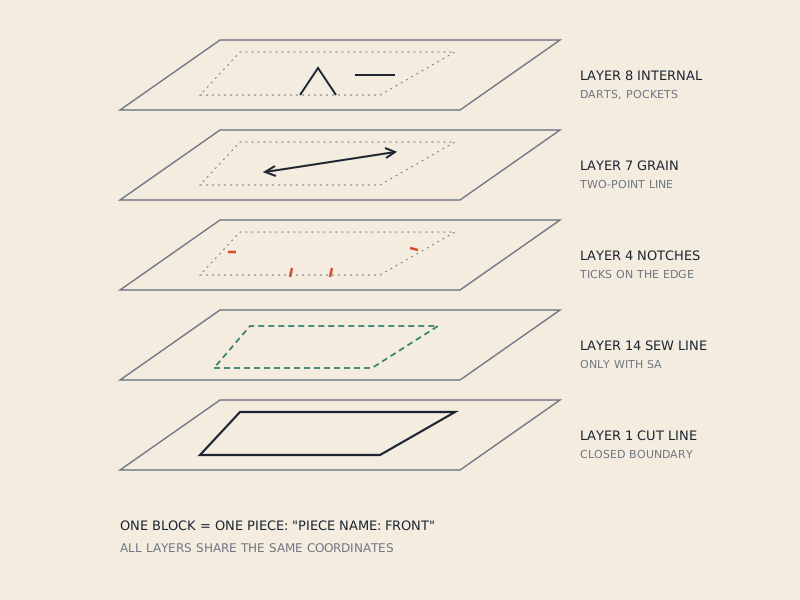
When patterns are exchanged as DXF AAMA, each notch is written on layer 4 as a short line that starts at the cut line and points into the piece. The line gives the notch position and angle. The notch type and width are often not carried as a shape at all, and the receiving CAD applies its own default notch type on import, so a V drawn in one system may arrive as a slit. The later ASTM version of the format adds ways to describe notch attributes more fully, but support varies by program. Details and failure cases are in how notches are stored in DXF AAMA, and the full layer list is in the AAMA DXF layers, one by one.
In practice, this means you should check notch type settings after any import, not assume they survived.
Notches in a converted PDF
PDF sewing patterns draw notches as graphics: lines, triangles, sometimes small T shapes. A pattern-aware conversion has to recognise each of those graphics as a notch, find the point where it meets the cut line, and write it as a layer 4 line at the correct angle. Our converter does this and reports a notch count per piece in the free preview, so you can compare against the printed pattern before you buy the DXF.
If you are preparing patterns for a factory, notch consistency is one of the items in what makes a pattern production-ready.
FAQ
What are the main types of notches in pattern making?
The main types are the slit (I-notch), V-notch, T-notch, castle or box notch, and U-notch. Slits are standard in fabric and CAD, V-notches are used on knits and spongy fabrics, and castle and U-notches are used on hard card patterns so they can be traced.
How deep should a notch be?
A common depth is 6 mm (1/4"), and 3 mm (1/8") on narrow seam allowances. As a working rule, the notch should not go deeper than half the seam allowance, so it never reaches the sew line.
What is a castle notch?
A castle notch, or box notch, is a small rectangular slot cut into the edge of a card pattern with a pattern notcher. Its width lets a pencil or chalk mark the notch onto marker paper or fabric.
Do notch types survive a DXF export?
Notch position and angle usually survive, because each notch is written as a short line on layer 4. The notch type and width are often not carried, so the importing program applies its default type, and you should check notch settings after import.
Why would a notch be angled?
Angled notches point along an adjoining seam at a corner, bisect a sharp point, or follow the grain at a hem. On curves, a notch must be perpendicular to the edge, or it marks the wrong point on the sew line.