"Place on fold" means the marked edge of a pattern piece goes exactly on the folded edge of the fabric, so that cutting through both layers produces one symmetrical piece twice the width of the paper. The pattern shows only half of the piece; the fold is its centre line. There is no seam allowance along that edge, and the fold must lie on the straight grain. In digital patterns the same idea is called a mirror line, and a half piece has to be opened into a full piece before it can be used in a marker or a 3D simulation.
What the fold symbol looks like
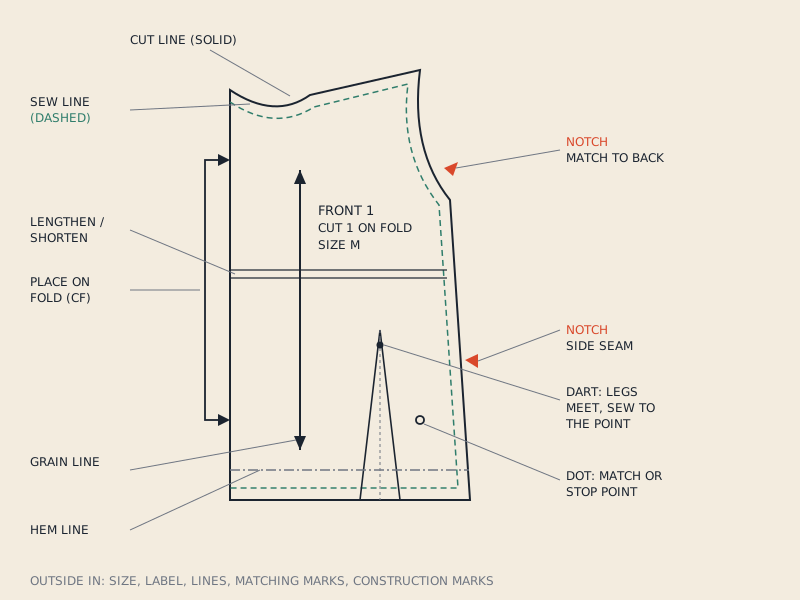
Paper and PDF patterns mark a fold edge in a few common ways:
- A bracket drawn alongside the edge with arrows at each end pointing to the edge, labelled "place on fold" or "fold".
- An edge labelled "CF fold" or "CB fold", meaning centre front or centre back is on the fold.
- A grain line with one end bent at right angles to touch the fold edge, used on some older patterns.
- The text "Cut 1 on fold" in the piece label.
- Short notches or marks at both ends of the fold edge, showing where the fold begins and ends and giving a centre mark on the cut piece.
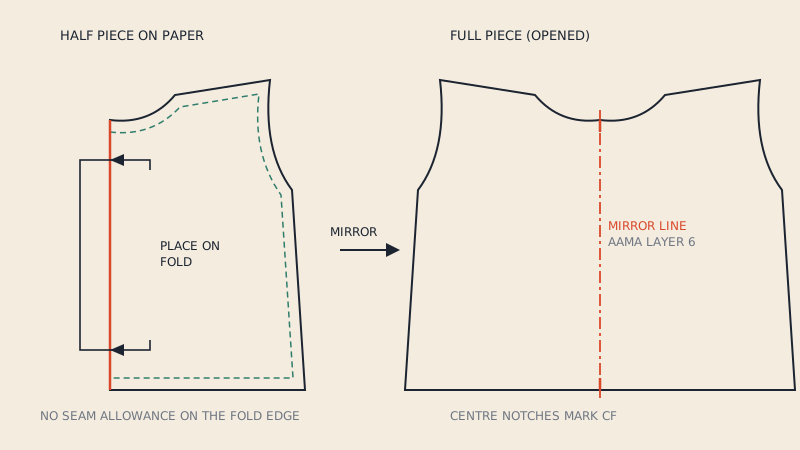
Do not confuse "place on fold" with a fold line inside a piece. A fold line marks where the finished garment folds, such as a facing turned back along a front edge or a hem turned up. That fold is made during sewing, not cutting. Both are explained among the other marks in how to read a sewing pattern.
Why patterns use half pieces
Many garment pieces are symmetrical about a centre line: a bodice front without a front opening, a skirt back without a zip, a yoke, a collar. Drawing only half saves paper, and cutting on the fold guarantees the two halves match exactly, which is hard to achieve by tracing a full outline by hand.
It also means the centre of the piece is exactly on grain, provided the fold is. That is why the fold edge usually runs along the straight grain, and why some patterns do not show a separate grain line on fold pieces: the fold itself is the grain reference.
How to cut a piece on the fold
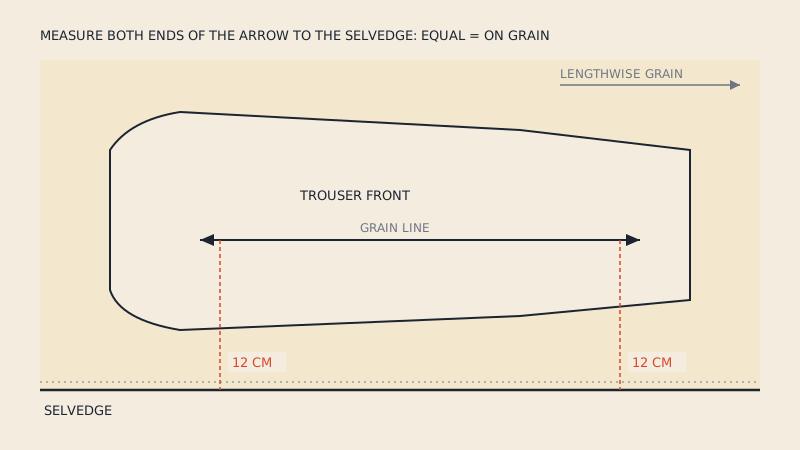
- Fold the fabric right sides together, along the lengthwise grain, so that the selvages lie together and the fold is parallel to them. Check this at several points along the length; a fold that drifts off grain makes the whole piece off grain. The background is in grain line on a sewing pattern.
- Fold only as much as you need. You do not have to fold selvage to selvage. Fold one selvage in just far enough to fit the piece, measuring from the fold to the selvage at both ends to keep the fold parallel.
- Place the fold edge exactly on the fold. Not near it, on it. A piece placed 5 mm (3/16") from the fold comes out 1 cm (3/8") wider than drafted, because the gap counts twice.
- Pin or weight the piece, then cut through both layers around the other edges. Do not cut along the fold.
- Mark the centre. Snip a small notch at the top and bottom of the fold, or press the fold lightly. That centre mark helps you align buttons, collars and other pieces later.
Seam allowance at the fold
There is no seam at a fold, so there is no seam allowance. If you are adding seam allowance to a pattern drafted without it, add it to every edge except the fold edge. A common mistake is to add allowance all round and then place the allowance edge on the fold, which makes the piece twice the allowance too wide at the centre.
When you cannot cut on the fold
Sometimes folding is not practical:
- The fabric is too narrow for the piece when folded.
- The fabric has a directional print, nap or a border that should not be doubled.
- You are cutting a single layer, for example to match a large print or a plaid.
- You want to place the piece to avoid a flaw.
In these cases, make a full paper pattern. Trace the half piece, flip the paper over along the fold line and trace the other half, so you have the whole piece. Then cut it from a single layer. Transfer notches and marks to both halves.
Place on fold in industry
In production, fabric is spread in many layers, usually open width, and pieces are cut with a straight knife or an automatic cutter from a marker. Folded spreads are used for some products, but open spreads are common, so production patterns are generally made with full pieces. A half piece is not useful in a marker, because the marker needs the whole outline to nest pieces and calculate fabric use; this is part of marker making basics.
Pattern CAD still lets pattern makers work on half pieces, because it halves the drafting work and guarantees symmetry. The piece carries a mirror line, and the program opens it into a full piece for markers, plotting and export when needed.
The mirror line in DXF AAMA
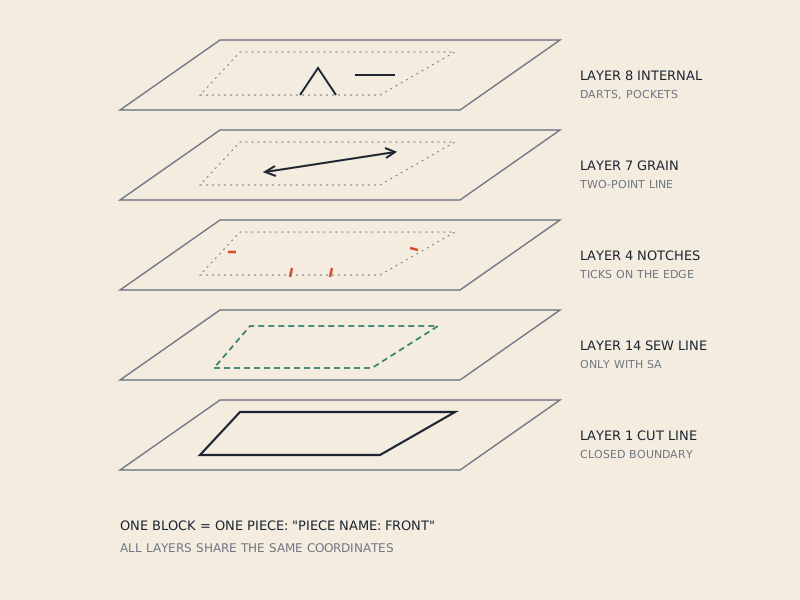
The AAMA format has a dedicated layer for this: layer 6, mirror line. A piece exported as a half, with its centre edge on layer 6, tells the receiving program that the piece should be mirrored along that line to create the full shape.
How well that works depends on the software:
| Situation | What happens |
|---|---|
| Half piece with a mirror line on layer 6, read by CAD that supports it | The piece is opened, or shown as a symmetrical piece that can be opened |
| Half piece with a mirror line, read by software that ignores layer 6 | Only the half is shown; you open it manually |
| Half piece without a mirror line | The software sees an ordinary closed piece; it has no way to know it is a half |
| Full piece already opened | Works everywhere; the centre line, if needed, goes on layer 8 as an internal line |
Many exchange problems come from the third row. A pattern that was correctly "cut 1 on fold" on paper arrives in CAD as a half-width piece with a straight edge, and if nobody notices, it ends up in a marker or a 3D sample at half its size. The other layers are listed in the AAMA DXF layers, one by one.
Half pieces in 3D software
In 3D garment programs, a half piece is a real problem: the simulation drapes exactly what you give it. A half front sewn to a full back will not close.
Before simulating, check every piece with a fold edge:
- Identify fold pieces from the piece label ("cut 1 on fold") or from the straight centre edge.
- Mirror them into full pieces with the program's unfold or symmetry tools, or open them in your pattern CAD before export. Several 3D programs also offer symmetric editing, where you edit one half and the other follows.
- Check the quantity. A piece that was "cut 1 on fold" becomes one full piece, not two.
- Sew and simulate, then compare the full width with the paper pattern doubled.
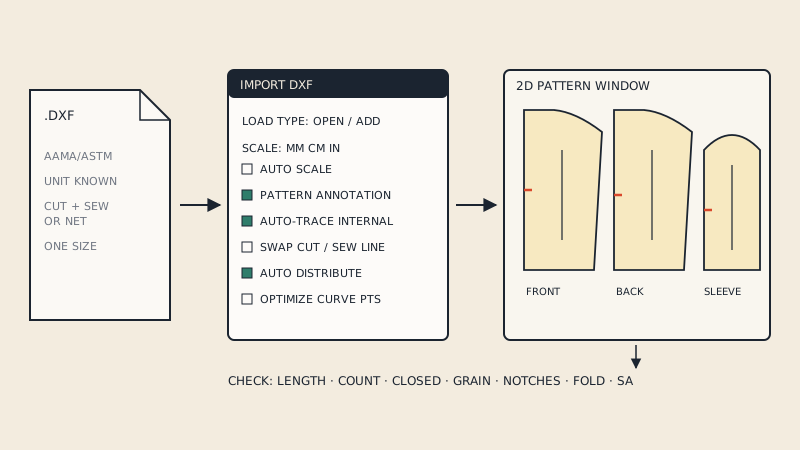
This is one of the first checks in a CLO3D workflow; see importing a DXF pattern into CLO3D.
When you convert a PDF pattern to DXF, a fold piece printed as a half will normally be detected as a half piece, because that is what is on the paper. Our converter shows each piece in the free preview with its size, so you can spot fold pieces and plan to mirror them in your CAD.
FAQ
What does place on fold mean on a sewing pattern?
It means the marked edge of the pattern piece is placed exactly on the folded edge of the fabric, so that cutting through both layers gives one symmetrical piece. The pattern shows only half of the piece.
Do you add seam allowance to a fold edge?
No. A fold is not a seam, so the fold edge has no seam allowance. When adding allowance to a pattern, add it to every edge except the one marked "place on fold".
What if my fabric is too narrow to cut on the fold?
Make a full paper pattern by tracing the half, flipping it along the fold line and tracing the other half. Then cut the full piece from a single layer of fabric.
What is a mirror line in a DXF pattern?
In DXF AAMA, layer 6 is the mirror line. It marks the edge along which a half piece should be mirrored to create the full piece; software that supports it can open the piece automatically.
Why does my fold piece come out the wrong width?
Usually because the piece was not placed exactly on the fold. Any gap between the fold edge and the fabric fold is doubled in the cut piece, so a 5 mm gap makes it 1 cm wider.