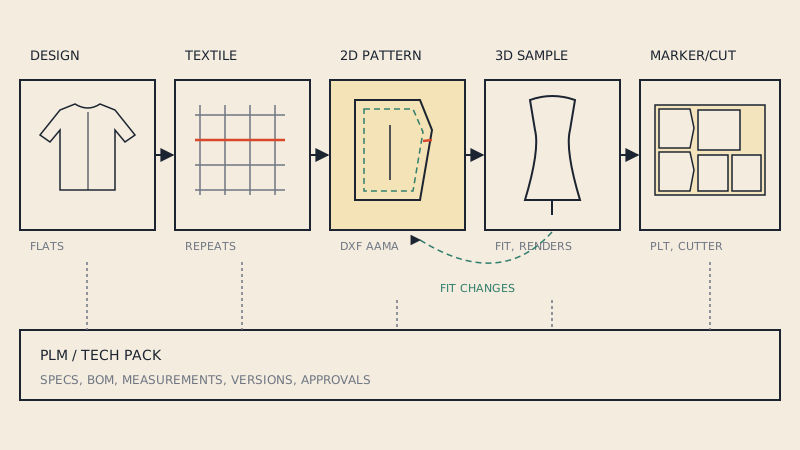
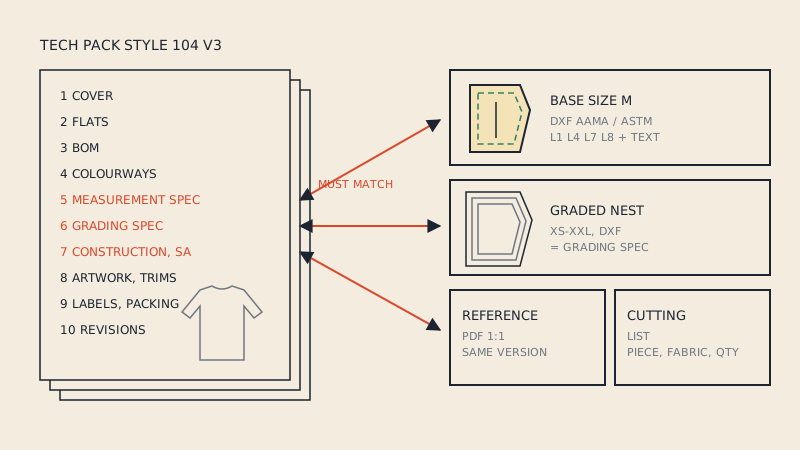
A tech pack is the instruction manual for one style: flats, materials, measurements, construction and labelling, gathered in one document so a factory can quote, sample and produce it without guessing. For a clothing brand, the tech pack and the pattern files are two halves of the same handover. The tech pack says what the garment must be; the patterns say exactly how to cut it. Most production problems at small brands come from gaps between the two: a spec that does not match the pattern, a pattern without seam allowance information, or a size range in the spec that the pattern files do not cover.
This article lists what goes into a tech pack, which pattern files belong with it, and the gaps factories most often have to chase.
What a tech pack contains
Formats vary by brand and factory, but the sections are broadly the same. A PDF or spreadsheet template is enough for a small brand; PLM software does the same job at scale (see CAD in fashion for where PLM fits).
| Section | What it holds | Why the factory needs it |
|---|---|---|
| Cover page | Style number, name, season, size range, version, date, contacts | Identifies the style and the current version |
| Flats | Front and back technical drawings, details enlarged | Shows the design without ambiguity |
| Bill of materials (BOM) | Main fabric, lining, interfacing, thread, zips, buttons, labels, with supplier, colour, quantity | Quoting and purchasing |
| Colourways | Each colour combination with material references | Correct materials per colour |
| Measurement spec | Points of measure (POM), how each is measured, base-size values, tolerances | Checking samples and production |
| Grading spec | Increments per size for each POM, or the full measurement table per size | Checking that graded patterns are right |
| Construction details | Seam types, stitch types and densities, seam allowance widths, finishes, topstitching | Sewing the garment as intended |
| Artwork and trims | Prints, embroidery, labels, placement with measurements | Branding and decoration |
| Labelling and packing | Care labels, size labels, hangtags, folding, polybags | Finishing and shipping |
| Revision log | What changed, when, and why | Avoiding work on an old version |
Measurement spec: the section that links to patterns
Points of measure are the bridge to the pattern. Each POM (chest 2.5 cm below armhole, front length from high point shoulder, sleeve length from shoulder point, and so on) has a value in the base size and a tolerance. The factory measures the finished sample against it. If the pattern produces a garment outside tolerance, either the pattern or the spec is wrong, and someone has to decide which.
Two things make this section work:
- Clear measuring instructions, ideally with a small diagram per POM, so the factory measures the same way you do.
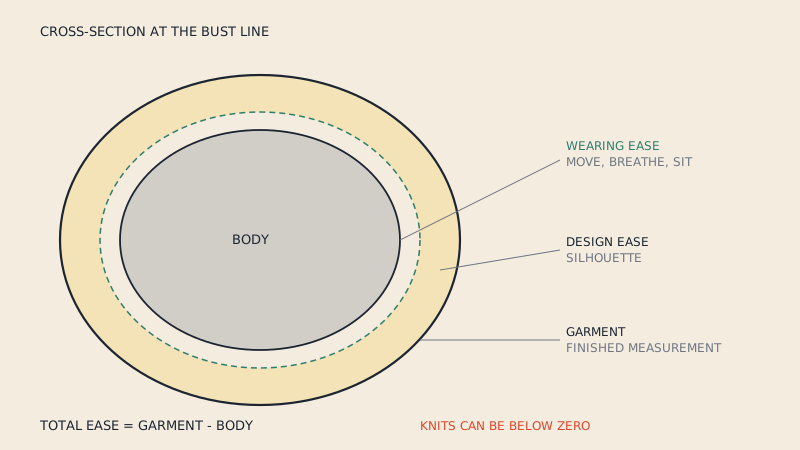
- Finished garment measurements, not body measurements. The difference is ease, which belongs in the pattern; see ease in pattern making.
The pattern files that go with it
The tech pack does not replace the pattern. A factory that is asked to sew from flats and a measurement chart alone will make its own pattern, which may or may not match your fit. If you have approved patterns, send them.
| File | Format | Purpose |
|---|---|---|
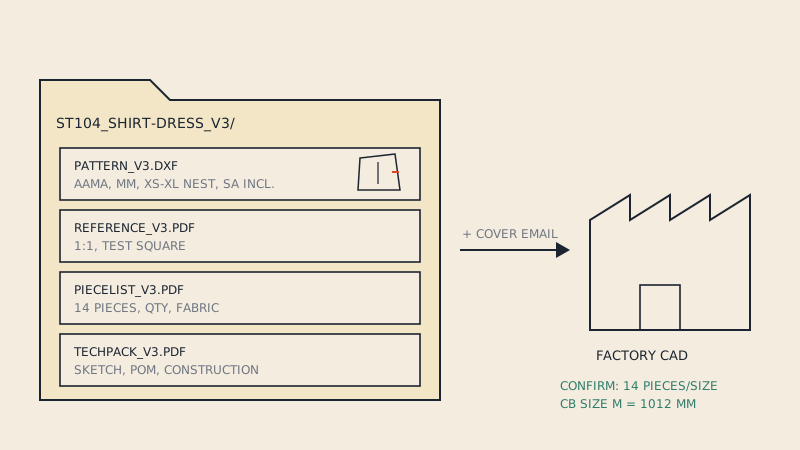
| Base-size pattern | DXF AAMA or ASTM | Cutting the sample; the factory's CAD imports it |
| Graded nest (all sizes) | DXF AAMA or ASTM | Production in the full size range |
| Reference PDF | PDF at 1:1, plus a reduced overview | Visual check, printing, comparing with the DXF |
| Cutting list | In the tech pack or a separate sheet | Every piece, in which material, how many |
| Marker (optional) | Usually made by the factory | Fabric consumption; most factories make their own |
| Native CAD file (optional) | If factory uses the same system | Fewer conversion losses |
What the DXF must contain
Factories commonly ask for DXF AAMA or ASTM because their pattern and marker systems import it with structure intact. The file should carry:
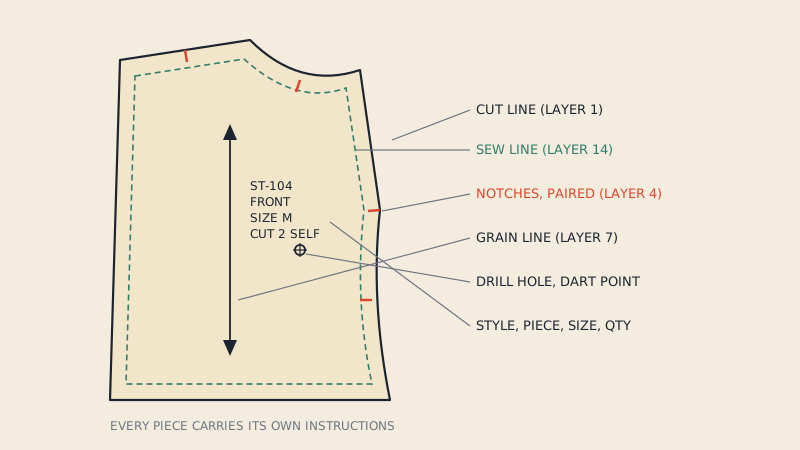
- A closed cut line for every piece, and a sew line if seam allowance is included.
- Grain lines, so pieces are cut and nested correctly.
- Notches at every match point.
- Internal lines: darts, pocket and buttonhole placements, fold lines.
- Piece text: name, size, quantity, and material if it is not the main fabric.
The what makes a pattern production-ready article goes deeper into each of these, and how to send patterns to a factory covers naming, packaging and the final check before sending.
If your patterns are only PDFs
Many small brands start with patterns as vector PDFs: from a freelance pattern maker who delivered print files, or a pattern licensed for commercial production. A factory can print and digitize them, but that adds a step and a chance for error. Converting the PDF to DXF AAMA before sending gives the factory pieces it can import directly. Our PDF to DXF converter does this for vector PDFs, one size per file (switching size after payment is free), with a free preview of the detected pieces so you can check piece count, seam allowance and notches before paying. Make sure your licence allows commercial use of the pattern; conversion does not change the licence.
Gaps factories chase most often
These are typical gaps between tech pack and patterns. None of them is exotic; all of them cost a sampling round.
- Spec and pattern disagree. The spec says chest 104 cm in size M, the pattern measures 101 cm. Measure the pattern along the sew lines (excluding seam allowance) and compare with the finished measurements in the spec before sending.
- Seam allowance unknown. The pattern does not say whether seam allowance is included, or which widths are used. State it in the construction section and in the piece text. Seam allowance included or not explains how to tell on an existing pattern.
- Size range mismatch. The spec covers XS to XXL; the pattern files cover S to XL.
- Missing pieces. Lining, interfacing, facings, pocket bags and small parts appear in the BOM but not in the pattern files, or the other way round.
- Quantities missing. "Cut 2" or "cut 1 pair" not in the piece text or cutting list.
- Wrong units. A DXF in inches read as millimetres arrives 25.4 times too small. Say which units the files use.
- Version confusion. The tech pack is version 3, the patterns are from version 2. Put the version in file names and on the cover page.
- Flats instead of patterns. A designer sends the flats file thinking it is the pattern. Flats have no scale and no seam allowance.
- Grading without a grading spec. The graded nest exists, but the factory cannot check it because increments are not in the tech pack.
- Fabric data missing. Width, shrinkage and nap are not specified, so the marker and the pattern cannot account for them.
A short checklist before sending
- Cover page shows style, version, date, size range.
- Every POM is defined with a diagram and tolerance.
- Grading spec matches the sizes in the pattern files.
- Construction section states seam allowance widths and whether the pattern includes them.
- BOM pieces (lining, interfacing) have matching pattern pieces.
- DXF AAMA or ASTM files open in a second program as closed pieces with grain lines and notches.
- Reference PDF matches the DXF version.
- File names carry style number, size range and version.
FAQ
What is a tech pack for a clothing brand?
It is a document that defines one style for production: flats, materials, measurements with tolerances, grading, construction details, labelling and packing. Factories use it to quote, make samples and produce.
Does a tech pack include the pattern?
The tech pack usually refers to the pattern but does not replace it. Patterns are sent as separate files, commonly DXF AAMA or ASTM with a reference PDF, and the tech pack's measurement and grading specs are used to check them.
What pattern file format do factories want?
Most factories ask for DXF AAMA or ASTM, because their pattern and marker software imports it with pieces, grain lines and notches. A 1:1 PDF is useful as a visual reference.
Can a factory work from a tech pack without patterns?
Many can, by making their own pattern from the flats and measurement spec. The fit then depends on their pattern maker, so sending your approved patterns gives more control over the result.
What is the most common tech pack mistake?
A mismatch between the measurement spec and the pattern files: different measurements, size ranges or versions. Measuring the pattern against the spec before sending prevents most sampling delays.