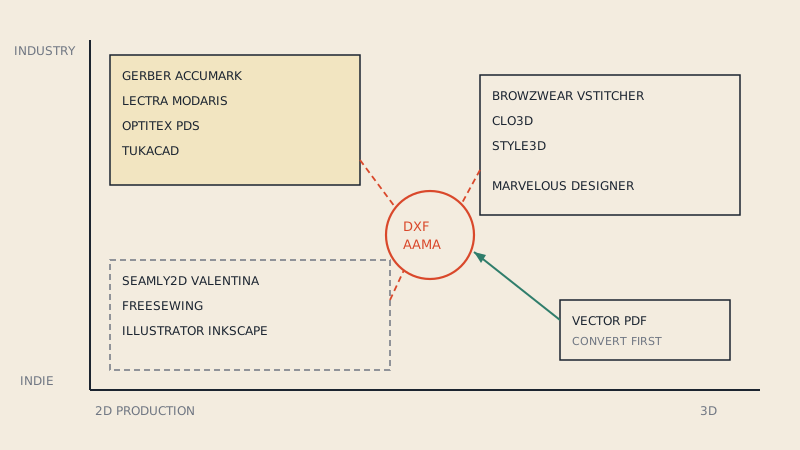
The best pattern making software depends on what you make and who receives your files. Factories and established brands mostly work in industry 2D CAD such as Gerber AccuMark, Lectra Modaris, Optitex or Tukatech's TUKAcad, because those systems handle grading, markers and cutting rooms. Designers and small brands increasingly start in 3D tools such as CLO3D or Browzwear VStitcher, and home sewists and indie designers often use Seamly2D, Valentina or vector editors. Whatever you pick, DXF AAMA is the format that lets these worlds exchange patterns.
This comparison is by criteria, not a ranking: what each tool is built for, how it is usually licensed, and which files go in and out. We have not run benchmark tests, and prices are not quoted because most vendors price by region, seat and plan.
Three groups of tools
| Group | Examples | Built for | Typical users |
|---|---|---|---|
| Industry 2D CAD | Gerber AccuMark, Lectra Modaris, Optitex PDS, TUKAcad | Pattern making, grading, markers, cutting room | Factories, brands with pattern rooms |
| 3D garment software | CLO3D, Browzwear VStitcher, Marvelous Designer, Style3D | Virtual samples, fit, visuals; some pattern tools | Designers, product developers, 3D artists |
| Indie and open-source | Seamly2D, Valentina, FreeSewing, Inkscape, Illustrator | Drafting, made-to-measure, PDF pattern production | Home sewists, indie pattern designers, students |
The lines blur. CLO3D has substantial 2D pattern tools; industry vendors have their own 3D modules; indie designers use Illustrator to produce PDF patterns that sell worldwide. But the group tells you a lot about what a program assumes you need.
Industry 2D CAD
Gerber AccuMark
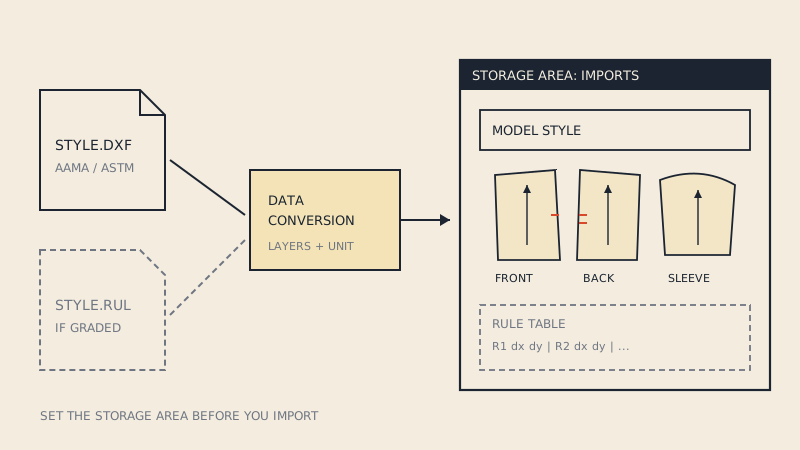
AccuMark is a long-established pattern, grading and marker system. Gerber Technology became part of Lectra in 2021, and AccuMark continues as its own product line. Patterns live in storage areas as pieces and models, grading is driven by rule tables, and markers feed cutting systems. It reads and writes DXF AAMA and ASTM. Import details: getting a DXF AAMA pattern into Gerber AccuMark.
Lectra Modaris
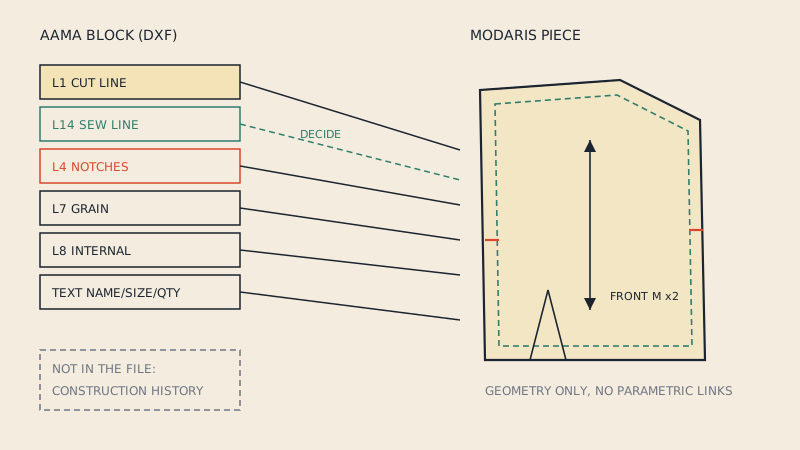
Modaris is Lectra's pattern making and grading software, with Lectra's marker and cutting systems downstream. It exchanges patterns through DXF AAMA and ASTM; imported patterns arrive as geometry without Modaris's construction history. See bringing DXF AAMA patterns into Lectra Modaris.
Optitex PDS
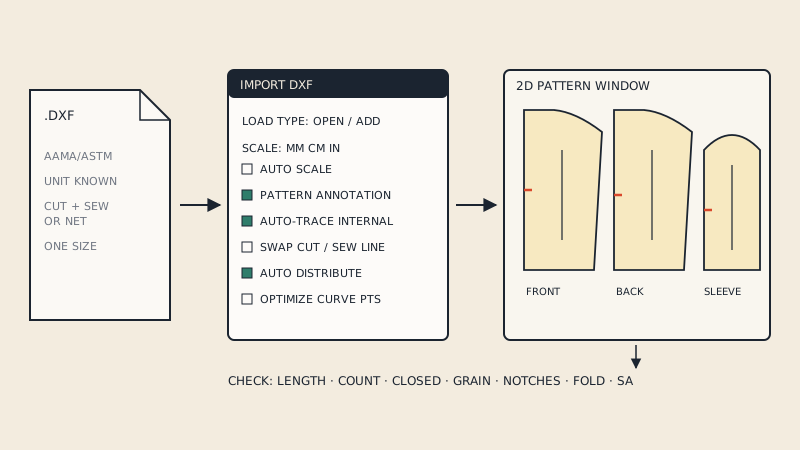
Optitex combines 2D pattern design (PDS), markers and 3D. Its Import dialog handles DXF, AAMA and ASTM with explicit unit, scale and layer settings, and grading comes with a RUL file.
Tukatech TUKAcad
TUKAcad covers pattern design (TUKAdesign), markers (TUKAmark) and 3D (TUKA3D). Tukatech advertises subscription plans, which makes it one of the more accessible industry systems for small factories. It exchanges patterns via AAMA DXF.
3D garment software
CLO3D
CLO3D simulates garments from 2D patterns on avatars and has its own pattern editing, grading and technical output. It is sold on published monthly and yearly plans for individuals, with enterprise options. It imports and exports DXF AAMA/ASTM, which is how most patterns from other systems reach it; see importing a DXF into CLO3D.
Browzwear VStitcher
VStitcher is a 3D design and fitting platform used largely by brands and suppliers. Browzwear asks for DXF AAMA or ASTM and recommends net patterns without seam allowance for import.
Marvelous Designer
From the same company as CLO3D, aimed at 3D artists in games, film and visualisation rather than production. It reads the same DXF files; CLO3D vs Marvelous Designer explains the split.
Indie and open-source tools
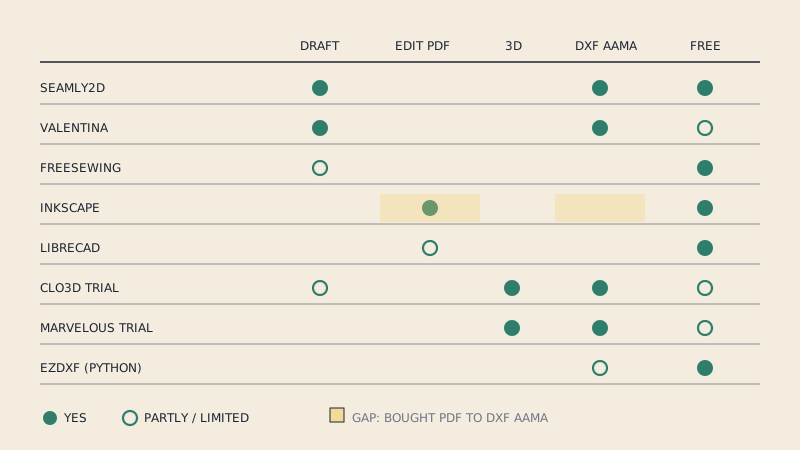
Seamly2D and Valentina draft parametric patterns from measurements and export DXF AAMA. FreeSewing generates made-to-measure patterns from programmed designs. Many indie pattern companies draft or finish their patterns in Adobe Illustrator or Inkscape, then produce tiled and A0 PDFs. None of these do industrial grading or markers the way 2D CAD does, and the vector editors do not write AAMA DXF. The free options are compared in free pattern making software.
Comparison by criteria
| Criterion | Industry 2D CAD | 3D garment software | Indie / open source |
|---|---|---|---|
| Pattern drafting | Full, production-grade | Good, varies by tool | Parametric (Seamly2D, Valentina) or freehand vector |
| Grading | Rule-based, production-grade | Available in some tools | Through measurements, or by hand |
| Markers and cutting | Core feature | Not the focus | No |
| 3D simulation | Optional modules | Core feature | No |
| Learning curve | Steep; usually formal training | Moderate | Low to moderate |
| Typical licensing | Quotes via vendor or agent, often per seat; subscriptions increasingly offered | Published subscriptions plus enterprise plans | Free / open source; some subscriptions (Valentina 1.0+, Illustrator) |
| Native file | Proprietary | Proprietary (CLO: .zprj) | Open formats (Seamly2D .sm2d, Valentina .val), SVG, AI |
| Exchange format | DXF AAMA / ASTM, PLT | DXF AAMA / ASTM | DXF AAMA (drafting tools), PDF |
Pricing models, without the prices
Prices change too often, and vary too much by region and contract, to be useful in an article. The models are more stable:
- Quoted licences. Common for industry CAD: a regional distributor quotes per seat or per site, often with annual maintenance or support.
- Published subscriptions. CLO3D, Marvelous Designer and Tukatech publish monthly or yearly plans; Valentina distributes its 1.0+ installers by subscription.
- Education plans. Many vendors offer student or school pricing; check the vendor's site, as these offers change.
- Free and open source. Seamly2D, FreeSewing, Inkscape and the Valentina source code.
- Trials. CLO3D and Marvelous Designer offer time-limited trials.
When you compare costs, add training time and the cost of moving files in and out. A program that cannot read what your suppliers send is expensive at any price.
File formats decide more than features
The single most practical question is: what will you receive, and what must you send?
| You need to... | Format to ask for or produce |
|---|---|
| Send a pattern to a factory or another CAD | DXF AAMA or ASTM, with RUL file if graded |
| Move a pattern into 3D | DXF AAMA or ASTM |
| Plot a pattern on paper | PLT/HPGL or PDF |
| Sell a pattern to home sewists | PDF: tiled A4 / US Letter, A0 and often a projector file |
The full list of formats is in sewing pattern file formats. The common gap is the last row turned around: a pattern that exists only as a PDF, which none of the CAD or 3D programs above can import as pieces. If it is a vector PDF, our converter turns it into a single-size DXF AAMA file with cut line, sew line, notches, grain lines and internal lines on the standard layers, readable by the programs compared here.
How to choose
- Start from your recipients. If your factory uses a particular system, being able to exchange clean DXF AAMA with it matters more than which system you use.
- Match the core job. Grading and markers point to industry CAD; virtual sampling points to 3D; selling PDF patterns points to drafting plus vector tools.
- Count the people. Industry CAD pays off with trained staff and volume; a one-person studio may be better served by a 3D tool with pattern features, or an open-source drafting tool plus a cutting service.
- Try with your own pattern. Use a trial or demo with a real style of yours, imported as DXF AAMA, and check grain, notches and seam allowance after import.
FAQ
What is the best pattern making software for a small brand?
It depends on the core job. For virtual sampling, a 3D tool such as CLO3D is a common start; for grading and markers in-house, an industry system with subscription options such as TUKAcad; either way, make sure it exchanges DXF AAMA with your factory.
Which pattern software do factories use?
Many factories work in industry 2D CAD such as Gerber AccuMark, Lectra Modaris, Optitex or TUKAcad. Ask yours which system it uses and which DXF flavour it prefers.
Is there free professional pattern making software?
Seamly2D is free and open source and drafts precise parametric patterns with DXF AAMA export. It does not replace industry CAD for production grading and markers.
Can different pattern programs open each other's files?
Not their native files. They exchange patterns through DXF AAMA or ASTM, which carries pieces, cut and sew lines, notches, grain lines and text.
Do I need CAD software to sell PDF sewing patterns?
No. Many indie designers draft and produce their PDFs in vector programs such as Illustrator or Inkscape. CAD becomes useful when you need grading, production or 3D.